
In the forecast I saw what looked like two good days of promising weather for a paddle from the Walstad Fishing Access site to Cedar Island, about four miles north of Wild Horse Island. I gathered the necessary gear for camping overnight on the island, remembering numerous occasions when I made this trip alone or with friends. One more time I wanted to experience this island in the middle of the lake, gaze at the star river overhead, enjoy the gentle decline of sunset and the drama of sunrise.
When I arrived at Walstad I avoided the traffic of boats being launched or returning to the ramp by ducking through the trees and putting my boat on the ground in front of the shallow pool of water west of the parking lot. As I unloaded gear from the truck and thought about its careful placement in the boat, two mothers with young children waded in the shallows. One little girl crossed an invisible boundary and dared to squirt her mother’s friend with a powerful squirt gun. This set up a splashing contest and led to all the noise of water-play.
Once the boat was loaded, I left a note on the dash saying “Out to Cedar Island” for anyone who might wonder why my old Tacoma sat parked in the lot overnight. I then slid Bluebird into the shallows and gave mothers and children a wide berth in case I, too, might become a target for a long shot of water. As soon as I made the turn into the main body of the lake, I felt the resistance of a headwind. Calm and determined, I paddled on.
Paddling a boat full of camping gear feels very different than paddling an empty boat that bobs and swings. Unschooled in physics, I simply trusted the power of momentum. In good time I arrived at the point that helps define the entrance to Skeeko Bay. But here, I made a good decision based on years of experience. After studying the waves and wind I decided to cross over to the west shore of the lake, preferring to face the direct opposition of this energy rather than face it obliquely. I knew I could use landforms to blunt the effect of the wind and eventually cross over to the island once I reached the entrance to Canal Bay.

This plan worked well. I passed to the north of Shelter Island, crossed the beautiful gap between islands then coasted down the east side of Cedar to the little pocket where I have always camped. In late August of 2025 this area of the island had accumulated massive amounts of wind-driven debris, feathers from birds, grass torn from riverbeds, huge logs, pieces of broken docks, and bits of garbage. I found a little slot where I could pull Bluebird well above waves flowing down from the north.
Before setting up camp I took some time to think about the tall red crane erected on the point slightly south of Painted Rocks on the mainland. Red steel high in the air catches one’s attention. There is no point in lamenting what people choose to do with their own property, especially in Montana, but I could not help thinking about how this site is sacred to Native peoples, the stories they tell about Painted Rocks, the centuries of vision quests in this area, how this red tower and the massive concrete structure emerging beneath it must seem like a huge middle finger in the air.
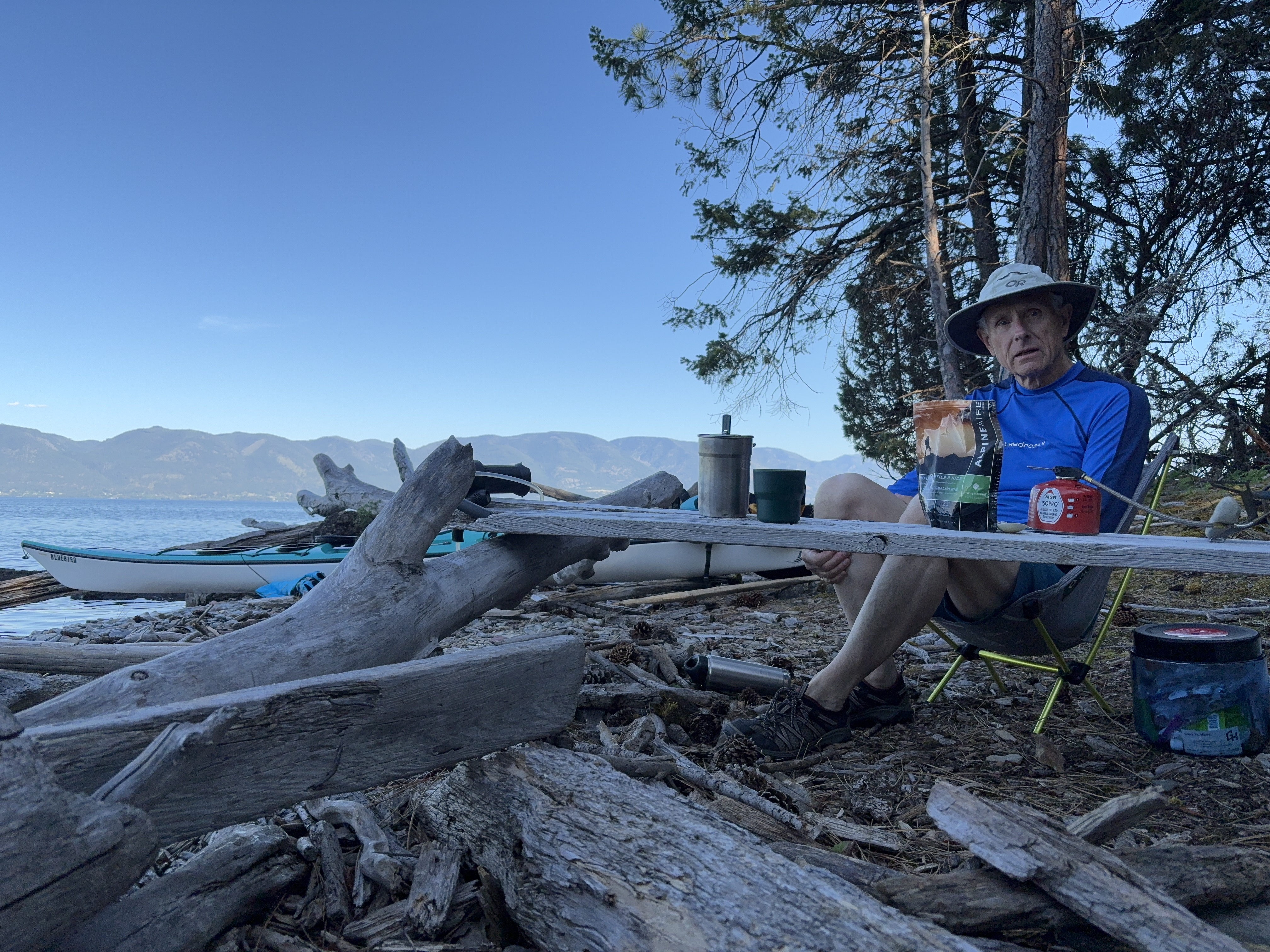
Eventually, I swallowed this sorrow and set up camp on the ledge about fifty yards above the beach. Next, I returned to the beach and used two big sawn blocks of wood and a long plank to make a level, informal table, a perfect place to set up my stove, cook dinner and watch water and sky.
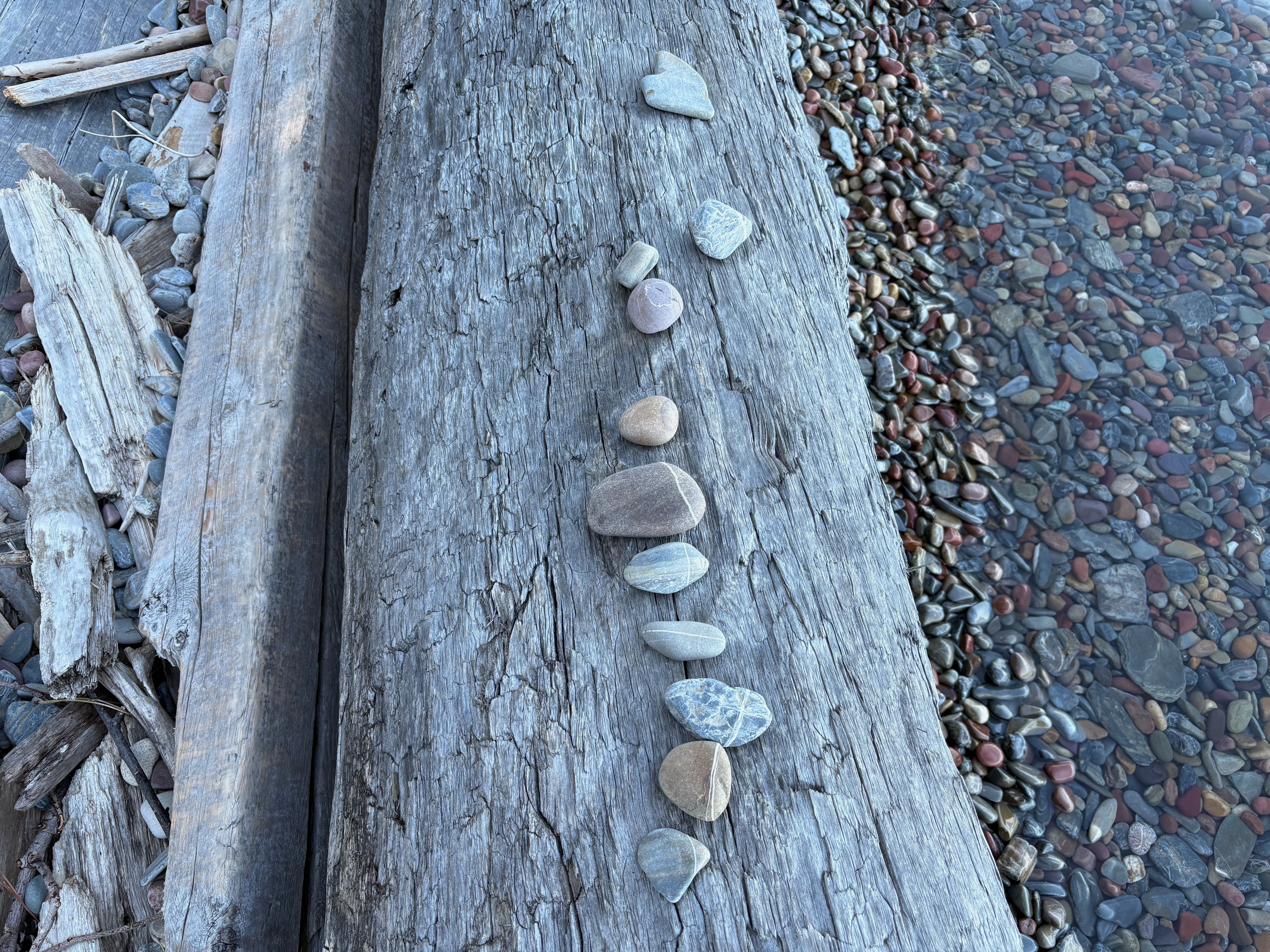
During the remainder of the afternoon, I wandered all over the island, re-familiarizing myself with the location of things I remembered—trails old and new, a memorial to a man who died at 55, the tattooed bungalow (an unholy Lascaux), and the location of the new tent sites created by Montana Fish Wildlife and Parks. In the process I found an artistic arrangements of stones with a common theme
and discarded cannabis paraphernalia, an accelerant to the island’s high. Then after dinner of freeze-dried lentils and dehydrated apples from a friend’s orchard, I found my way through dead fir trees and fallen mistletoe to the point on the southern tip of the island where one has a view of everything to the south, from Finley Point, up to the Mission Mountains, to the north shore of Wild Horse Island. As I stepped onto this limestone platform, I also noticed a milling flock of ring-billed gulls below me. When they eventually saw the disturbing silhouette of a human profile against the sky they took off. The setting sun turned the backs of their wings a golden hue before they disappeared. This is an image I must hold in my memory, my iPhone camera left behind in camp.
I returned to my tent, settled into my own nest and went to sleep. But during the night I woke numerous times to the sound of wind and waves slapping, then thundering against the rocks that form the pocket where I left my boat. I kept trying to evaluate the sounds, the meaning of the occasional boom when a bigger wave hit the shore’s stony armor. I got up twice, my path illumined by a headlamp, and pulled Bluebird even higher up the beach, eventually tying it to a small tree. I could not afford to lose my means of return. At first light I went down to the beach and sat in my folding chair to study the conditions. Waves continued to break against the north facing beach, swirled around barely hidden blocks of stone, and sent white splashes into the air. I could not time my photos to capture the actual chaos of the conditions. What should I do?
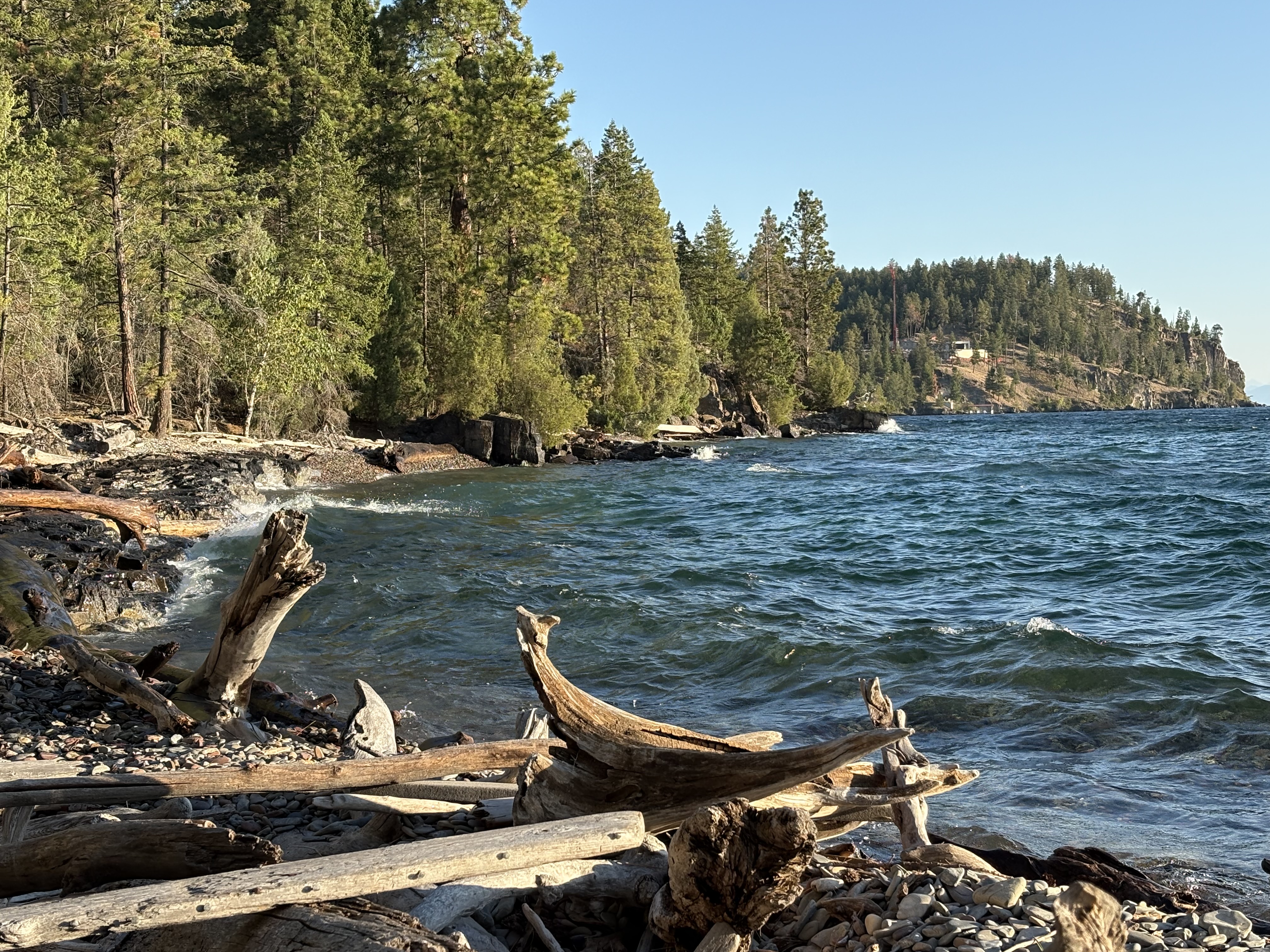
I had launched from the beach in these conditions on one other occasion when I made the trip with my friend Jeff Stickney. On that day we had each other if one of us got into trouble. Alone, with no one else on the island and no one coming to the island on such a rough day, I could not afford a spill in the waves or to have my boat broken against blocks of stone. Gathering information before making a decision, I took my water bottles and pump to the opposite side of the island where I could safely stand in the shallows, refill the empty bottles, and assess my options. Standing in the lee of calm water and looking at the waves between Cedar and Wild Horse Islands, I decided to carry my boat and all my gear over the island’s crest and down to the east side. In four stages I carried everything over the same ledges, through the same trees, down the dusty trail, turning right at the dead pine tree, and down to the opposite beach I marked by tying a strand of tow rope to a tree branch.
Eventually everything was stowed in a proper position, and I dropped into my seat. On the one hand it was a tremendous relief to have launched safely and to feel the push of a tailwind. On the other hand, I was quickly gripped by inexorable forces. I knew it was not safe to let these forces come at me from the right, crossing the way I had come. So, I made the barely better decision to let this energy push me south toward the southeast tip of Wild Horse Island. I had not reckoned, however, with what I call the wrap-around effect of even bigger waves coming from my left out of the main body of the lake. Waves from behind corkscrewed the boat. Waves from the left lifted and plunged the vessel of return.
I do not want to exaggerate the danger of these conditions. It is enough to say that a spill in the middle of this channel with almost no chance of rescue probably would have been fatal. I used nineteen years of experience to brace, accelerate and, crucially, to conserve energy, depending on each wave and the overall pattern of them, to make a long arc toward and then down the east side of the bigger island until I could rest a moment in the temporary lee at the end. From there I knew I could return to Walstad in smaller waves due to the protection of both Wild Horse and Melita. On a gravel bar opposite from the Boy Scout camp I hauled out, waded up to my knees and washed my face in the waters of relief.
Again, I pulled into the shallow pool and reversed the process of unloading gear from the boat. Stepping out into the parking lot, I was hailed by a young man in a big Ram pickup. He quickly began to tell me his story. “When life gets hard, I come out here from Wisconsin,” he said. He then filled in a few details, telling me about his experiences in Kalispell, Lakeside and Butte which he called “a fun town.” I wondered about what he meant by “fun.” He chatted on about breakfast that morning at a café in Lakeside that offered more breakfast than he could eat. At one point he held out a paper carton from the café. “Feel this,” he said, as he asked me to hold the weight of his huckleberry pound cake which certainly weighed more than a pound. He would have calories for the foreseeable future. After telling me about his new origami kayak back in Wisconsin, he offered help loading my boat. By my slow movements he could tell I was in no position to refuse. After casting lures from the dock a few times, he returned to his truck as I completed final preparations for the trip home. He gave me a fist bump, a strong handshake, and a lovely Irish name before we both pulled out of the lot and on to the highway.
Deprived now of precise information from NOAA about wind speed and direction, as well as wave height, I may never make this trip again, at least not by myself. On this occasion I brought the full strength of experience and knowledge of the lake to bear on the situation. I celebrate having made all the right decisions at exactly the right moment, but I do not wish to repeat this experience. There are other reasons to stay alive. It is time now to rest.
 ospreypaddler
I am more than glad you arrived home safely to rest, dear one.
Goodness, Gary. You earned those waters of relief and rest.
Wow, Gary! So glad you made it home safely!!
Beautiful, terrifying story! The swallowing of grief, the waters of relief. So vivid and sparse. Very glad you made it home to tell the tale.
Rita, thank you. You really understand.