Afterthoughts About Public Readings

I wrote a book based on my experiences in a kayak on a huge, ever-changing lake. Because I believed in what I had written, and that a portion of my life could be expressed in language, I felt a responsibility to face the public.

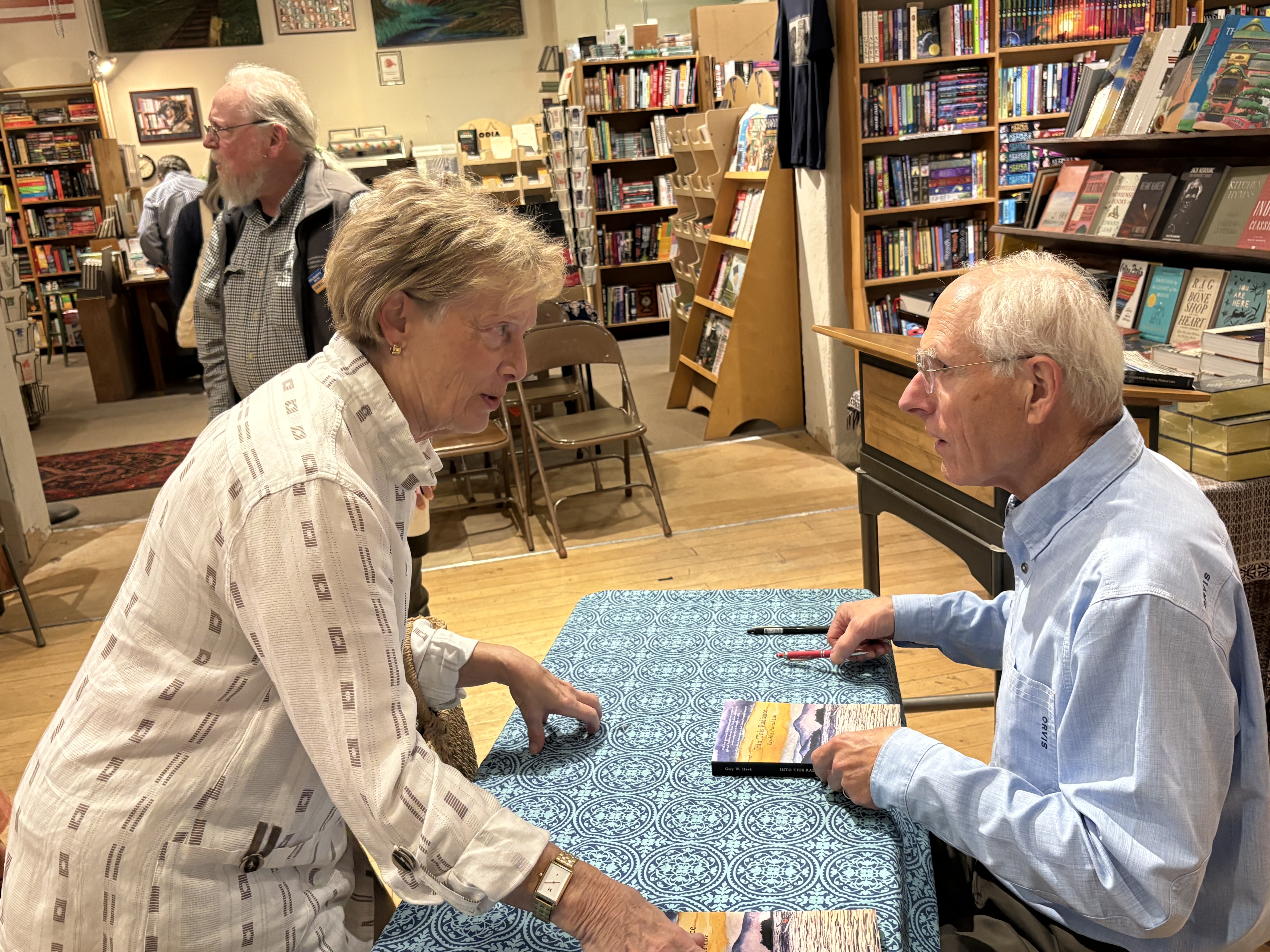
I have read twice now, once in a bookstore and once in a public library. A couple of other events hang on the calendar. I have learned something important, something I did not expect. On the surface a public reading can interest attendees in a book and a few copies might be sold. But I now see clearly that drawing attention to a book is not the purpose of the event.

On both occasions before different kinds of audiences, conversations flew through the air like October’s leaves yanked from stems by gusts of wind. The reading of an essay stimulated activity in the minds of listeners and helped them connect with their own experience. Suddenly this usually silent and invisible mental activity became visible and audible. People began to tell stories about their own encounters with light and sound, waves and wind, stories about friends they have loved and lost, things they make, things they have done and hope to do if given the time. The room began to sparkle with ideas and interaction. People spoke not just to the author but to each other.

Reflecting on these experiences I have concluded that people are hungry for interaction, seem eager to be heard by anyone who stands still long enough to hear a story or pay attention to a question. I do not know if this need is the lingering aftereffect of the pandemic and imposed isolation or, if in fear of the other, we have held ourselves back from interaction because we anticipate criticism or conflict. Whatever the reasons, I witnessed a great desire to speak and feel heard.

I learned an equally important thing. The second event was held in the public library in Polson, Montana. It seemed as if people in the community knew that a library is a safe place for all kinds of people, almost as though an unwritten covenant guides behavior and brings people together in a common purpose. To be sure, this sense of safety and openness is fostered by the librarians, their knowledge, warmth and hospitality. But I had never seen so clearly the value of a library to a community, especially in a small town. A library or an independent bookstore fills minds and hearts with fresh ideas, awakens generosity, and makes clear that not every contact is driven by the repetitive and reinforcing loops of algorithms.

On both occasions a writer became a listener.
The Season of Change

The days around the solstice seem to flatten into a kind of sameness. In winter a curtain closes on light. A broad wash of gray flows across our lives, occasionally punctuated by clear skies and sudden cold. Then in mid-summer we experience the flatness of lingering light and heat. But around the equinox we come face-to-face with the dynamism of rapid change.

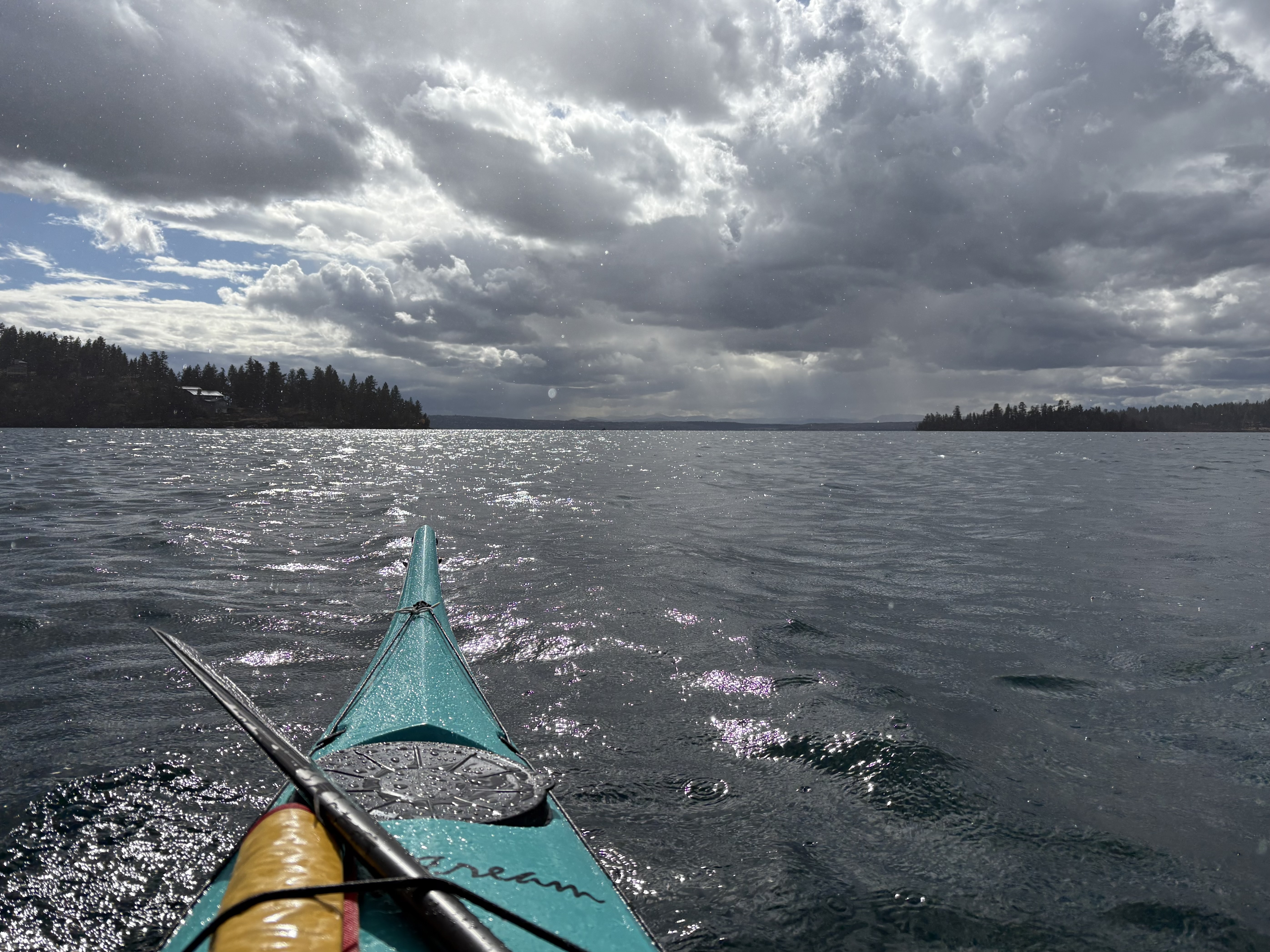
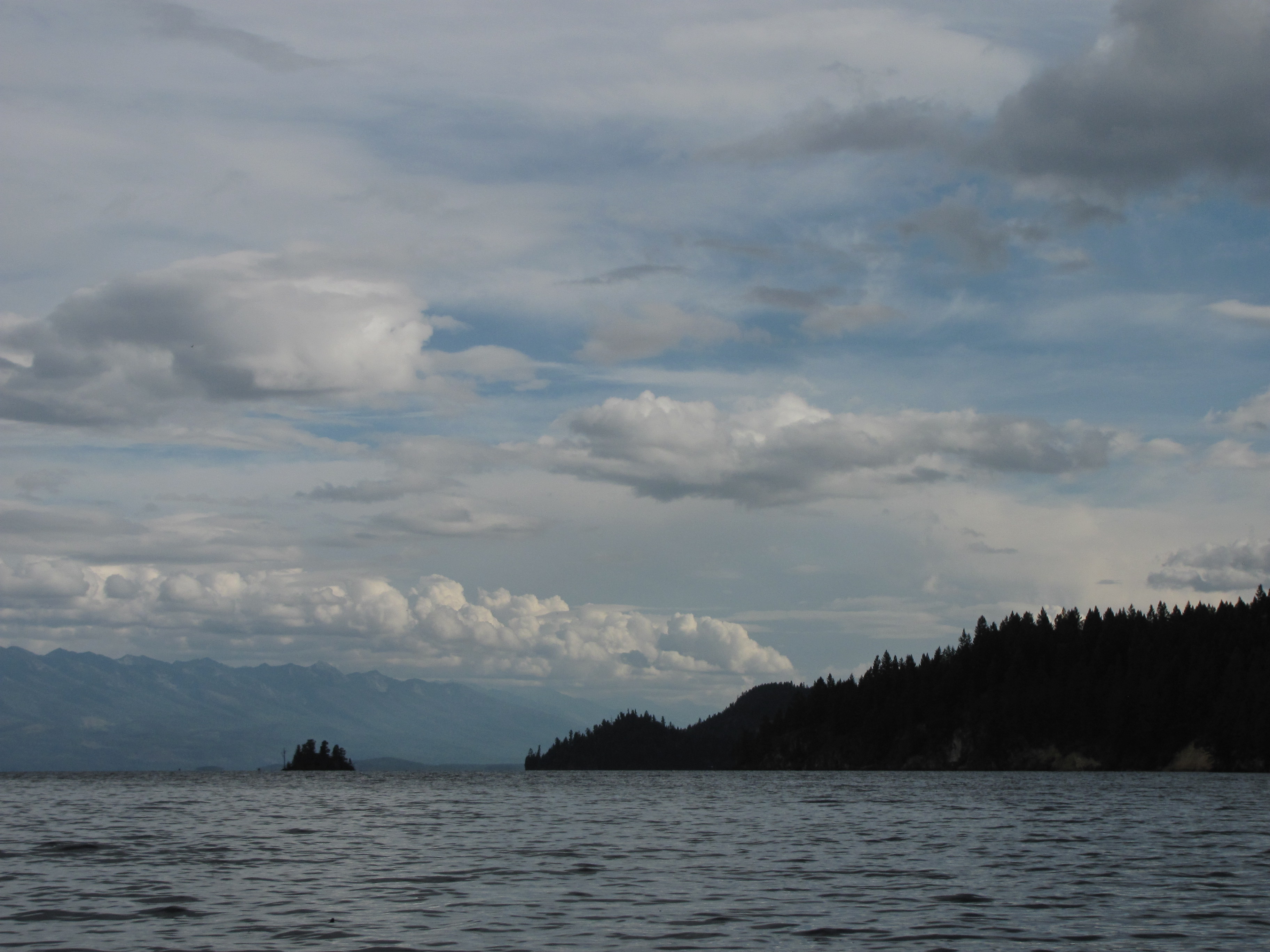
If possible, I like to paddle at these times. I feel especially drawn to the autumnal equinox. The water sits a few degrees above the temperature of the air and suggests a sense of safety that feels elusive in the spring. Autumn also reminds me of the season of my father’s death. I cannot help but think about him when chokecherries and red-twig dogwoods turn red and orange. But I also prize a paddle in early October because the sky can be wild. High, flying clouds sweep over the heavy, rain-laden clouds that stack up against the Mission Mountains and drop squalls of moisture through huge columns. As the clouds break over the crest and move toward the plains, the color of the lake changes moment to moment. Within a fifteen-minute span the lake can go from black to cobalt to green, from graphite to amber to pale blue.

I also sense the excitement of the birds. Geese form staging committees as they sense the migration to come. A double-crested cormorant with its long neck races one direction and suddenly returns. Then there are the waves. They shift directions as quickly as a swinging compass needle and may suddenly lay down as if for a nap, almost as if sensing a need for rest.

A few photos suggest the dynamism of this season, the improbable combination of rain and light,

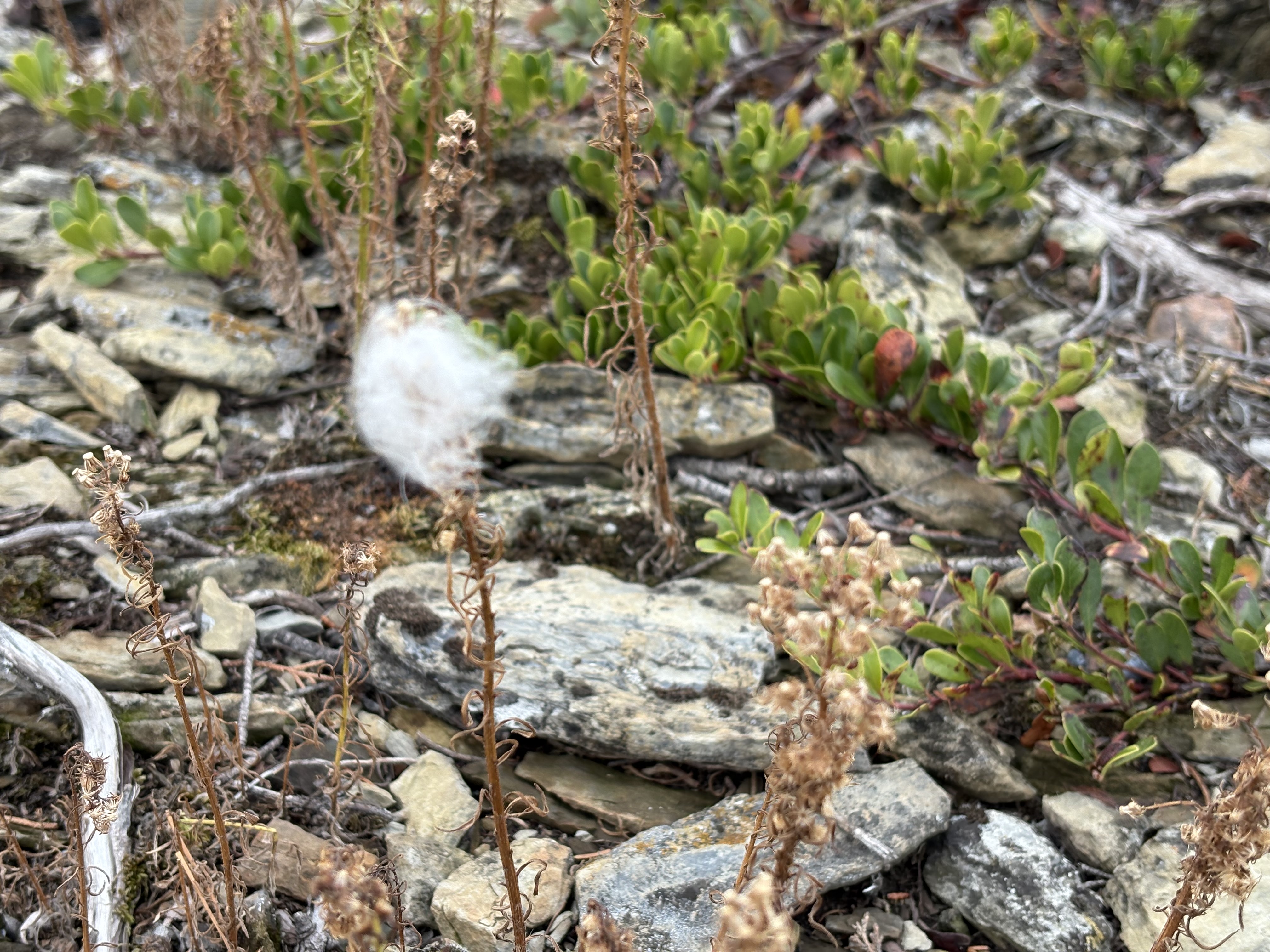
the way mosses awaken,

and how goose down catches on a dry stem and flutters so fast that the camera cannot stop its quivering. Welcome to the season of change.

Into This Radiance

Years ago, when I was making furniture for clients and a couple of local galleries, I brought a table into a gallery for an upcoming show presented by local woodworkers. When the manager asked me about the sales price I gave him a number. He laughed and said, “You’ve got to be kidding. Get out of here. Let me take care of this.” So much for marketing my own work.

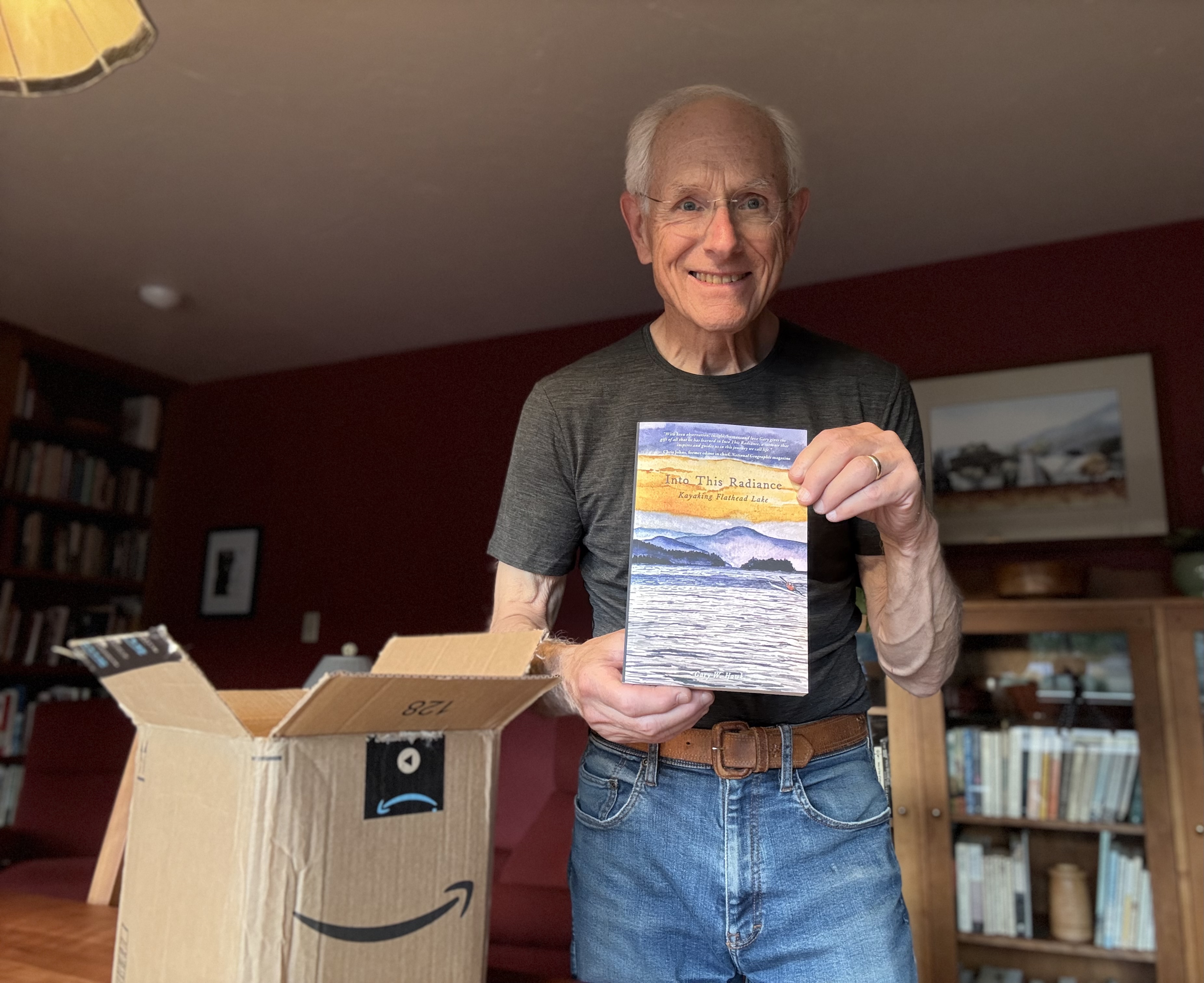
Once again other people have set a price on several years of almost daily work that now takes the form of a book. My in-house marketing agent says I am supposed to tell you that I have published Into This Radiance in both a print and digital format. It is easily available through Amazon, though I hope you will buy it from an independent bookstore. It looks like this:

When people ask me what the book is about, I usually stumble, not feeling sure how to answer. Perhaps it is enough to say that the book contains as many colors as the green ash tree outside my window in October. The book is part memoir, a tribute to a place, a set of lyric essays, a little cautious instruction, and musings about how to live thoughtfully in the world around us. If a crushed leaf emits a fragrance, so the turning of the pages reveals an appreciation for the gift of life and a sense that the whole world is alive, conscious, and waiting for us to be attentive, if not loving witnesses to its conditions and changes.

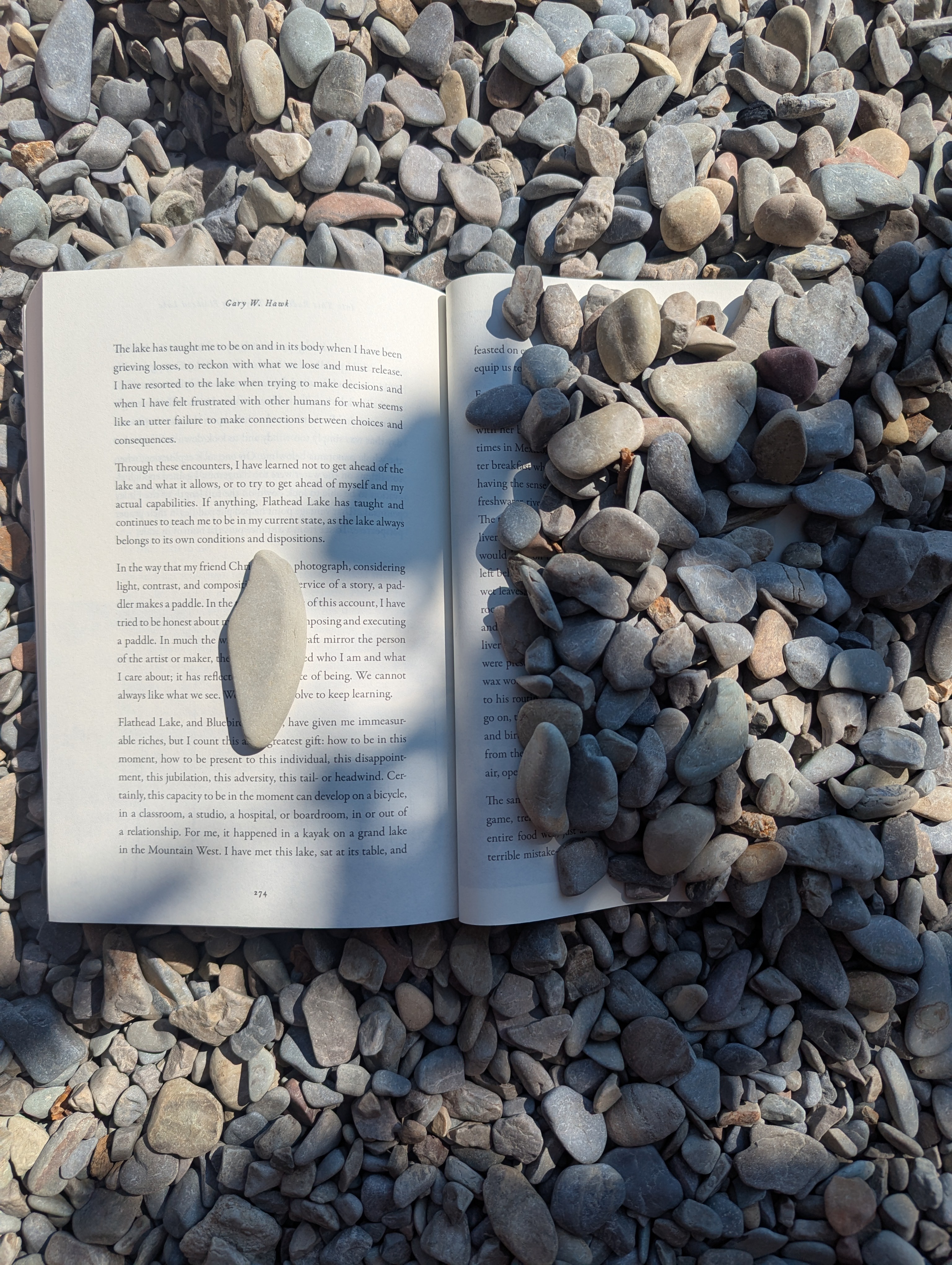
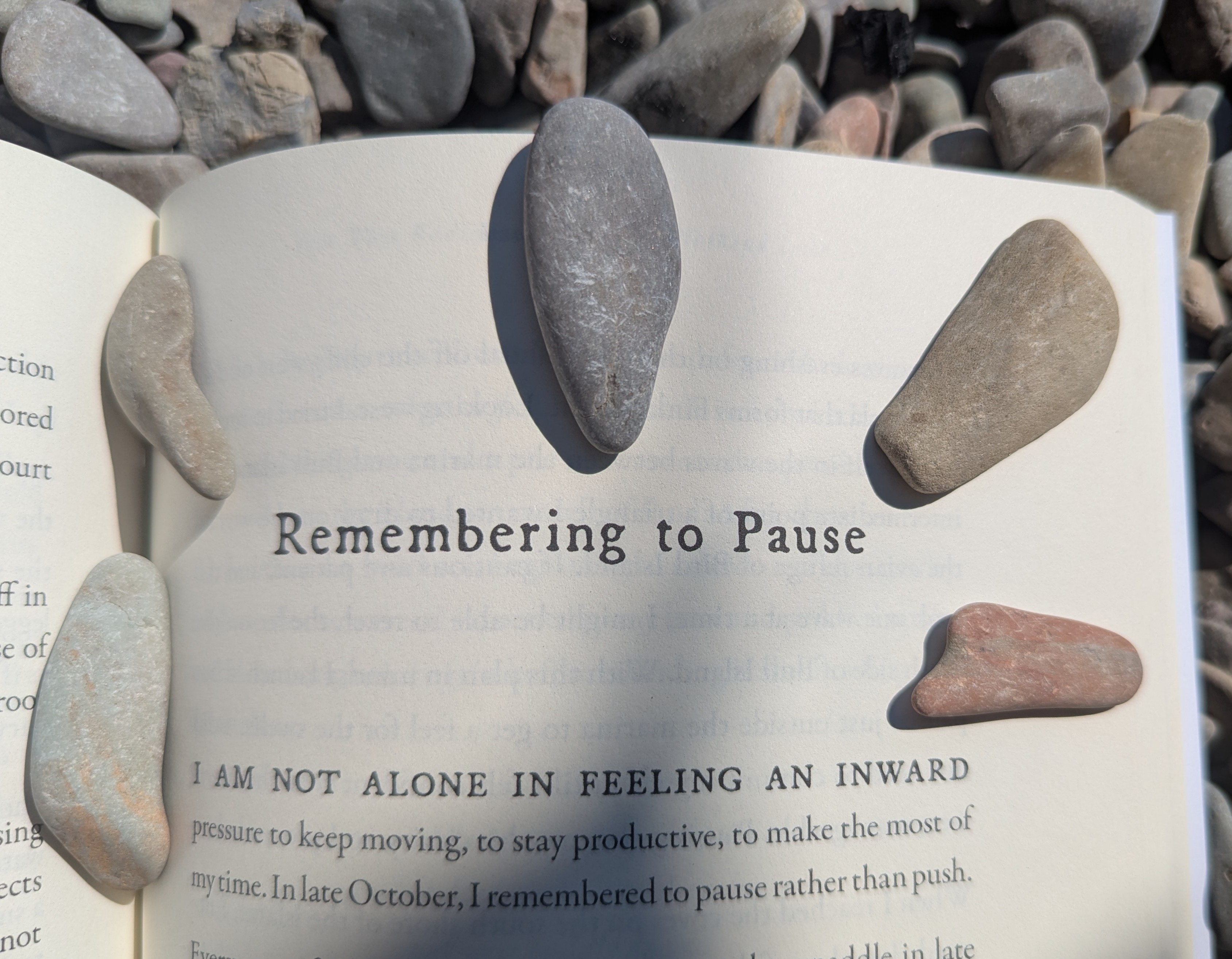
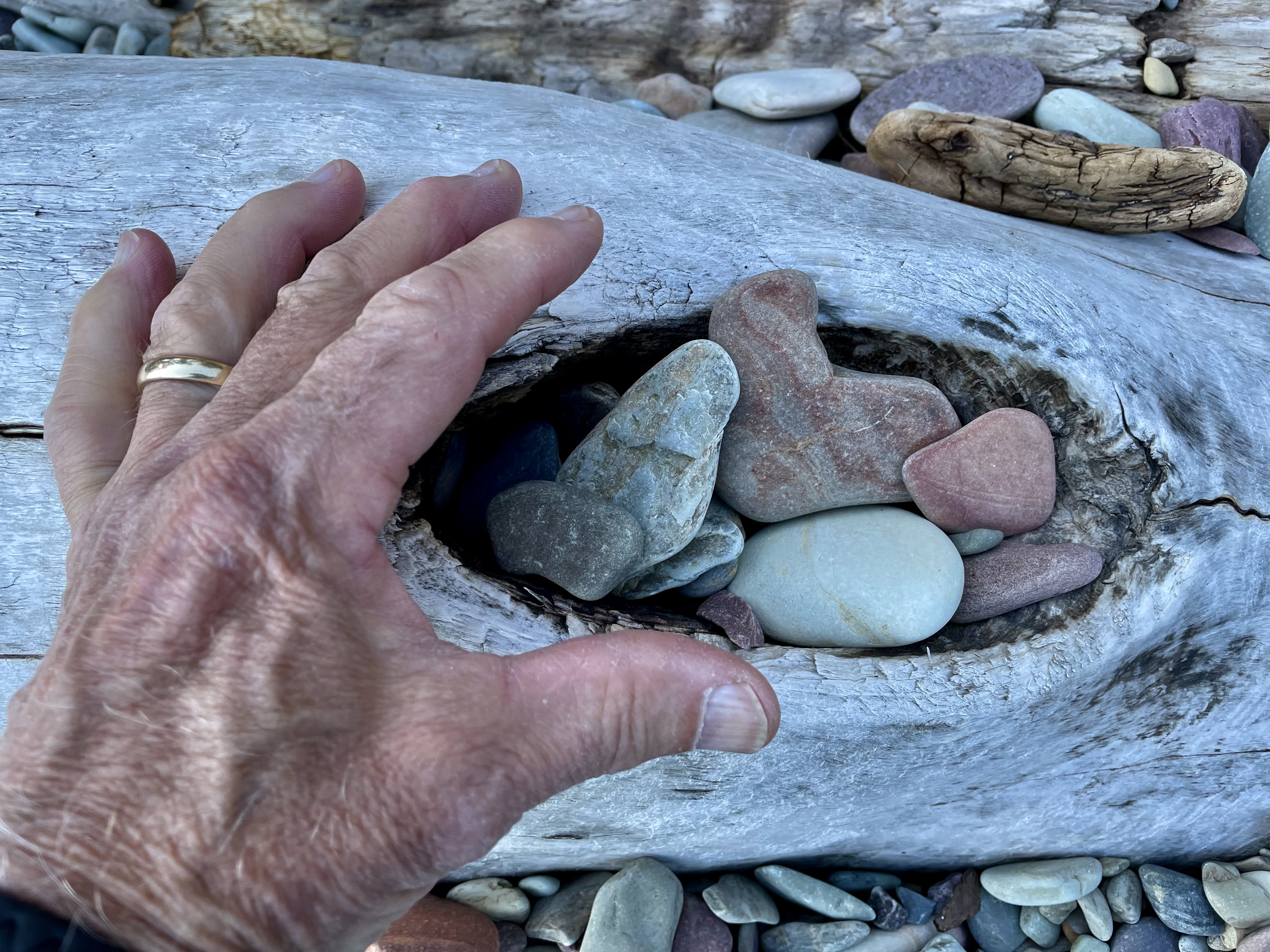
As people begin to read the book, they tell me that they are approaching it as if it were a daybook: they read one of the short essays each day and take time to ponder its themes. Another person sent me photos of her amazingly creative response. Constanza von der Pahlen, whom I met at the first public reading of the book, arranged Yellow Bay stones on the pages to reflect images in some of the essays.

I have at last completed a very long process of awakening to an idea, converting that idea into language that required editing and arranging, painting a cover, and then releasing all this into the world. If you purchase the book, or happen upon one, I hope you find something of value, as did the person who bought my table long ago.

Looking More Closely

Early last week I sensed an opportunity to paddle. By midweek a wave of tropical moisture that substantially dampened fires north and west of Missoula headed into British Columbia and Alberta. Canadians would be as happy to receive rain as we were. The remnants of the storm made it possible for me to make my favorite paddle—an open-water crossing from Finley Point State Park to Wild Horse Island—this time with a little help from winds out of the south.

When I arrived at the campground I saw what the lake looks like when it is 2.5 feet below its normal summer level. Boaters cannot use the docks at this level, so no boats were in the marina. Beyond the nearby islands and beyond the three fingers of Rocky Point my destination appeared as a rounded hump in the distance.

I have heard people complain about the lower water level, occasionally blaming the tribes for this disappointment. In fact, the Salish and Kootenai peoples who control water releases at the dam are bound by federal contracts. In addition, they cannot be held accountable for climate change and drought, both contributors to the lower-than-normal water level.

I stowed emergency gear and lunch and made ready to paddle. As soon as I crossed the mouth of the marina I felt the corkscrew motion caused by waves slapping the port stern quarter. I paused and took the feather out of my paddle. In these conditions I did not want to stroke air while thinking I would meet the resistance of water. A flat paddle would be better, the wave motion making balance a little tricky. Having made this adjustment, I settled into ten miles of water and the rhythm of countless strokes, eventually landing at the East Shore access on Wild Horse Island. From a kayaker’s standpoint the lower water level allowed me to come ashore on a broad beach normally unavailable unless one is willing to risk paddling in the cold conditions of April.

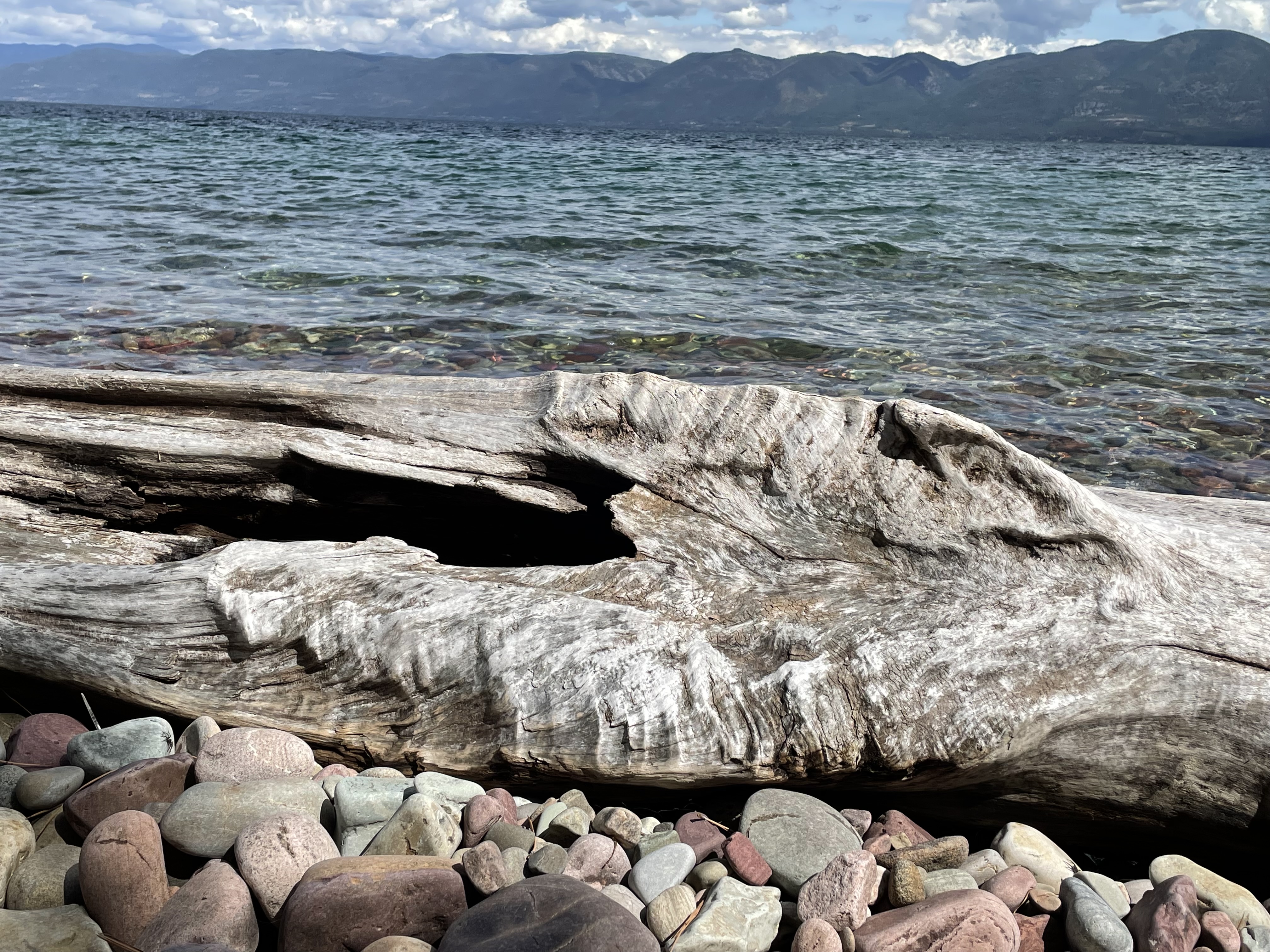
On the comfort of a big log I ate my banana and blueberry muffin and a thick triangle of Spanish Manchego cheese. I drained my water bottle, knowing I could filter a full bottle for the return trip. While I ate my eye was drawn to a long cottonwood log. At some point in its life the wind broke off a side branch that had once been married to the main trunk. Time, water, and stones polished the soft ripples in the grain.

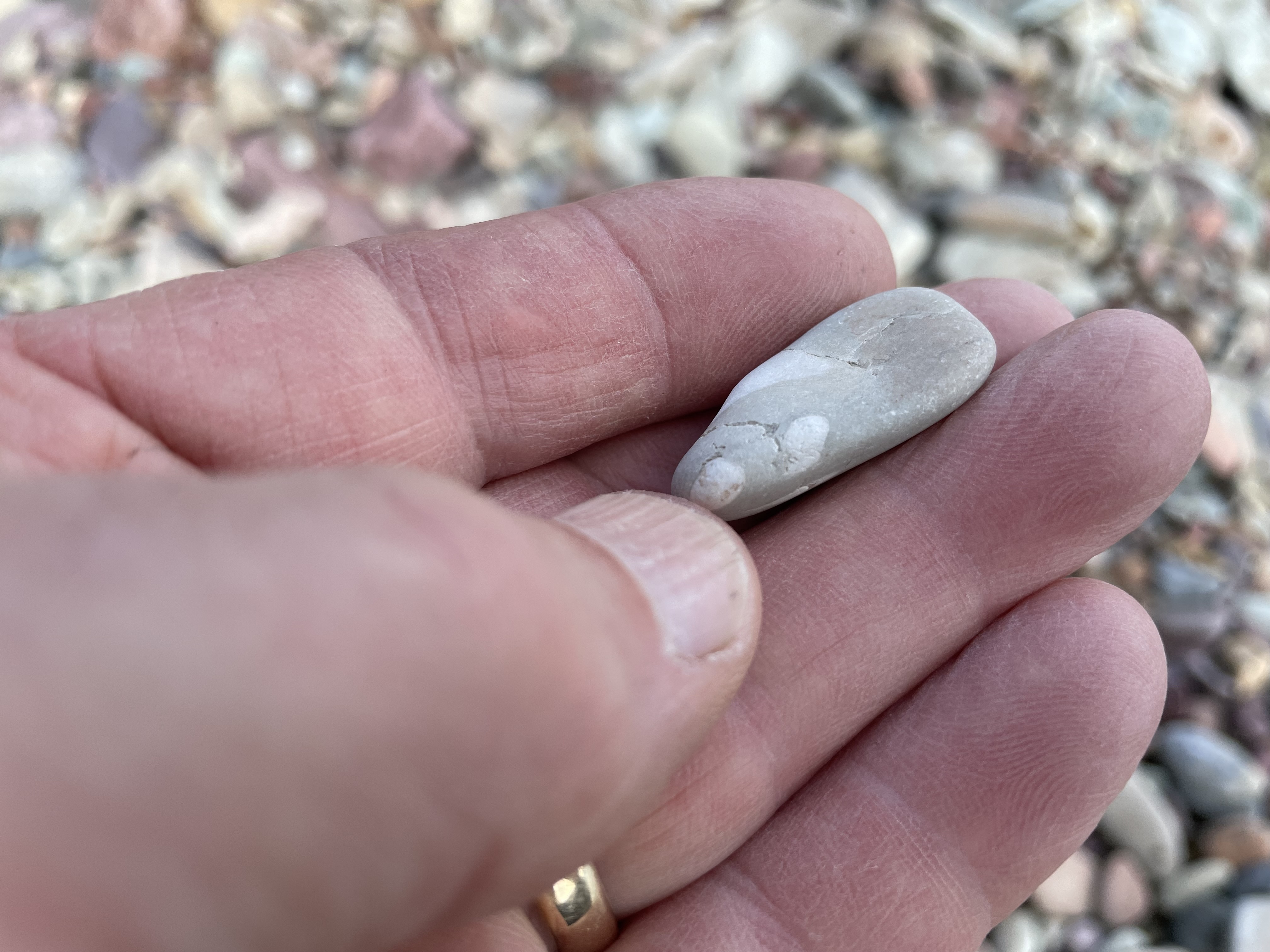
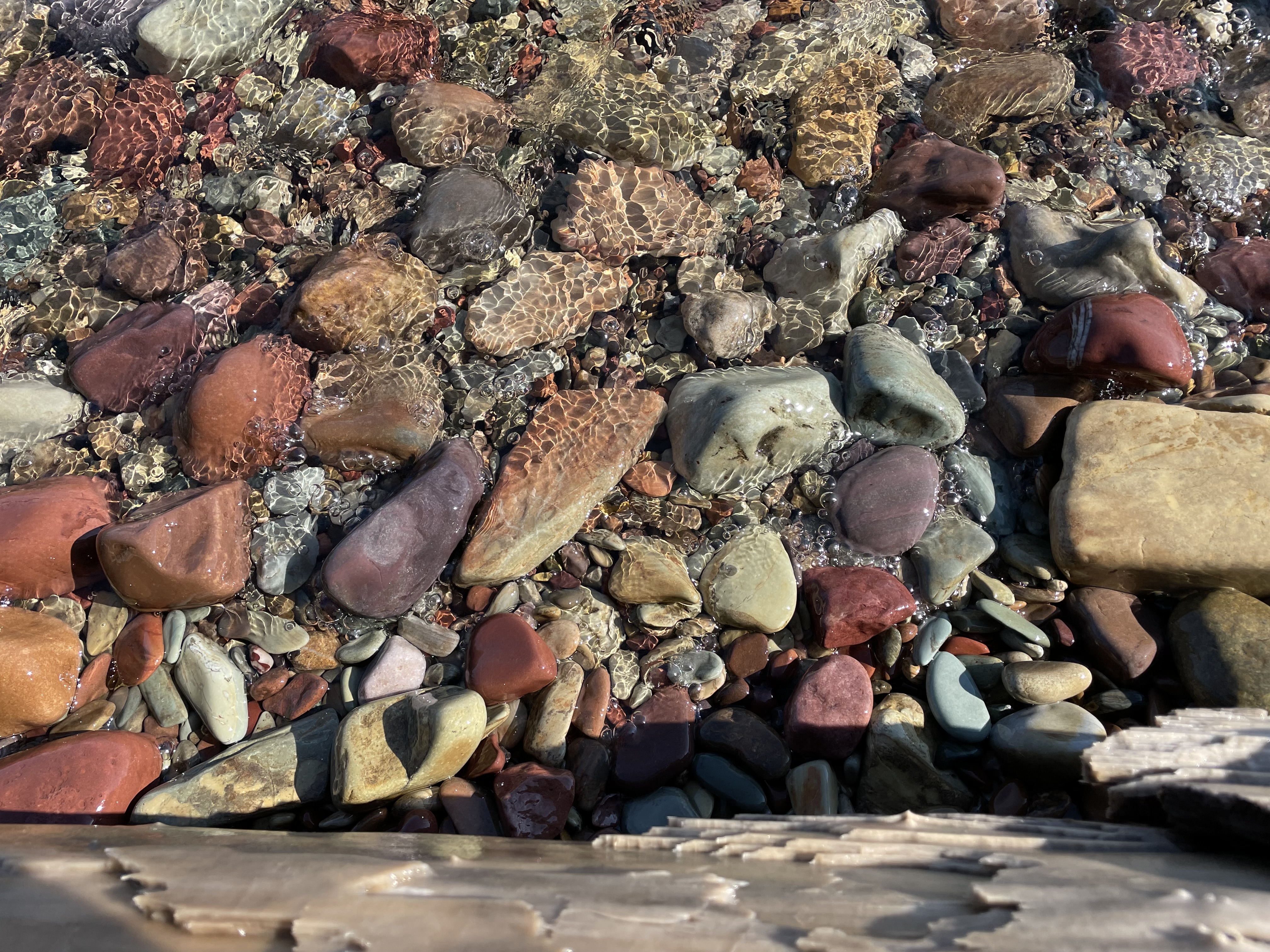
Though I had visited this spot several times, usually while circumnavigating the island, this time I decided to look more closely. I noticed many things I had ignored or overlooked. With the lake at a lower level I saw harder stones trapped in the mudstone ramps that once formed the floor of the lake basin and may have been part of the foundation of the mountains raised by shifting tectonic plates. I found a miniature version of the process among the countless stones on the beach.

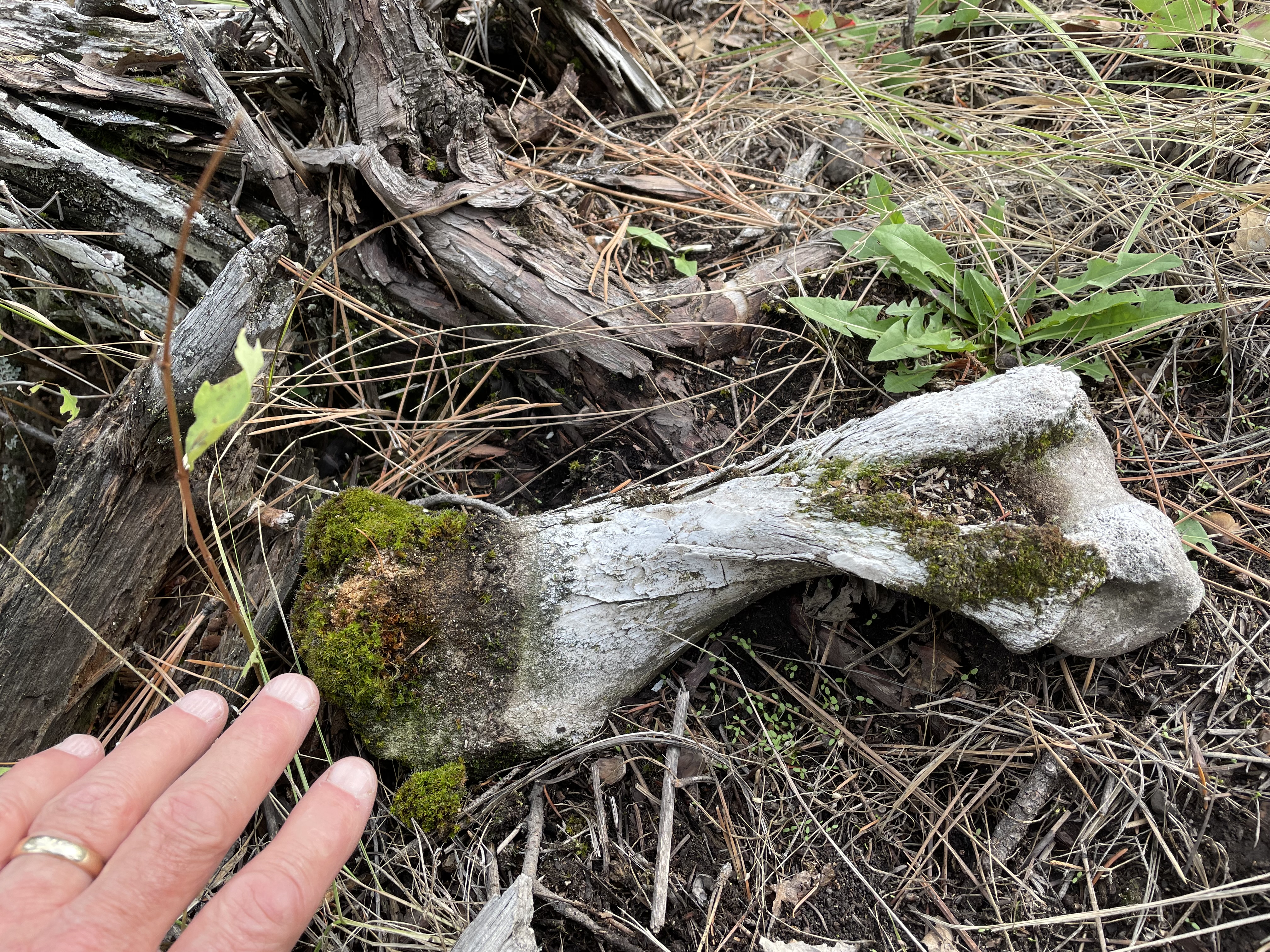
Climbing into the forest I immediately sensed the effect of more than an inch of rain. Within a day the patient mosses had swollen and recovered. Among the mosses I found the humerus of a horse that long ago had laid down its heavy bones.

Bunch grasses were full and soft and invited me to sit down and enjoy them.

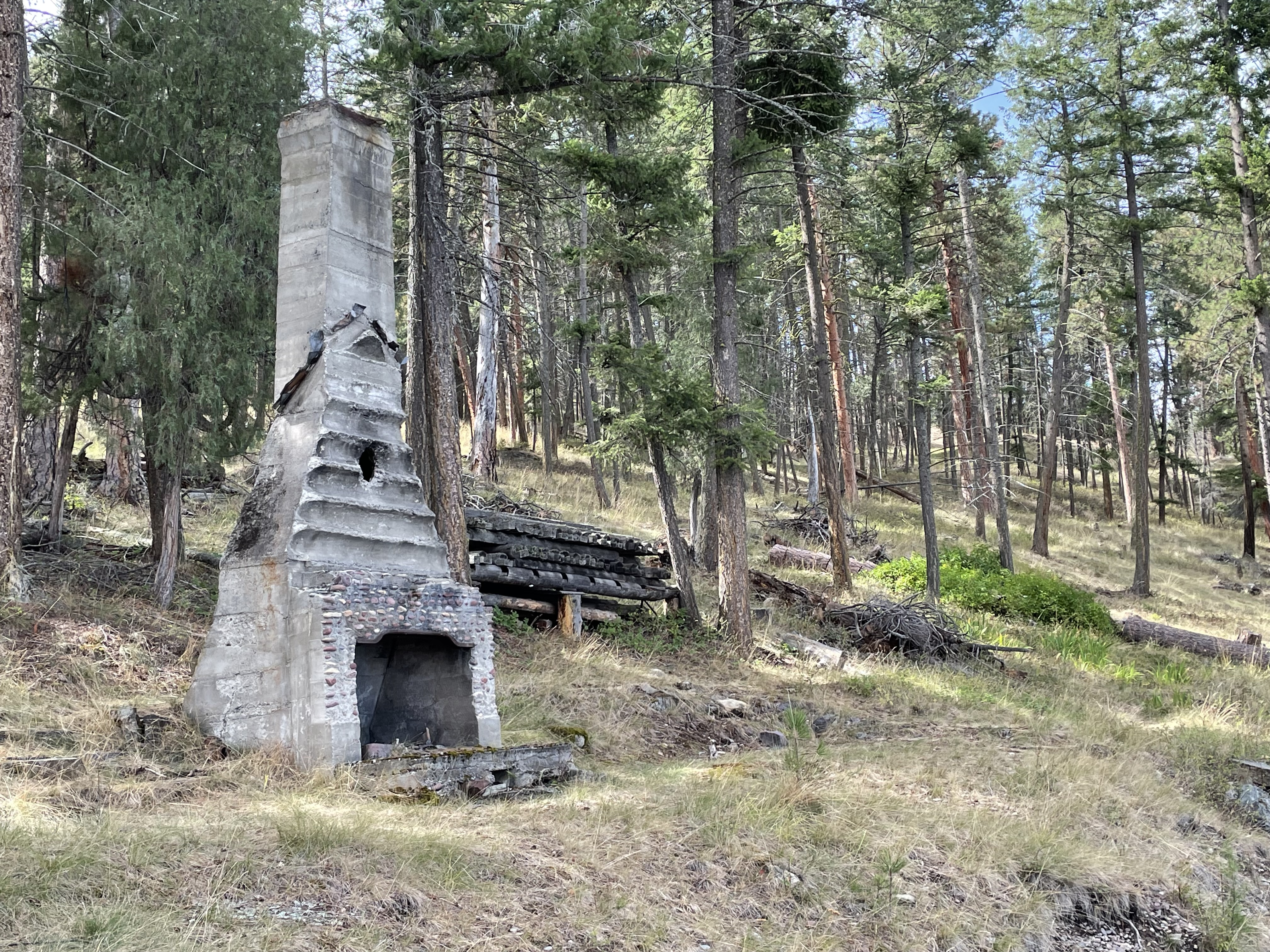
Hiking higher I saw massive pine trees thrown south by relatively recent storms. Dropping back toward the water I inspected more closely the chimney of a once splendid lodge that was built in a cantilevered fashion over the lake. The concrete had been poured against the log walls leaving horizontal flutes, and the face had been decorated with beautiful stones from the beach.

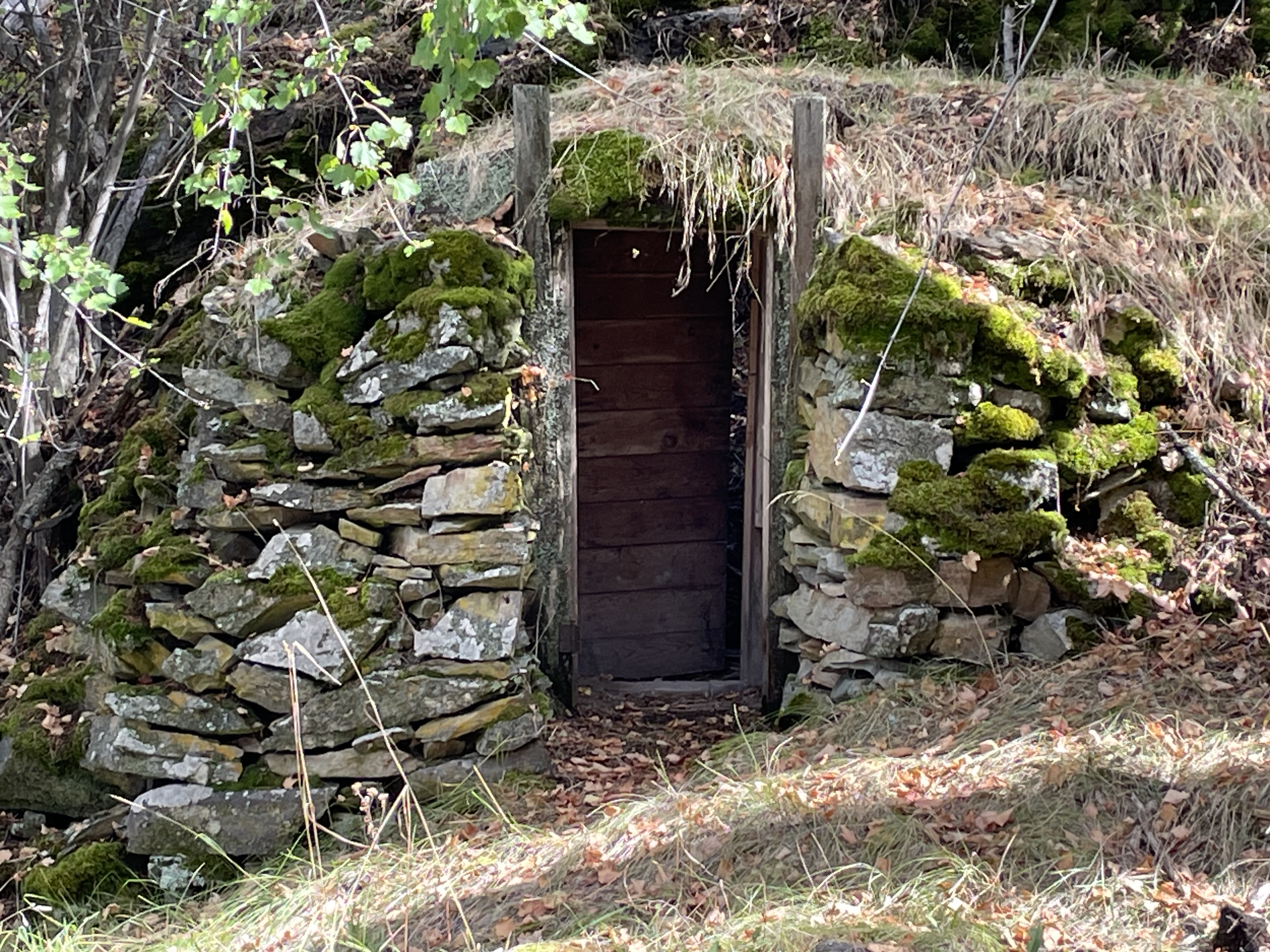
About a hundred yards away I found strands of an old telephone line, white ceramic nobs like flashlights in the forest, but telling the story of how people once communicated on the island. I also discovered a cold cellar that the lodge cook must have used to keep meat and vegetables cool for hungry guests arriving from the mainland. As the roof had fallen in, it seemed like a gateway to nowhere.

While wandering around I sensed that the wind was beginning to shift around to the north. If this change continued it would ease my paddle back to Finley Point but would again create quartering seas requiring my concentration. I went back to Bluebird, made ready, and headed home. Along the way I was careful to avoid the rocky spine now exposed at the northern tip of Rocky Point. Here the waves were actively breaking and seemed a hazard. In another hour I slipped into the marina and was relieved to be out of the rocking motion of endless waves.

Having a whole day and an evening to enjoy the experience, I put my extra food on the picnic table for an early dinner of sardines, Dakota bread from Great Harvest bakery and a crisp apple. Unfortunately, I was out of monster cookies.

Sometimes a paddle takes the form of a story. It has a trajectory, a narrative arc, and concludes with something that feels like arrival. But other times a paddle leaves one only with images, fragments and small observations that might eventually find their place in a story or simply sit in one’s memory like stones on a beach. I have learned that it is best not to force life into the form of a story. I am content with seeing clearly, looking more closely, enjoying the time we are given.

Reasons to Celebrate

I sometimes ask myself, Why do I do this? Why drive 160 miles round trip to get wet, windblown or sunburned? Why burn about six gallons of gasoline at a time when we are warming the planet faster than it can absorb the carbon dioxide we produce? Why deal with the aggression on the highway of the big-truck crowd? Why do this when so many things demand attention at home, especially in October when we are trying to finish outdoor chores before winter slams the door on light and comfort?

Midway through my paddle out to and around Wild Horse Island I realized a couple of possible answers to my questions. On September 15, I tested positive for the Omicron variant of the Covid 19 virus. My case was relatively mild compared to others whose coughs linger for weeks, who lose taste and smell, who suffer lasting fatigue, or even die. Paddling against a north wind reminded me that I have recovered, that my body has restored itself to health. In the two-hour beat against the wind, without distraction and in the company only of my thoughts, I remembered something else. On a recent visit to see my youngest son and his family I told Kyle that getting older does not necessarily mean things get easier. He looked at me squarely as we hugged one last time at the airport and said, “Stay strong, Dad.” I think he was telling me, “Dad, I need you in the world. Stay active. Don’t leave too soon.” Perhaps I drove north and paddled north for these reasons—to celebrate the recovery of health and as part of the process of staying strong for those who need me in the world.

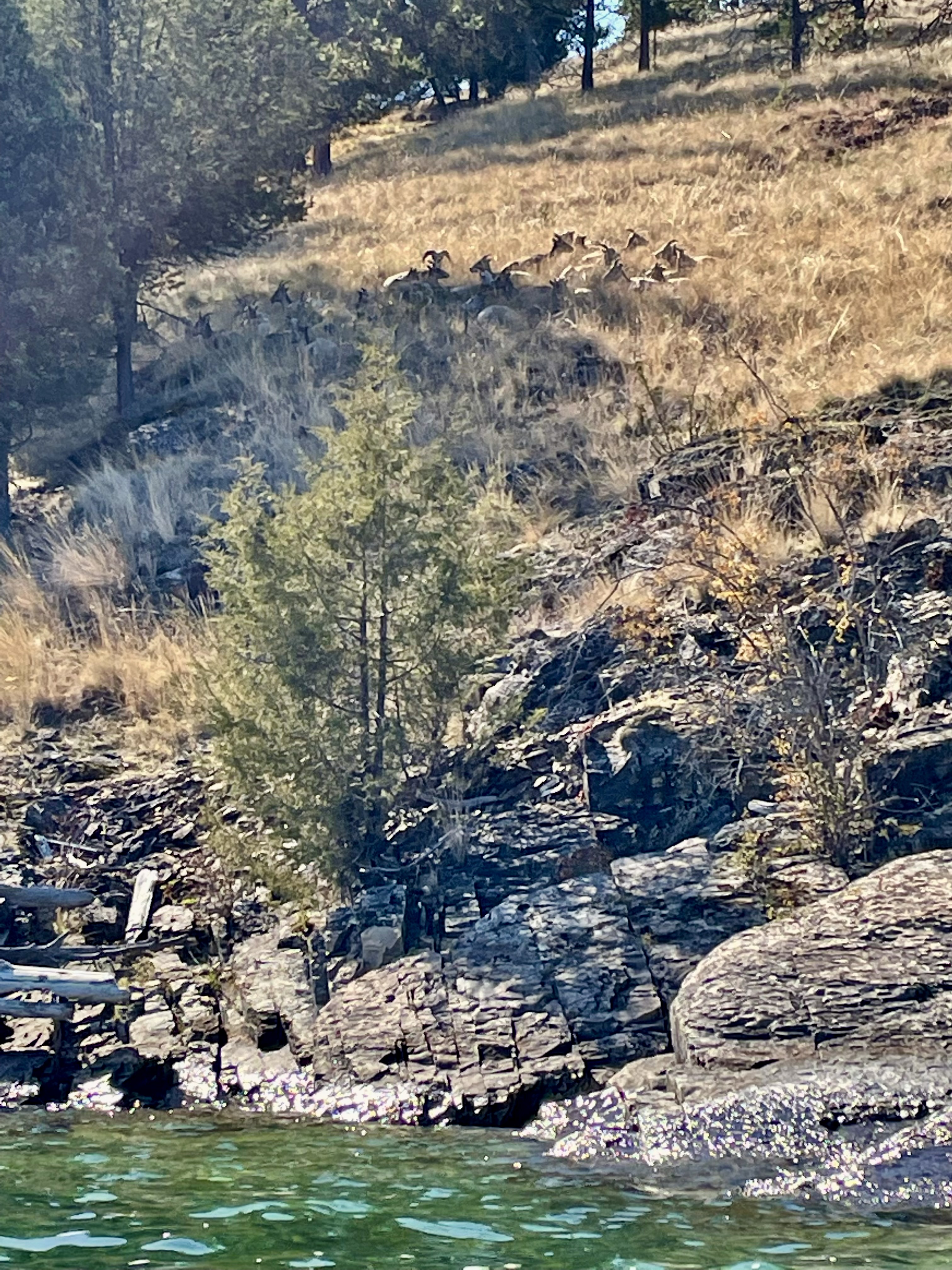
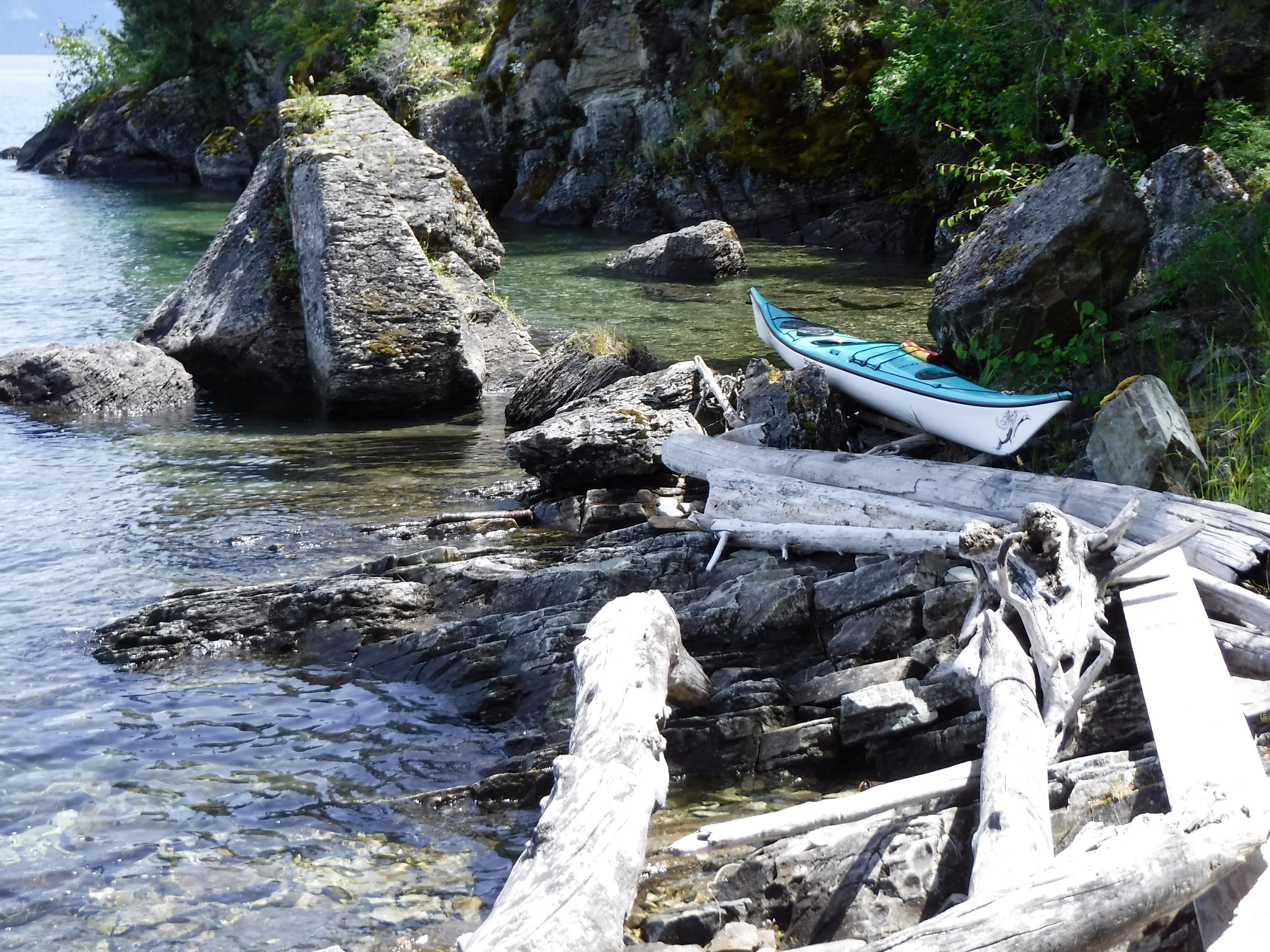
In my circumnavigation of the island I looked to Osprey Cove as a refuge where I hoped to rest and eat lunch, but the landing did not feel safe; waves had pushed the gravel into a steep and sliding slope. I backed out of the cove and headed south where I hoped to find a more protected place to land. I found such a spot at the East Shore access to the island. I got out of Bluebird without spilling and wedged the boat between two drift logs. Thanks to my beloved I enjoyed a massive and spicy Beach Boy sandwich from Tagliare and Smyrna figs. After lunch I wandered the shoreline, climbed into the dry grasses and yarrow. Along the way I discovered a Big Horn sheep skeleton, bleached and barren. I took time, too, to marvel at the clear water of October, all the sediments and pollen settled out. At this point in the season the water seemed like a pure distillation. Once back in my boat I continued south, avoiding the ramps of stone along the shore because the reflected energy of waves created rougher conditions a few yards off shore. When I saw sheep resting in the shade of a pine tree, however, I could not resist approaching for a photo. I rarely see these animals in the open. This was their time to build reserves before winter makes life more difficult.

At the south end of the island I turned west and enjoyed several miles of assisted paddling as wind and waves nudged me from behind. In the face of things I felt I should do, I left home, but returned feeling as though my body had been washed clean as October gravel near shore. The lake offered an image to the imagination. This is something to celebrate.

On Not Paddling

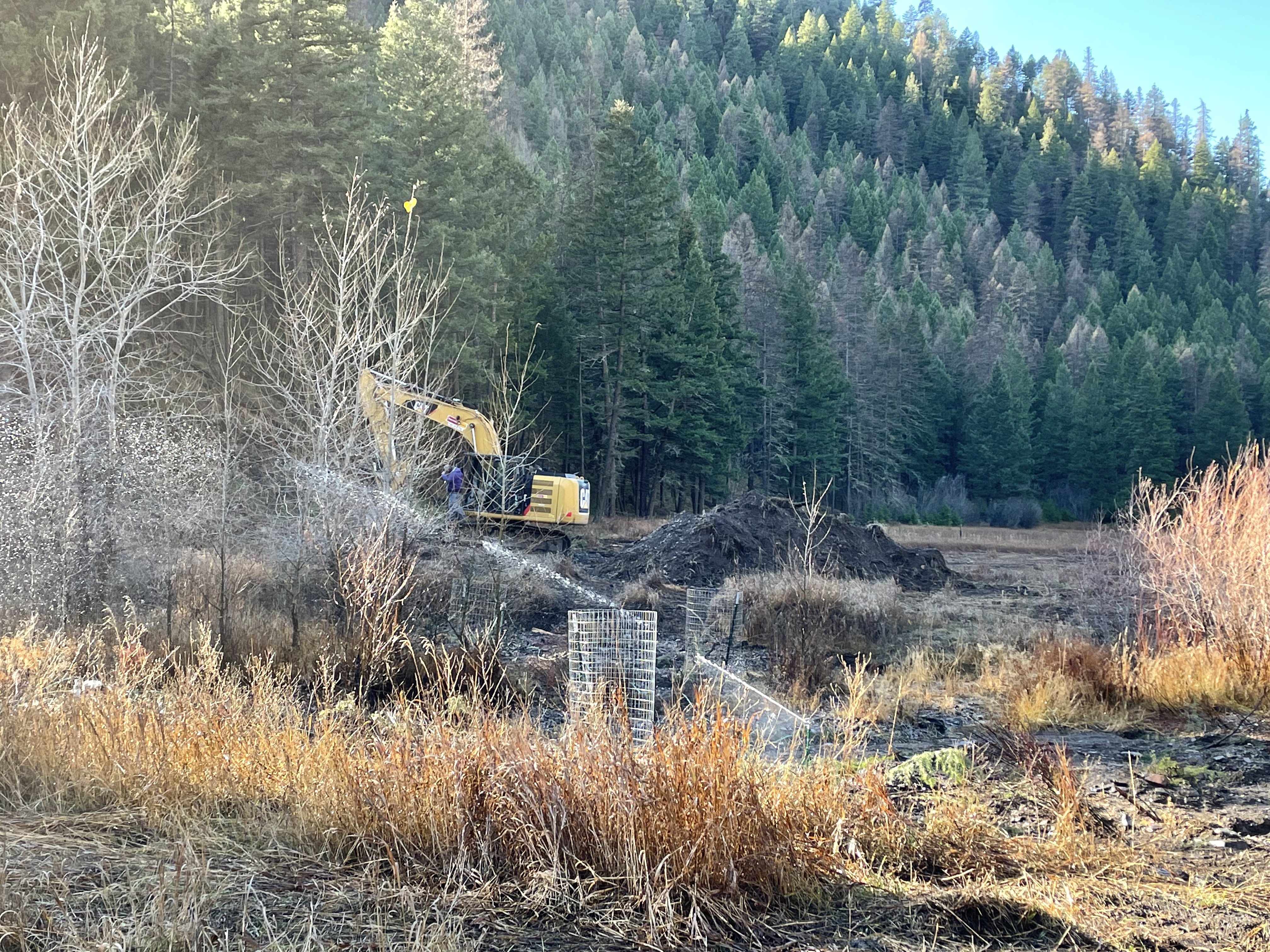
Heavy equipment at work

Every year I look for an opportunity to paddle in November. Though there is snow in the mountains and frost in the valleys, paddling in November is my way to honor a father who died at this time of the year when cranberry bogs and raspberry thickets near his home blazed against a blue sky. Though he never paddled a sea-kayak, he was never without a boat. A final paddle begins to repay the debt to a man who introduced me to life on the water. This year I kept my eye out for the perfect day—a high temperature around 50 degrees, water conditions almost as warm, waves not raised by the energy of autumn’s first storms. I found that day on November 5. But two days before I was ready to paddle along a shore lined with golden larch trees, I received an email. It contained an invitation to return to the upper watershed of Miller Creek, a tributary of the Bitterroot River, not far from where we live, upstream of water we use every day.

The Clark Fork Coalition had received a grant from the Environmental Protection Agency and Montana’s Department of Environmental Quality to work in two riparian areas along the stream, a stream considered “impaired.” Four years in the planning phase, the two projects, both on private land, had many goals. Heavy equipment operators would stabilize banks so less sediment flowed downstream; new meanders in the stream course needed to be built to slow the current and create holding water for native fish; woody debris in the form of logs needed to be anchored in the banks; willows would be placed in trenches parallel to the stream and finally, cottonwood trees and red-osier dogwood needed to be planted to maintain cool water temperatures, provide habitat for avian migrants and offer a degree of protection for fish under the eye of osprey and kingfishers.

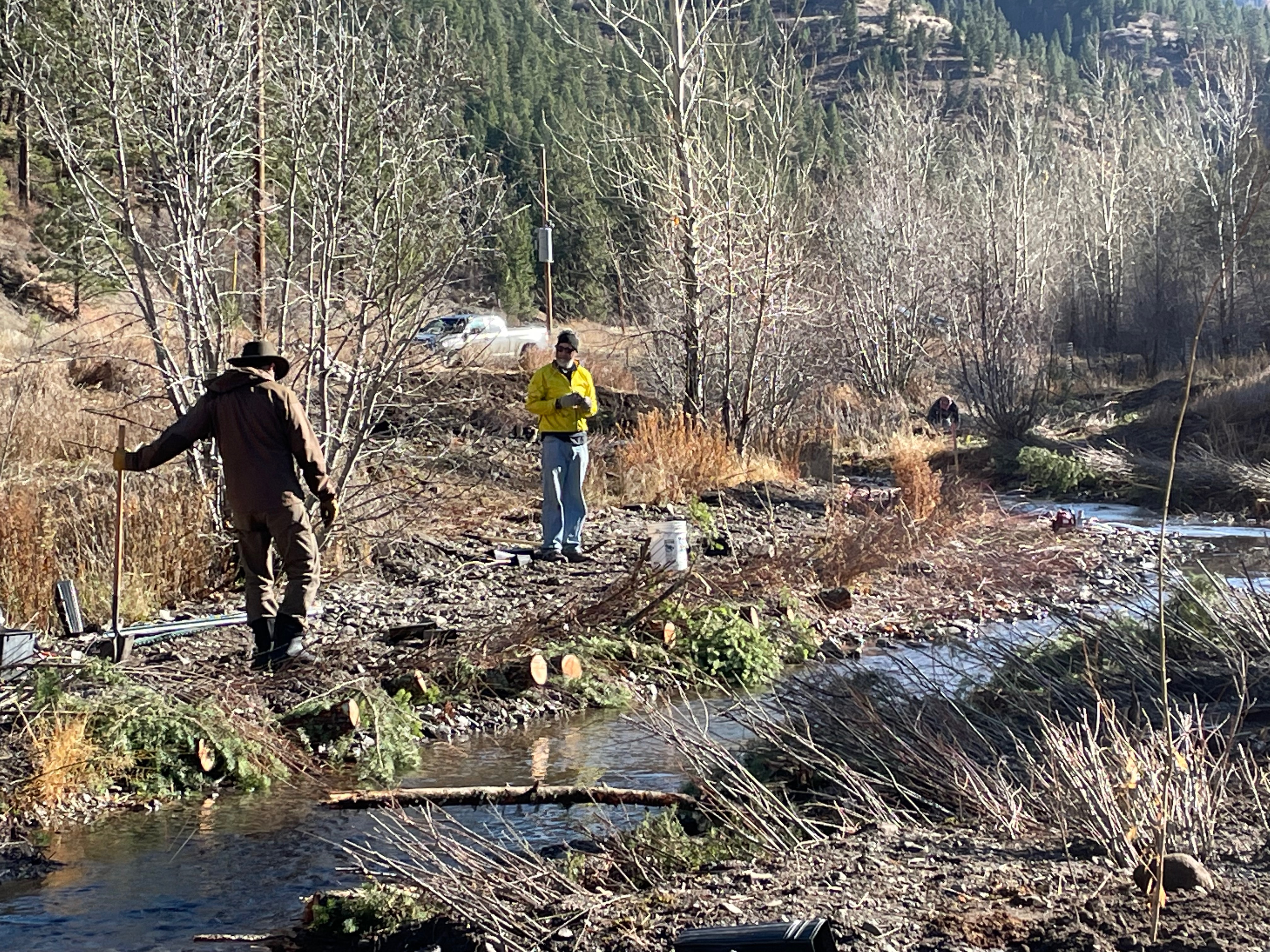
After weighing the options, and knowing there is no guarantee of a good day at this time of the year, I chose to return to the stream, even though I had devoted a day to the project the previous week. We have so few opportunities to translate deep concern for the earth into concrete action, action that makes a difference to a land owner and to wild creatures waiting for improved conditions.  Here was a rare opportunity to practice what our Jewish community calls Tikkun Olam, or repair of the world. Under the direction of two hearty and motivated young women from the Coalition, volunteers from Missoula drove into the frosty Miller Creek canyon, carried picks and shovels and armloads of desire into and across a little stream waiting to be repaired. As we worked we were amazed to see fish take up position in the newly configured stream in less than an hour after pools were excavated and the stream gradient was changed.

Willows and anchors

When Congress seems bogged down in negotiations on social and physical infrastructure bills, while the earth itself seems stuck on a hot plate, an email arrived inviting us to mend a few hundred yards of one watershed. We were given a chance to increase the likelihood that a warming earth will lose fewer of its adapted species and water will flow clean and clear upstream of where we live. Spending a day digging holes in the rockiest of soils, pounding T-stakes, and securing fencing around saplings so deer and elk will not devour them the first night after they are planted, seemed like an even better thing to do than paddle Bluebird one last time this year. Were he alive, I believe my father would understand.

Ready to plant

Drifting through the Questions

In early October, good friends invited us to spend a night at their cabin. In the face of uncertainties we did the best we could to work out a protocol for minimizing exposure to the virus, planned meals, and eventually joined them at their place on the east side of the Mission Range. Unsure how to strike the balance, we tried to find a middle way between the safety of isolation and the desire to connect. As we turned into their driveway I realized that I never cease to be moved by that first glimpse of water, the wavy horizontal dabs of blue, yellow and green on the textured surface of the lake.

After peanut butter and jelly sandwiches and sharing too few cookies because I ate two of them while driving, we went down to the dock. I helped Joyce get in her boat, watched Glenn work bravely around a knee needing replacement, and Jeanne slip easily into her autumn-colored Swift. We did not feel ambitious. On this paddle we meandered into a shallow bay not far from the cabin and then ventured out into open water. Joyce struggled with a sore shoulder, inflamed perhaps by helping her brother stack firewood for the winter. Seeing Joyce in the distance behind us, Jeanne said she would turn back, join Joyce and spend time with her on the dock. Glenn and I paddled on toward the delta where Herrick Creek flows across a gravelly beach into the lake.

Satisfied with this destination, Glenn and I put our paddles across our decks and let a north wind carry us down the lake. We simply drifted. But as the wind pushed us we talked. Stimulated by a class Glenn was taking, we talked about our own unconscious racism, all the destructive assumptions built into America’s “doctrine of discovery,” where we encountered people of color in Kansas and California as we grew up. Mindful of Breonna Taylor, we asked each other about our own encounters with law enforcement, how even as white men we had experienced the way some officers can flaunt their power to humiliate and control. We shared the sense that If these things could happen to white boys, imagine, we said, what it must be like for people of color. For fifteen minutes or so we drifted through the questions and stories, finding connections between our own lives and the current state of the nation.

After a while, wanting to see our partners again, we picked up our paddles, turned our boats and dug into the wind. In the shade of the opposite shore we saw another paddler in a bright red boat, a striking contrast in relation to larch and Ponderosa. In a deep part of the lake we stroked past fishermen who had caught a nice trout they were beginning to fillet. Still, the effort to make sense of our own histories and that of the nation stayed with us and influenced conversations for the remainder of our time at the lake.

After dinner, despite choppier conditions, I convinced Jeanne and Glenn to join me for a night paddle. I wanted to see a full moon rise over the Swan Range, a pale wall of stone across the valley. Heading west we navigated by looking at Saturn, and heading east toward the cabin, we returned inside a cone of moonlight. Though we might have extended this paddle, we wanted to get back in time for the news, the President in the hospital, questions about our nation and its future ever on our minds.

This fall Joyce and I are taking a class on the poetry of Tony Hoagland. During the second week of class we considered a poem called “Theater Piece.” Here the poet imagines a bunch of well-meaning white people inviting a “black performance artist” into their troupe and a conversation with the playwright who “…won’t give unlimited shoeshines/ to white millionaires with season/ tickets to the Coliseum.” In the awkwardness and difficulty of the conversation and ensuing silence, “tangled in feelings and thoughts from the past,” they all wonder how they are going “to get into the future together.” At the lake with thoughtful friends we, too, are wondering how to get into the future together and what kind of future it will be. We drifted through the questions, shared stories, and lacked answers.

The Gap

Two years in a row we have been fortunate to rent a place near Angel Point on the west shore of Flathead Lake. Staying in a single location for a few days, we can enjoy sunrise over The Missions and sunset in the forest, a waxing or waning moon, and the changing moods of the lake without having to sleep on the ground. Even before we made these arrangements I held an idea in a back pocket: for a few years I have wanted to paddle the gap between Angel Point and the village of Bigfork in the northeast corner of the lake.

When we arrived at the cabin we walked out on the deck to enjoy the view from elevation. In the distance we saw a dark storm system approaching from the north. It descended on the lake with a vengeance. Suddenly shore-side flags stretched taut as military sheets, trains of whitecaps and spray covered the lake, and within ten minutes six-foot waves began to crash onto the rocks and pour across the surface of docks. I did not have time to dig my camera out of luggage in the truck. We stood in awe of what the lake can become. Fortunately, my wife caught the aftermath with her iPad.

The Aftermath

The Aftermath and the Gap

Over the next few days we watched the energy from this autumn storm gradually dissipate and conditions improve. By timing my paddles to coincide with shifting wind directions, I was able to paddle to Somers in the north and Deep Bay in the south. On Thursday I finally saw my opportunity to paddle the gap, the six miles between the point and the far shore. I studied distant peaks above the Jewel Basin until I created a confident triangle between a single mountain, Bigfork, and my starting point. I packed a little food and two water bottles and lifted the boat off the dock and into the water.

The gap is more a mental challenge than a physical one. At first glance the gap seems impossible to cross, but I have paddled more than 12 miles in a single day on many occasions, and am well aware this trip is nothing compared to crossings made by Jon Turk and those who have circumnavigated Ireland or New Zealand. The challenge of the gap comes in the form of questions:

  • What if I am three miles from land and a storm arises like the one that we witnessed on Sunday?
  • What if a big pontoon boat passes too close and casts a wave that rolls the kayak?
  • What if an inattentive or inebriated speedboat driver does not see the flashes of light from my paddle?

I worked to control the noise of these questions by concentrating on other things—my alignment in relation to the far shore, evidence of intermediate progress in the form of a yellow cottonwood leaf that had drifted down the river, a cluster of pine needles, or feathers from ring-billed gulls slipping by. I concentrated on smooth, efficient strokes, ones in which I applied force at precisely the right moment after the blade entered the water. I focused on posture. I pondered ways to enjoy the gap, taking pleasure in the sun on one cheek and wind on the other, a visit from what I think were long-legged kittiwakes that hovered above me, and then out of curiosity, settled beside me before flying away. Distant fishing boats drifted past the curvature of the earth or disappeared into shore-side shade. Though I choose another way, I managed to enjoy the sounds of well-tuned engines and a small plane overhead. In a sense paddling the gap is a meditation on calling the mind back from its fears to the qualities of the present moment.

In good time I passed the river delta that extends about a mile and one half into the lake, saw details sharpen, and came ashore opposite a humble cabin made of recycled materials. The owners had created a large heart shape by piling round stones into a pattern that left the center full of water—a beating heart. I ate a snack, drank water and used my cell phone to reassure an anxious spouse. After creating another triangle between my eyes, a spot somewhere just north of Angel Point and a distant hill I settled into my return, committing myself to shorten the long hypotenuse.

The Landing

The Landing

Crossing the gap again I reflected on other gaps in our lives—the gap between loneliness and friendship, the gap between illness and recovery, the gap between a fossil fuel economy and one built on renewable forms of energy. I let my imagination consider the terrible gap between addiction and sobriety, indebtedness and solvency, conflict and reconciliation, complaint before the court and a long-awaited just decree. In truth we live in the gaps, somewhere between setting off in relative uncertainty and the suddenness of arrival. Entering a gap seems vastly different than paddling near shore. For a long time we see no evidence of progress. We have no passing cliff or boathouse or tree by which to measure our advance; we have only the distance to measure, miles in the gap that seem not to close. Paddling offers practice for the larger process and never seems like an end in itself. For the other gaps in my life I gain strength at binding the mind to the present, controlling anxiety, learning to enjoy something as seemingly small as a leaf floating on the surface or a bubble rising from the sediments below.

When I finally reached my original starting point I lifted my boat out of the water, pulled it up my thighs, then lifted it onto my right shoulder. I carried it up the steep steps leading to the driveway and set it in the cradle atop my wooden rack. I cinched down the straps realizing that it would be a long time before I paddled again. Other autumn commitments and then winter will stand between me and my boat. I felt sad knowing I had completed the last paddle of the year. Another gap has appeared. It seems difficult to cross the distance, but I remind myself I have had practice living in the gaps.

Clearings

Sometimes we wait a long time for things to clear up. Day after day of undifferentiated gray eventually gives way to more definition in the clouds, a kind of coagulation of vapors with patches of blue in the background.

A change in the weather may be metaphor for clearings in other aspects of our lives. We can wait a long time before we are clear about vocation, avocation, and the line in between. One day, after muddling around in the options, we wake up and say to ourselves, I am more a person of this region of the earth than this one, more a person of the forest than the desert, more urban than rural. Or, after some confusion in the realm of relationships, causing pain in someone else’s life, or on the receiving end of such pain, we realize that one particular person is the true companion of our lives. And sometimes these things never come into focus; they remain blurry, obscure, and without clear margins, as the surgeons say.

When things do become clear it feels like a gift, something that arrived in its own time from another world. Clearings lift the heart. The energy we spent feeling around in the dark suddenly becomes available for a deeper exploration of where we are and does not dissipate itself in all the half-hearted starts and stops of our confusion. Though such clearing came at the end of our stay near Lakeside, it did eventually arrive. The clouds congealed over The Missions and the way, even if only the way home, became clear.

IMG_2759

Sheltering Place: Return to Deep Bay

IMG_2750

In 2015, the plight of refugees fleeing Syria, Afghanistan and Iraq is on the mind of most people. Whatever our private thoughts or acts of charity, I cannot help but give thanks for various forms of shelter in my own life. In mid-September friends allow us to rent their cabin just south of Lakeside. From the deck we look north and see the flats of the Flathead River delta and Glacier Park’s peaks in the distance as well as waves breaking around Angel Point to the south. During a week of unremitting wind it never seems prudent to make the long, open-water crossing to Bigfork. Instead, I honor the pull toward Deep Bay in the south, a pull as sure as the one that causes cliff swallows to return each spring.

As I paddle south I let memories of Deep Bay come to me. For at least twenty years Deep Bay has seemed like a sheltering place. My wife led retreats here for organizations and small groups. When we were remodeling our home we came to Deep Bay to recover from the effects of sheet rock dust, hammer drills, and concrete saws. This cliff-side perch with a deep green bay below has always seemed like a place to restore the mind to stillness. Recognizing the difficulties of maintaining this place and its original vision, we understand that Deep Bay Center is no longer available to the public and may be up for sale. Nevertheless, I feel pulled toward this deep notch between the cliffs and the quiet I have always found here. Whoever owns the land and timber-frame structures, Deep Bay will always seem inviting, like a place of safety and rest. So, I continue south past Angel Point, Hockaday Bay and Hughes Bay. I pass the reef on the northeast corner of the refuge and make a right turn into the quiet. In the pocket of the bay I wander among drift logs.

IMG_2753

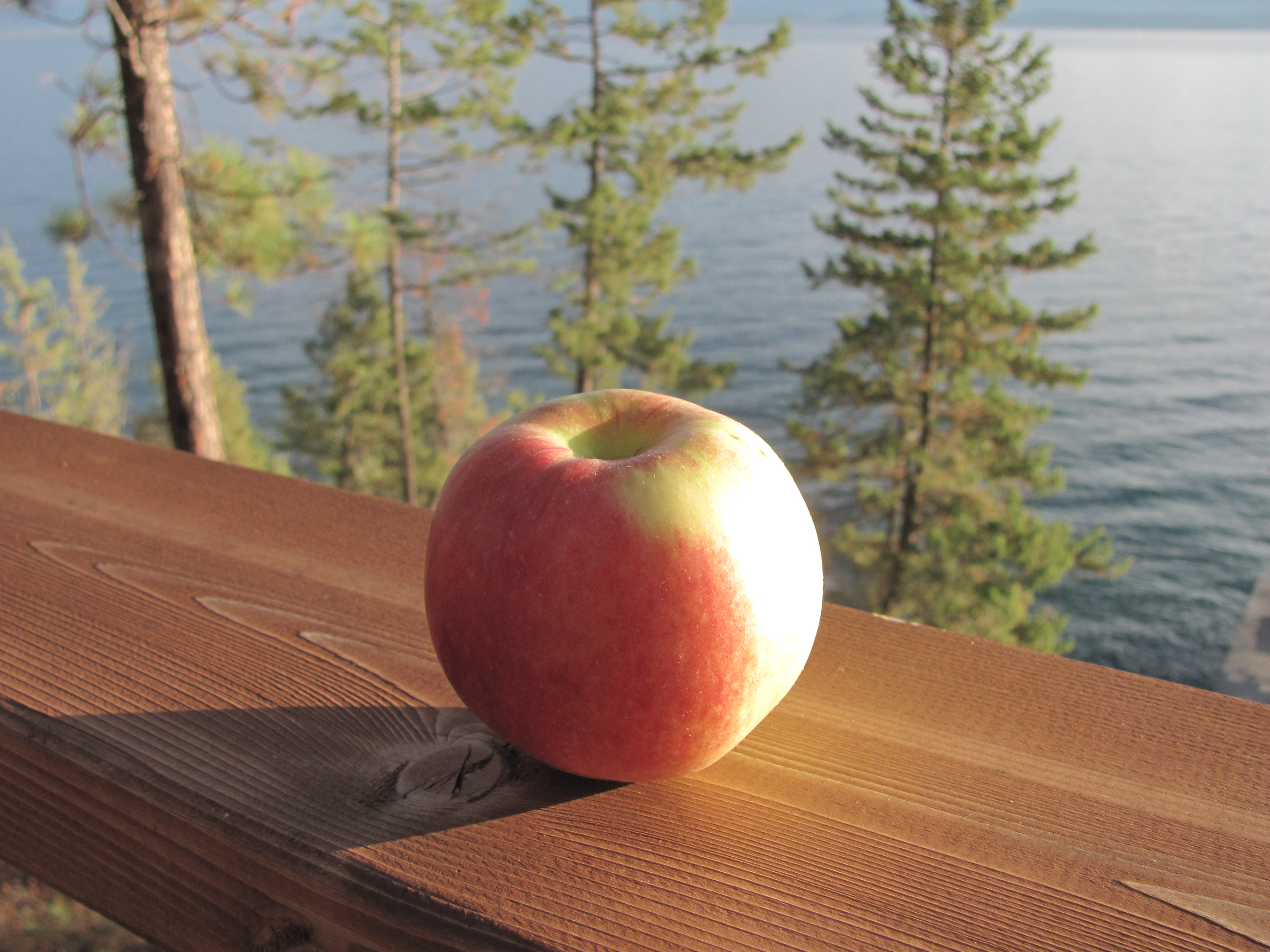
Continuing to wander, I find a perfect apple in the wild depth of the forest. There is no way to know if it sprung from a picnic’s tossed core or a bear’s secret deposit. Either way it shines bright against the gray light. Not equal to Augustine’s scruples, I reach up and pick the apple hoping to turn what might be considered theft into a present for someone else, my way of expiating the guilt and sharing a beautiful surprise.

IMG_2773

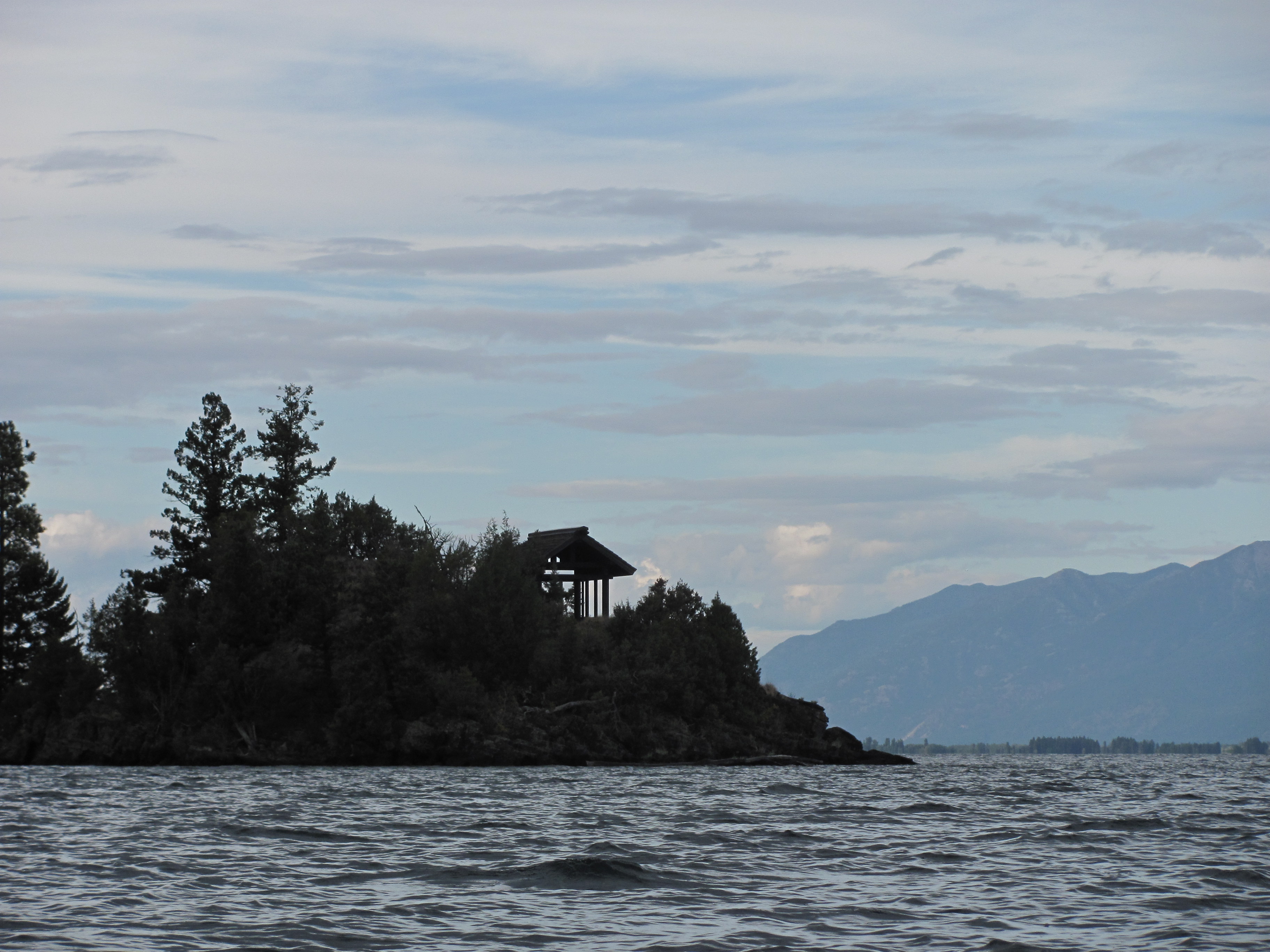
On the return paddle I slip the right blade under the bungee cord, lift the loop of my skirt and carefully extract my camera for a shot of the meditation center on the top of Angel Point, a structure I have always admired.

IMG_2760

After I come into the narrow slot between the dock and the cliff I think of lines I wrote long ago after my first encounter with Deep Bay.

Deep Bay Swallows

From the top of the cliff above the lake

swallows launch themselves into air,

never wondering if air will support them,

never doubting that air

will lift their pointed wings.

They seem not to need to rehearse

first lessons, nor do they hesitate,

hundreds of feet above the rocks

or the flat plate of the lake.

No, in the insubstantial medium of air

they draw their unselfconscious arcs.

They do not seem to have suffered a fall

that did not end in flight.

What wings have we with which to fly

except the trust

that for now someone or something

holds up all our falling,

intending for us to learn

to lean forward into apparent emptiness

and push off from where we cling

into all that waits to meet

our outstretched faith.