Ways of Seeing

This June we produced our annual crop of whitetail fawns, a pair of twins born on the west side of the house and a single fawn born in the grove somewhere on the back slope. Again, I noticed something about how fawns perceive the world. Because everything is new to them, they are curious about everything––the smell of fence wire around the peonies, the behavior of crows, anything their mother eats. Early days with fawns remind me of the first few years of my sons’ lives. They were as curious as fawns about everything in the human and natural environment. Fortunately, they have maintained much of this early openness to the world.

These observations about young deer and my sons remind me of the qigong practice called Eight Silk Brocades. As this practice was taught to me, the fourth movement in the first set invites the practitioner to see everything in one’s field of vision. While doing this practice almost every morning, I have noticed that I tend to skip over some objects in my field of view as I turn my head back and forth. For example, I notice mahonia blooming in the rock garden on my right but miss the mix of shadow and light in the lilacs on my way toward my neighbor’s pine tree on the left. This practice asks a person to see not just the objects we want to see but everything else in the field of awareness. This is a tall order.

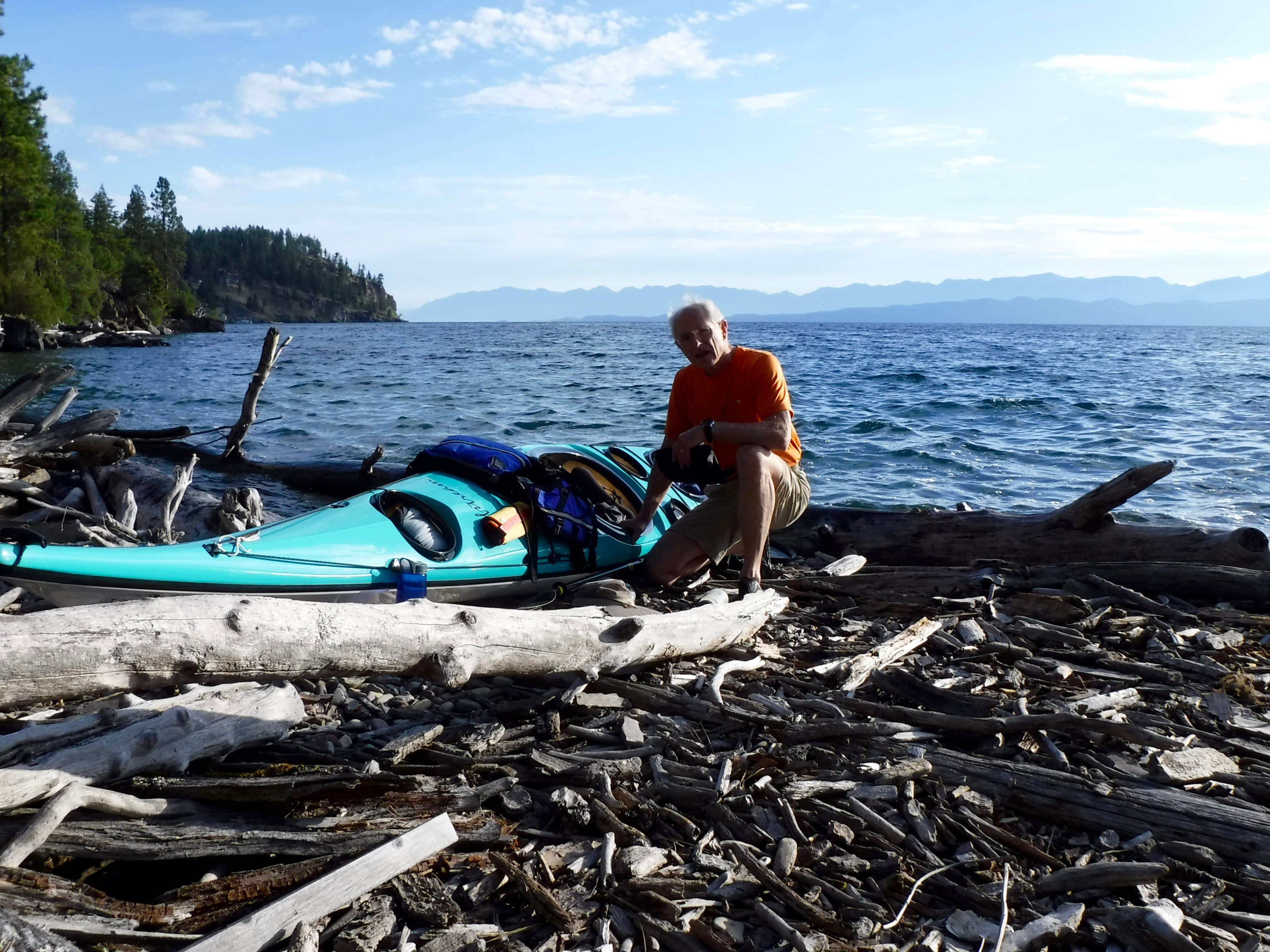
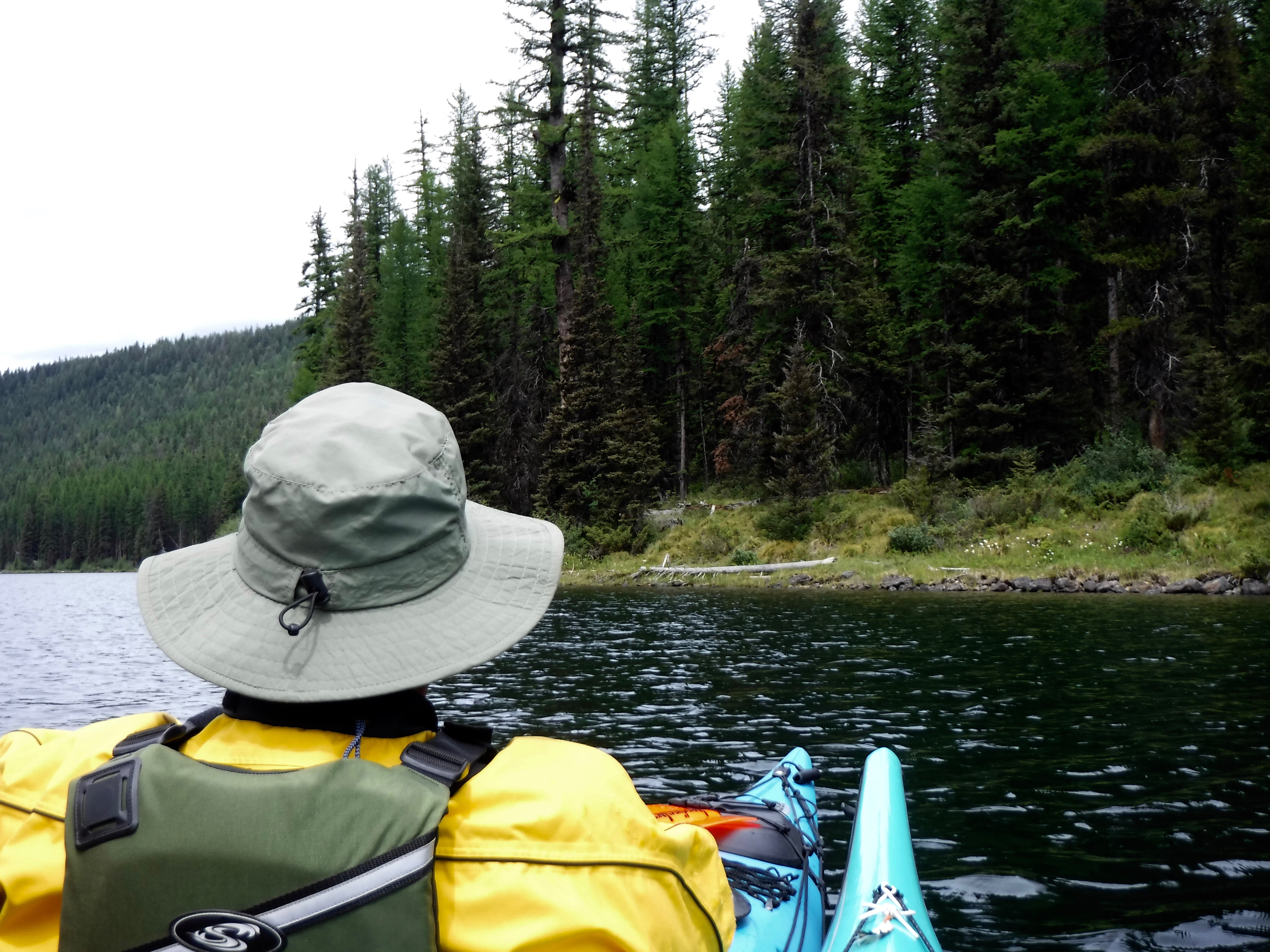
On July 23, the weather seemed perfect for a paddle out to Wild Horse Island. I began by paddling through a stiff headwind to reach the east shore of the Island, swam a couple of times off a driftwood-covered beach, then proceeded counterclockwise around the island, pausing again on the west shore before letting a faint tailwind push me back to my starting point. During the day I noticed my tendency to skip over some things in the field of awareness, but I kept reminding myself, influenced by qigong, to attempt to see the whole. As I approached the first cove, I noticed bighorn rams grazing grass and forbs on the slope above the beach.
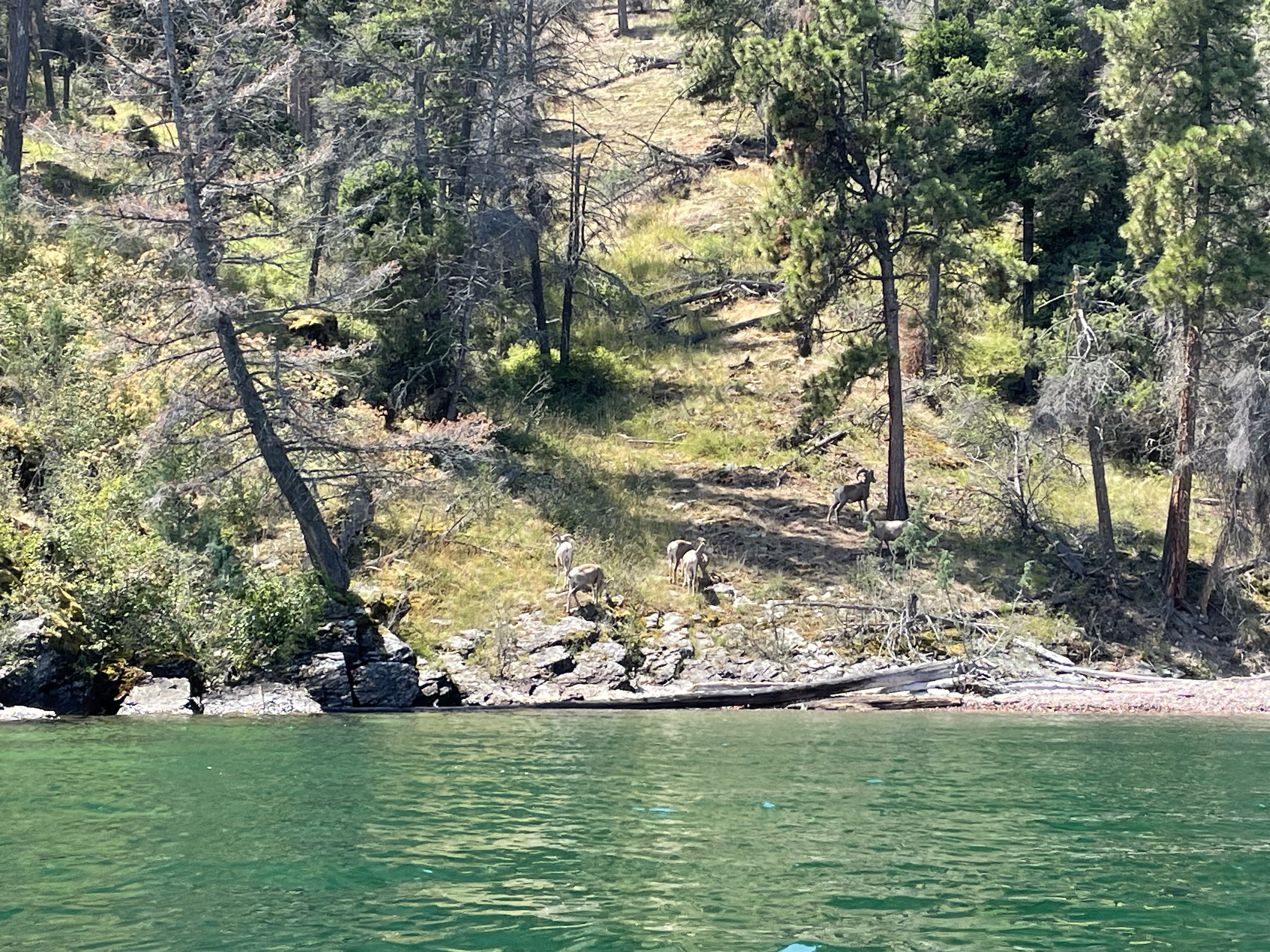
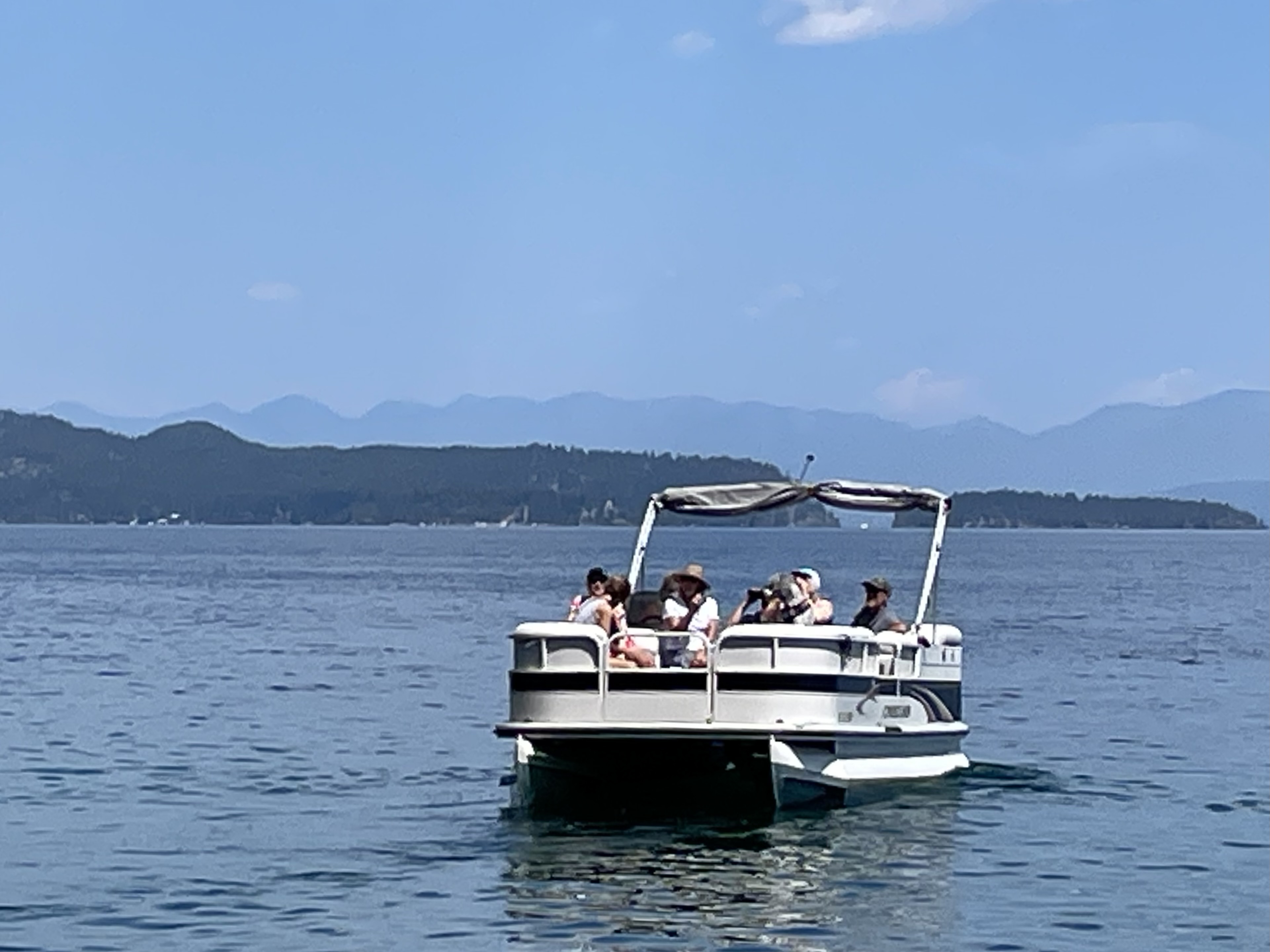
This was indeed a wonderful encounter with wild animals at close range as they went about addressing the business of hunger and thirst. But trying to take one of my spiritual practices into my daily life, I reminded myself to also notice the three boatloads of people watching the sheep.
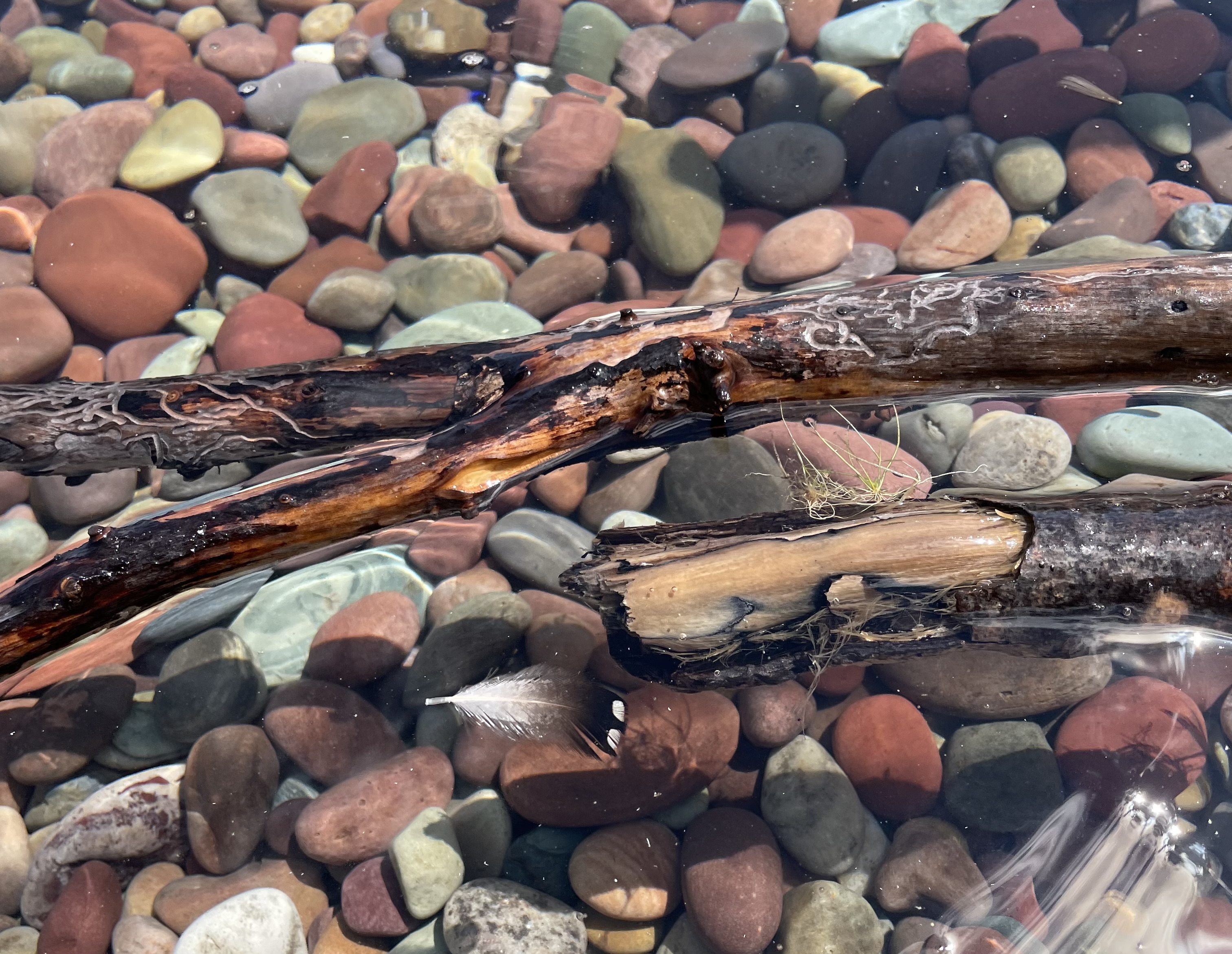
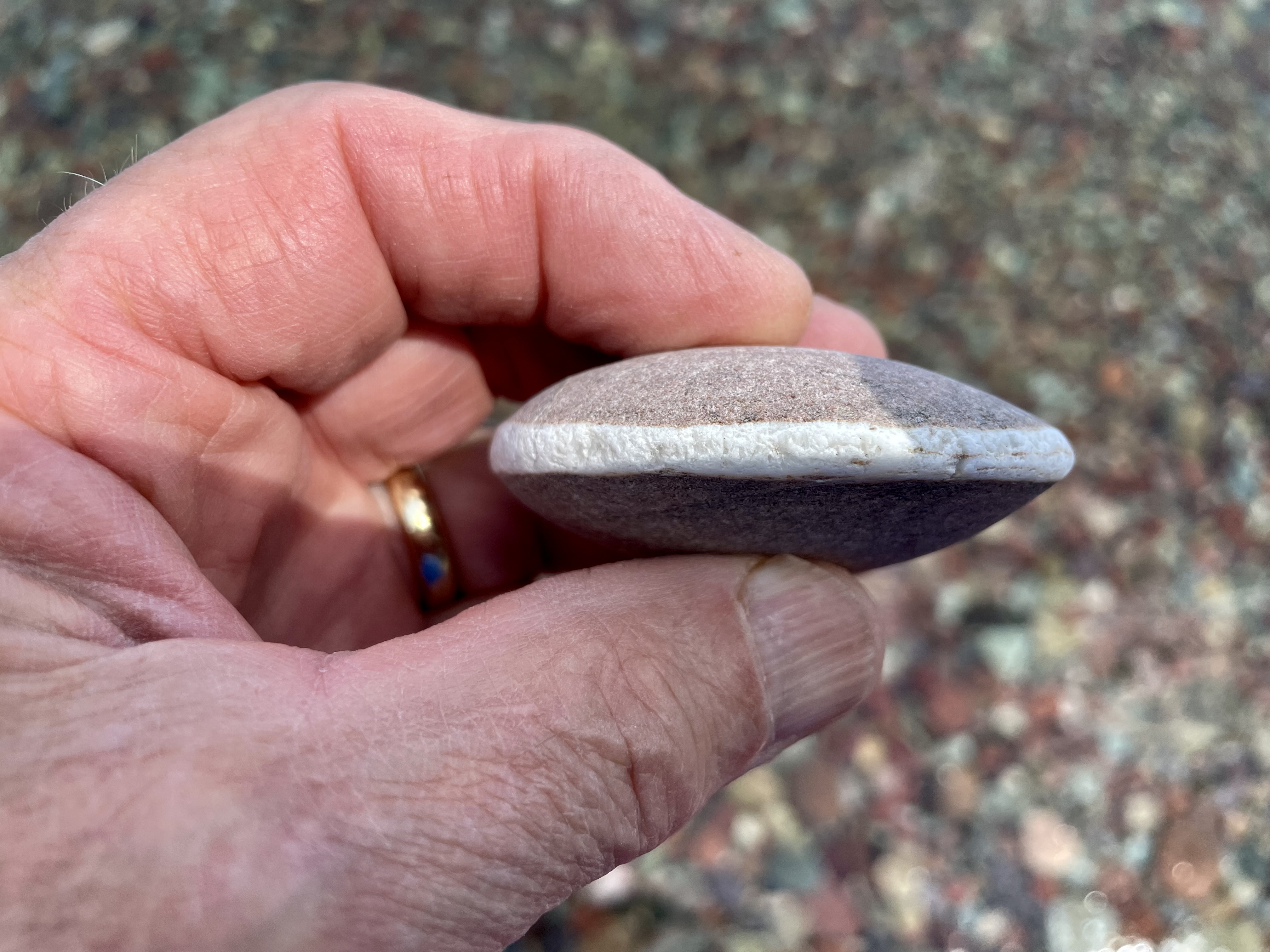
Beyond that, I reminded myself to notice two stones that seemed to have washed downstream from the same strata and were distinctly different from surrounding stones, a stone that reminded me of a flying saucer, and then a floating feather unlike any feather I had ever seen, one with two white dots in a black field.

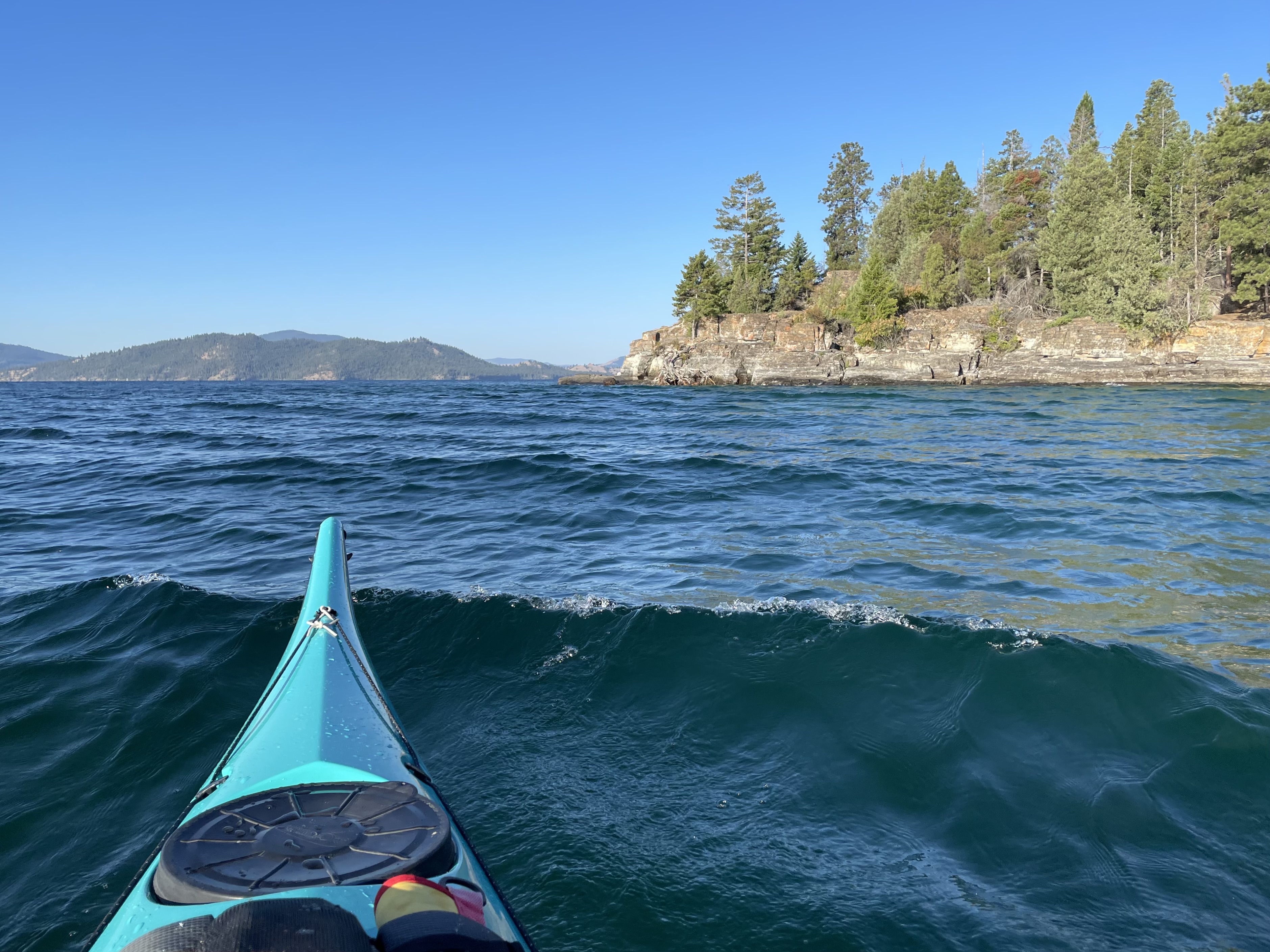
After leaving the cove I noticed two kayaks traveling east. Again, trying to practice a way of seeing, I slowed down and adjusted my course as we converged from different directions. The woman asked about my “strange looking paddle.” This led to a wonderful conversation about Greenland paddles and then an even more amazing conversation about an academic background the man, my father, and I had in common, all in the middle of the lake. When I reached the west shore all my favorite spots were occupied by other people. Eventually I found a few square feet of gravel where I could secure my boat during a brief hike. I climbed a steep slope up to a bench, noticing that this trail was well traveled by animals on the island. After a brief exploration of the area, I dropped back to my boat. After lifting Bluebird over some sharp boulders and into the water, I felt a faint tug of intuition suggesting that I needed to simply stand still. I kept in touch with my bobbing boat by letting small waves push the kayak into the back of my legs while I kept watching the slope above me. Moments later about 30 bighorn ewes and lambs came bounding down the same slope I had climbed. They poured over logs and boulders, tried to balance on driftwood rolling in the waves, and walked past me, almost as though I was invisible.

Seeing the world as qigong asks us to see presented close encounters with two herds of sheep, their absolute confidence in their own footing and strength, but also the intuition that told me to stand still and wait.

It may be asking too much of the human brain to remain open to the whole field of awareness all the time. But at least on this one day in July, I felt richly rewarded for trying to see the whole field––objects and interactions that interested me as well as everything else in between.

Room to Imagine

In mid-July I found two days with good, clear weather in the forecast so I made my Cedar Island overnight solo. In part I wanted to see improvements that Montana Fish, Wildlife and Parks had made on the island—a series of looping trails, tent pads marked out on the ground, and the installation of a first-rate composting toilet to prevent the fouling of the island and surrounding water with human waste. The island now awaits people willing to paddle this far, in my case, from Walstad Fishing Access to the island, or arrive under power to spend some time on an island that feels like a ship in a vast sea.

During this paddle I love adjusting myself to the multi-directional winds around Wild Horse Island—the challenge to balance and centeredness posed by crosswinds, the strength that headwinds require, the temporary pleasure of tail winds. I love the big, open-water crossing between Wild Horse and Cedar Islands that asks me to be patient and the marvelous conjunction of turquoise and cobalt water colors along the way. When setting up camp I am grateful for a hummingbird’s visit probably because I wore my red swim trunks. I am always astonished by the way they make eye contact. Sitting in my lightweight folding chair, I like watching the noise of the waves grow still around sunset. Waking in the middle of the night, I see the star river through the mosquito netting and the overhead appearance of brilliant Deneb and companion stars that form Cygnus the swan. Time on the island in a state of stillness allows me to watch two eagles race each other to a fish they spotted a half mile away, their powerful wing beats, the sudden splash, wheeling turn with taloned fish, and the long return to the roost. Time and attention are rewarded with many gifts.

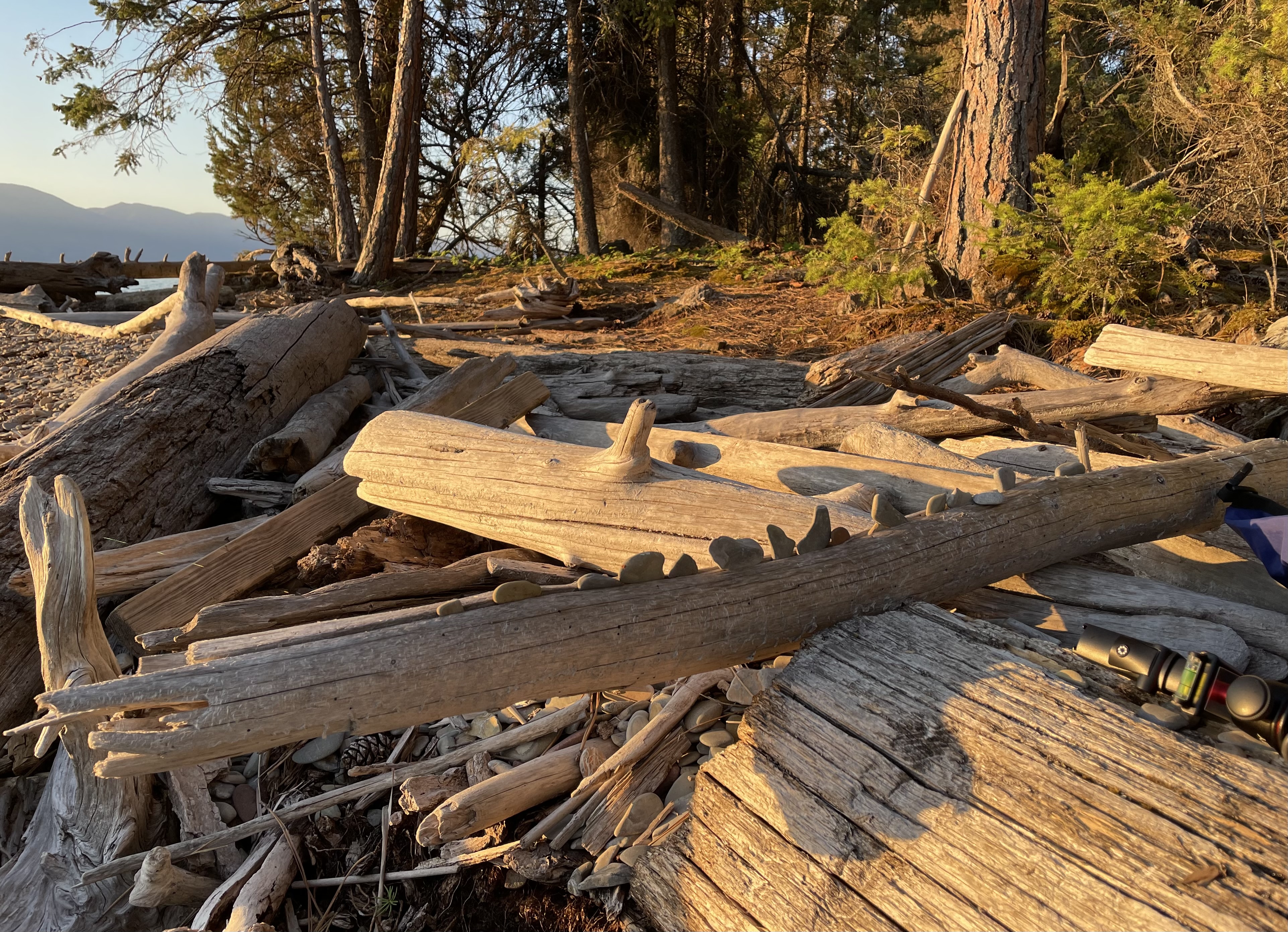
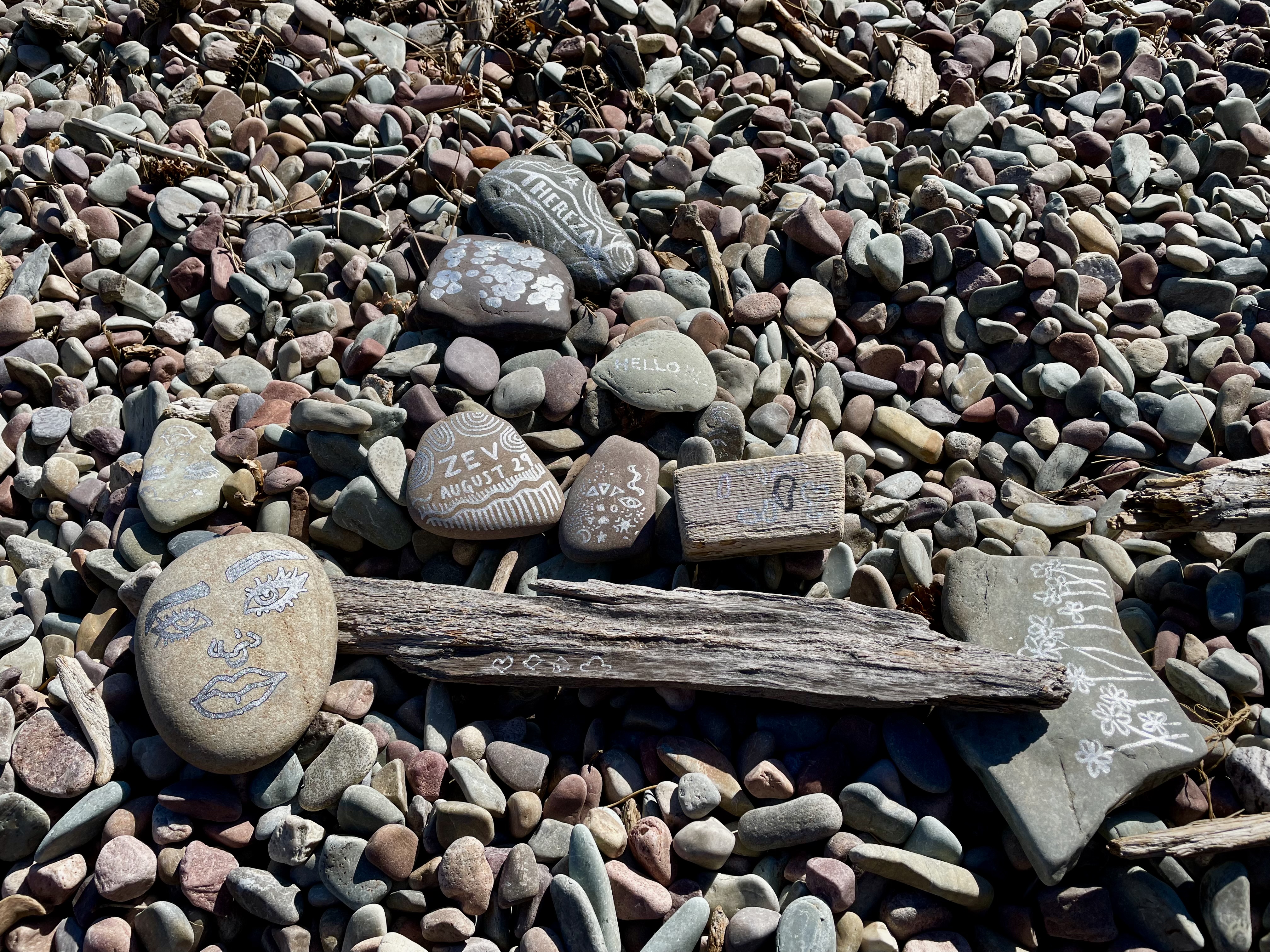
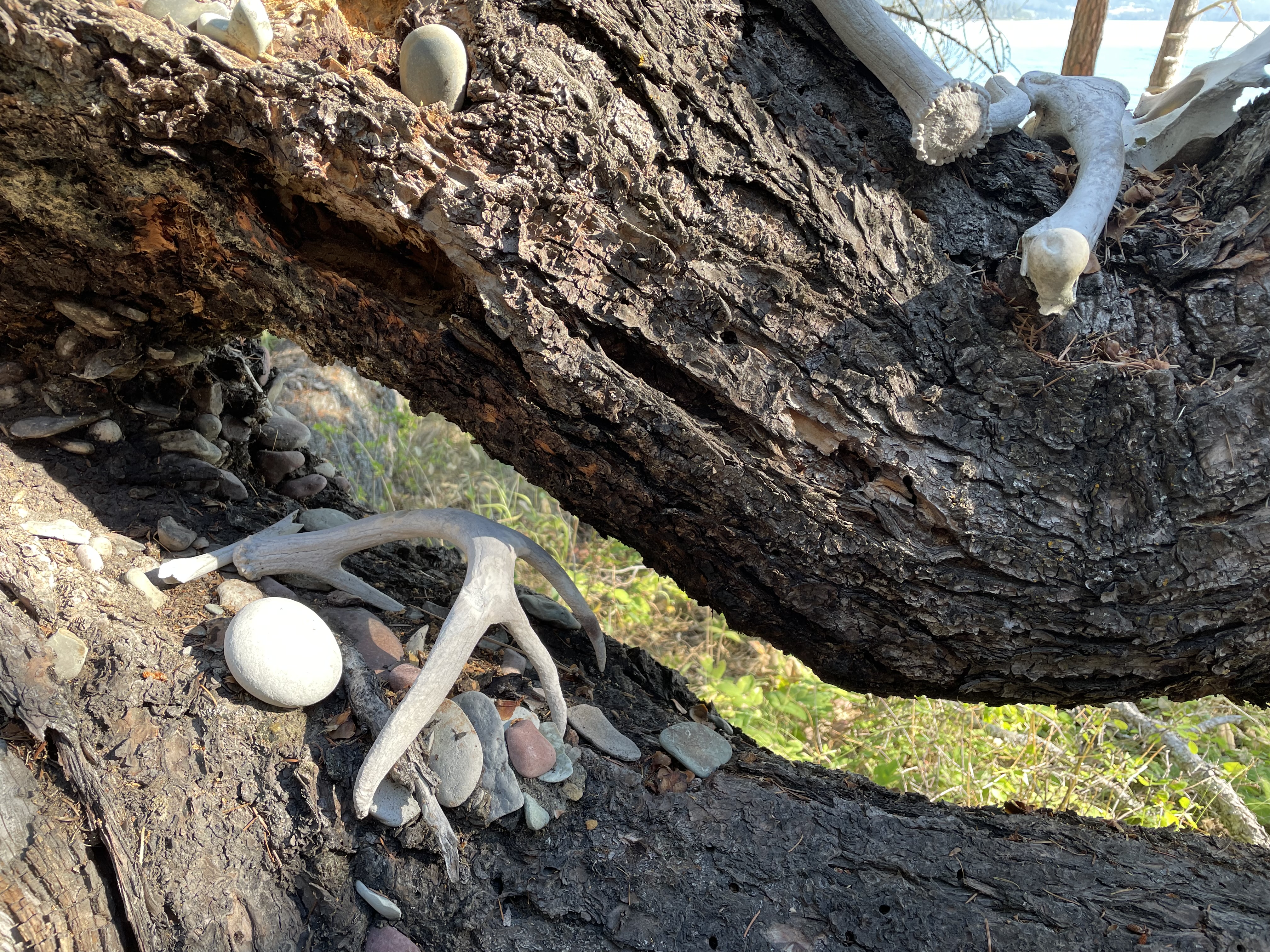
This time I noticed something else. In three different locations I saw imaginative expressions of human creativity in the use of natural materials. As if undistracted by technology and its trailing devices and cords, people, perhaps children, expressed themselves in wood, stone, and bone. In the absence of civilization, with space and time to imagine, something arises in us that lies dormant during hours of attachment to our screens.

On one beach I saw the long lower jaw of a now extinct sea monster:

On another beach I found a constellation of stones and driftwood decorated with symbols and signs in waterproof paint:

In another location I found what I call a Wild Horse Still Life, an arrangement of natural objects that tells a geological story and recognizes the comparative transience of the lives of deer inhabiting the island.

Away from home and its entaglements we get playful; imagination awakens and the materials of the world present themselves, inviting rearrangement in accord with images that arise in the mind. This, too, is beautiful. This, too, is part of the journey.

On Stillness

Last winter when we discovered that all the campsites were booked six months in advance we availed ourselves of historical connections to one of the church camps on Flathead Lake. For a reasonable price we rented an unused cabin during the middle school band camp. Day and night we listened to middle schoolers practicing their instruments or terrorizing a cabin full of sleepers before dawn. In the heat of the day we heard instructors practicing scales in a way that made this necessary discipline seem truly beautiful. The chapel was set up with arcs of chairs, metal stands, keyboards, trap sets, and a xylophone.

Over the course of two days I took advantage of calm weather to make a couple of shorter paddles. On the first day I wandered around Cedar and Shelter Islands but saw no sign of the modest improvements Fish, Wildlife and Parks has approved for visitors to Cedar. On the second day I made the open-water crossing to Wild Horse Island. For once I was not paddling in rain, wind, or hail. It was like paddling a different lake.

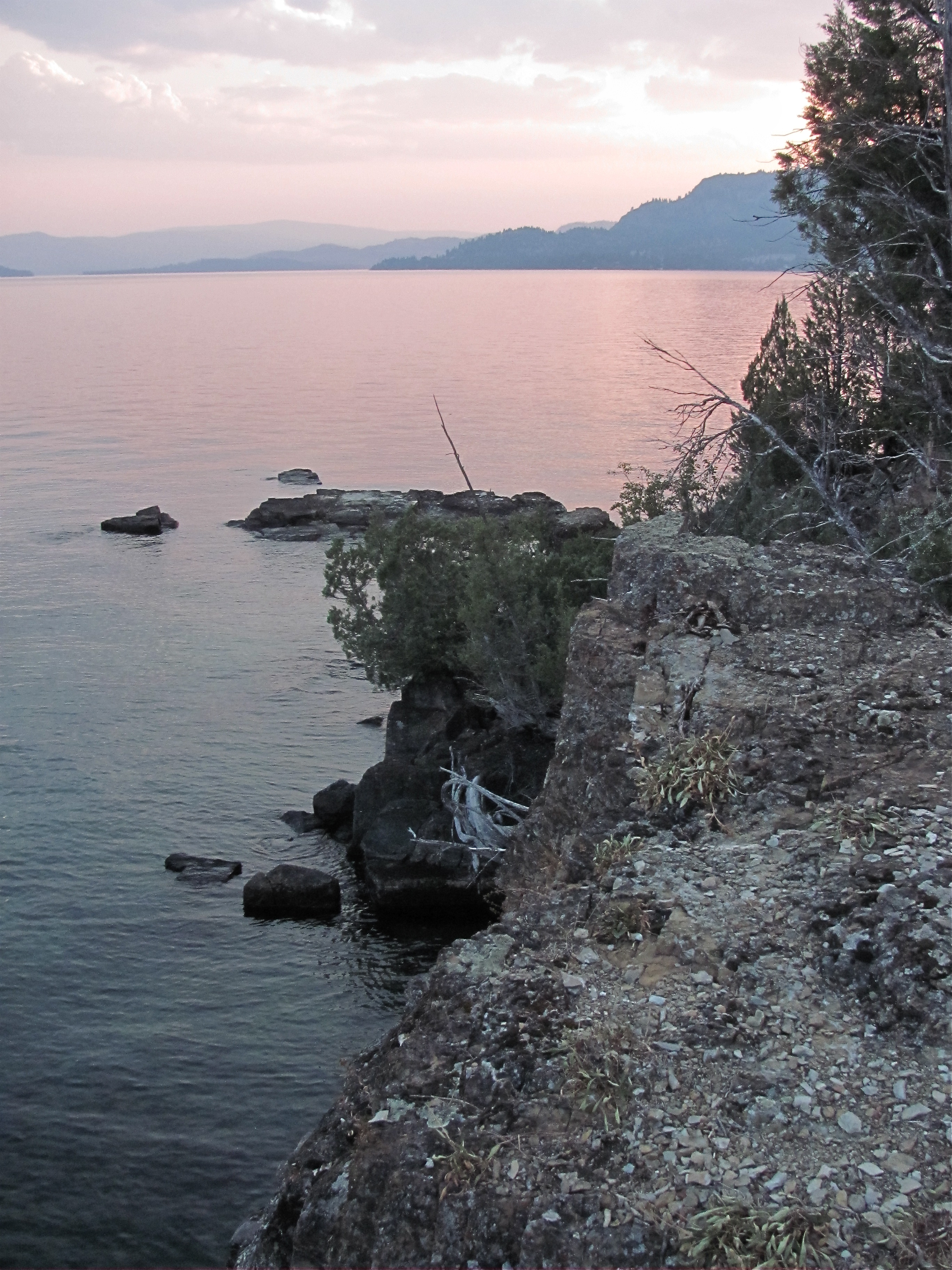
Cedar and Shelter Islands before dawn

As much as I love to paddle Bluebird, I also took time to be with the lake, to sit still and observe. Even the marginal comfort of a wooden bunk beat camping on the ground. The sun woke me, not pain in my hips. Taking time to be still I noticed things I miss when I’m in a hurry to get to the lake.

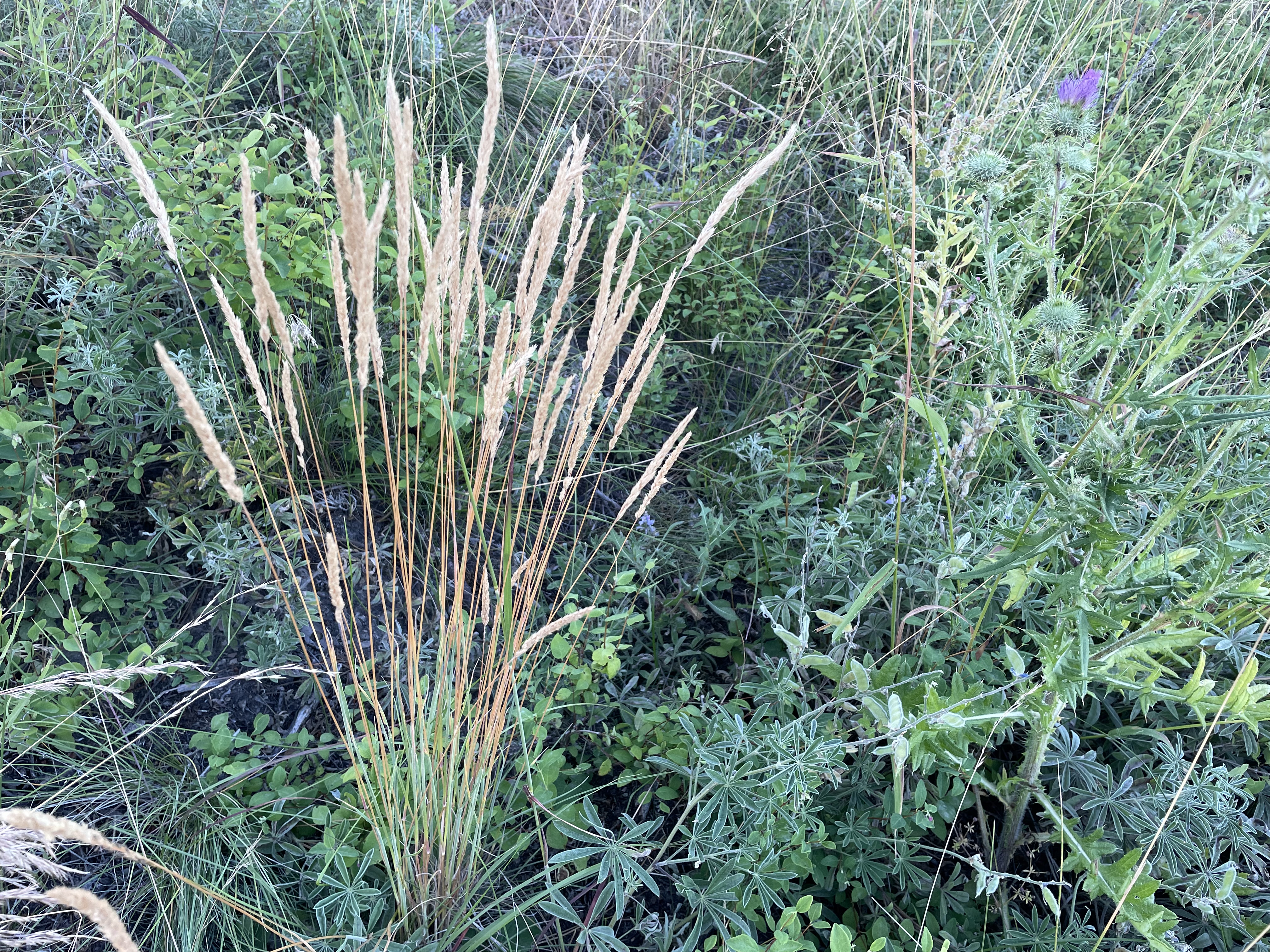
The margins of the lake are a part of the lake. They, like the water’s surface, are ever-changing, a palette for the shifting colors as one plant succeeds another, where Balsamroot gives way to lupine and then tall grasses, as green gives way to yellow and brown or the purple of asters. In addition to sounding brass we listened to little waves lap the shore. No longer trying to prove that I can cross the lake or paddle its length, I felt content being still on its edges.

At home I almost take for granted the value of stillness. When I am still, the Black-throated and Calliope hummingbirds show up on the deck to sip from potted plants or the red feeder. When still, I am more likely to see the warbler in the willows or notice how early morning shadows make mounds of lavender even more beautiful. When still, the moon’s sudden appearance seems like its own kind of brass instrument. For three mornings the same was true at the lake.

On the second morning I locked myself into the boat for the crossing to Wild Horse Island. Able to take a straight shot across the three-mile expanse in calm conditions, I landed at Eagle Cove, a public access point, shed skirt and pfd and began to walk into the forest. By 9 a.m. the sun was already too high for mostly nocturnal creatures to be active; but the air was filled with the calls of young osprey. Without binoculars I could not be certain, but the long, sharply defined feathers led to the tentative conclusion that I was seeing four young birds. They circled each other as they rode the rising and warming air above the island. When one landed on a rocky outcrop to rest, another approached from behind, dropped its legs like landing gear and swooped over the head of its sibling. This caused the resting bird to take to the air and give chase. My stillness among the trees gave me a vantage point on birds of prey at play.

On the third morning I took a bitter cup of instant coffee onto the cabin’s deck and sat in first light. Moving only to raise the cup I noticed a swallow asleep on a dead branch above a bird house someone had nailed to a tree. The silhouetted bird was little more than a swollen node, a knuckle on a branch, a tiny black shape, motionless. When the sun rose over the Missions and brushed the world with warm tones, including the breast of the bird, it sprung to life. It leaped from the branch and without warm-up began to cut arcs through the air. Seeing me it dropped from elevation in a descending curve and rose in front of me to confirm I was a quiet human.

Swallow a moment before flight with Wild Horse in the distance

When still, a better review of one’s choices becomes possible. When still, quiet things reveal themselves. When still, the edges of life become as interesting as the expanse of open weather and water.

End of Summer?

July 29, 2021

We are still trying to bear up under the heat dome that produced temperatures in the 90s, and occasionally the 100s, and a pall of smoke from fires all around us. One cannot help but wonder if 2021 will be the end of summer as we know it, historically the season of recovery for us who live in northern latitudes, the season of leisure and lounging near the water. We need these three months and it now seems as though our actions across the globe will take them from us. Though I read hungrily in this field, I do not know how we will manage the necessary transition in time.

With company at the house and plans for a dinner deck party for friends visiting from Iowa, I decided to go paddling. Aware of a host’s proper duties, I had abandoned my plans until I saw a radar image showing powerful thunderstorms sliding west to east across the lake early in the morning. Anticipating a slight cooling effect and perhaps cleaner air, I loaded Bluebird mid-morning and packed the truck for a day on the water. When a big truck passed me on a straightaway and rainwater sprayed across the road and into the air, I knew I’d made the right decision. One can stand only so many deck parties.

When I arrived at Finley Point State Park the campground was unusually quiet. I suspect people slept in after enjoying the sound of rain on the roofs of RVs. Knowing I had the whole day, I took my time to prepare for being on the water. It was hot enough that I changed into my bathing suit. Because planning reduces anxiety, I took time to carefully stow truck keys, phone, and emergency contact information. I also planned to have food and water readily available for a long paddle from the state park to Wild Horse Island. Fortunately, conditions were perfect for a paddle of slightly over 20 miles—variable winds, waves less than a foot, water like liquid mercury.

This would be my first long paddle using the Greenland style “Kalleq” paddle. The catch of the blade is noticeably easier on my less-than-perfect left arm. As the miles slid under me I sensed that the design of this paddle allows for hours of strokes without strain. I soon rounded Black Point with all its security cameras, crossed the gap north of Cat and Taylor bays and pulled into the rocky shelter at the tip of Rocky Point where I stood in the shallows for a few minutes to grant hamstrings a reprieve. I got back in the boat and reminded myself to be patient with the four-mile crossing to the Wild Horse.

I aimed for a dense cluster of Ponderosa pines and a dock where friends spend part of their summer. After a long time in the deep blue, I felt glad for the green of the shallows. I took a few minutes to rest on the dock where I have permission to land, ate high-calorie food and pumped water back into my bottle. Heading back always seems easier than venturing forth, though the efforts are probably equivalent. In the mid-afternoon heat I decided to take a small detour to Bull Island where a swim seemed to be calling to me. Feeling charitable, I waved to jet skiers and pontoon boat captains when they waved to me and my quiet craft.

I pulled into the bay on the south side of the island buoyed by a host of memories—the memory of Joyce floating on her back in this bay, a memory of a friend who, taken for his first paddle in a kayak, fell out of my boat as he approached the shore and had to walk the last few yards to shore but seemed unfazed by water temperatures in May.

Wading ashore

I slid Buebird over some drift logs, shed skirt and PFD, stripped my sweat-soaked shirt, and dove into the warm water, warmer than any Flathead water I could remember—about 74 degrees. Though I sometimes keep my glasses on when going for a swim, this time I took them off because I wanted to immerse my head, dissolve the remnants of sunscreen and perspiration. It never felt so good. In fact, after coming ashore I turned around and dove in again.

Restored, I settled back into the boat for the last two miles home. This time I had to be a little more cautious. I was surrounded by pontoon boats and a vessel modified to produce a very large wake which allows people to surf the wave at the stern. Like an owl, I kept rotating my head so as to keep track of approaching waves, not wanting to be caught off guard.

When I finally pulled into the marina I passed a big dead fish floating over the boat ramp. I suspect the fish had died from the water’s high temperature. It seemed a troubling omen of days to come.

Taking the same time to organize gear for the drive home, I avoided the self-imposed pressure that goes with being in a hurry. In good time I slipped through the vale of smoke and traffic in town. When I pulled into the driveway I could not park near the garage, other cars having blocked my way. I carried Bluebird to its cradle and removed the wettest things from the bench seat in the back of the truck. I greeted friends on the deck, went back to the kitchen for a big bowl of chicken salad, and later, a huge helping of ricotta, blueberry and lemon cake with a massive mound of vanilla ice cream. As I returned to the deck the assembled women said, almost in unison, “Now that is more than a dollop.” Dollop must have been the word they used to signal their modest appetites for dessert. I ate the whole thing and soon fell into bed.

Rest

I have been thinking about the importance of rest. Like most paddlers I take my boat to the water when I can, when I create a gap between responsibilities at home or time with family. This year especially, the weather in these gaps has been unstable, unpredictable and wildly dynamic. I think, for example of an afternoon when I paddled from Canal Bay, near Rollins, Montana out around the south ends of Shelter and Cedar Islands and back. The waves caused me to hesitate before launch and required extreme care when broadside to their wind-driven and rolling energy. After I landed I learned that a sailboat from the Lutheran Church camp had requested permission to anchor in the swimming area of the United Methodist church camp, so tired and fearful was the crew.

I also remember a recent paddle from Finley Point campground to Bird Island. Conditions were unsettled and the waves so chaotic that I only saw one other boat on the water—a powerful inboard towing a tuber and creating endless contradictory waves in addition to those generated by wind across a 20-mile fetch. By the time I reached the island I was so concerned about turning broadside and beginning my drift south that I did not even glance into my favorite cove and did not dare to take a photograph. I could not figure out a way to use my camera and brace against the waves at the same time.

As I coasted south I knew it would be wise to find a place to rest and eat lunch. I remembered a gravel bar on the south end of the island where boats often ground themselves and get out of the fray. I left this spot to a merganser family and found a slip behind an ancient grounded pine tree covered now with a community of mosses and other small plants. I felt a profound sense of relief to be in the lee of the island’s mass and to glide in behind the log.

Paddling, almost always by myself, gives me ample time for reflection. So, contemplating my own need for rest, and the relief that accompanies it, I could not help but think about other people whose need for rest is far more consequential. I thought about all the people along our southern border looking for escape from gangs, border patrol agents, militias, and others who exploit their vulnerability. These people need places to rest, shade under a bush, and the shelter of human kindness.

I feel fortunate that I can enter into difficulty by choice and that I know where to find places to rest. Paddling gives me ample time to fly in my imagination toward those who are forced into flight and who search desperately for a little pool in the lee of events.

Discoveries

In late August four of us left town for the lake. We wanted to escape the smoke in Missoula’s valley that made the simple act of breathing a health risk. Three of us wanted to go for a longer paddle. My wife preferred to read in camp and listen to lapping waves.

Joyce sometimes asks encouragingly, “Would you like to take a trip and paddle somewhere on the coast of British Columbia?” I know this is one of the most beautiful coasts in the world but I appreciate having access to the largest and cleanest body of fresh water in the western U.S. and feel as though I still have so much to learn, even after more than ten seasons of paddling Flathead Lake. I am content to keep exploring close to home because experience tells me, if I keep myself open and do not let my ability to perceive grow dull, I will make discoveries.

This trip confirmed that belief. Over the course of our two days we discovered how to have  fun while helping each other get ready to launch,


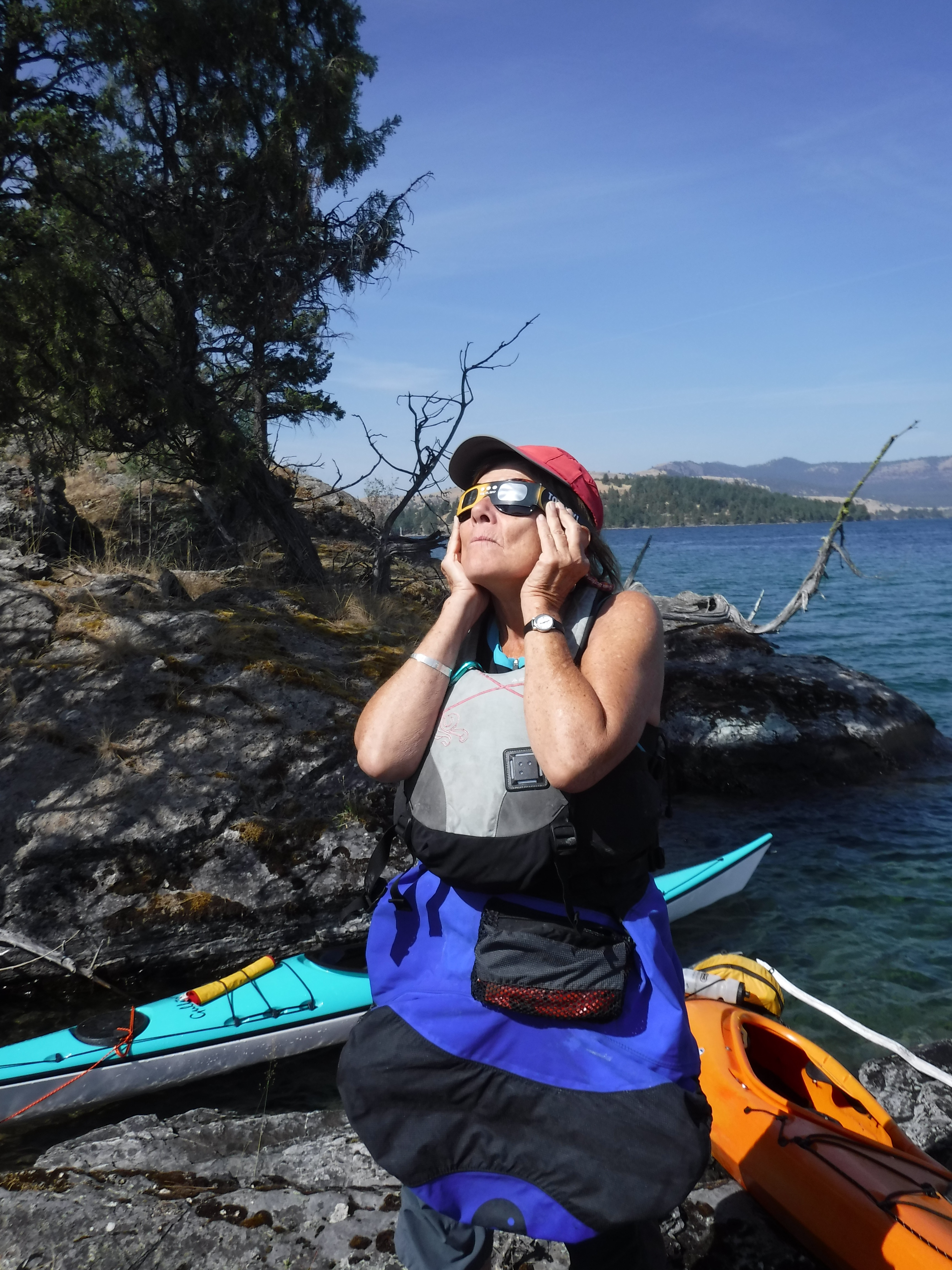
a rocky point for viewing the eclipse of 2017,


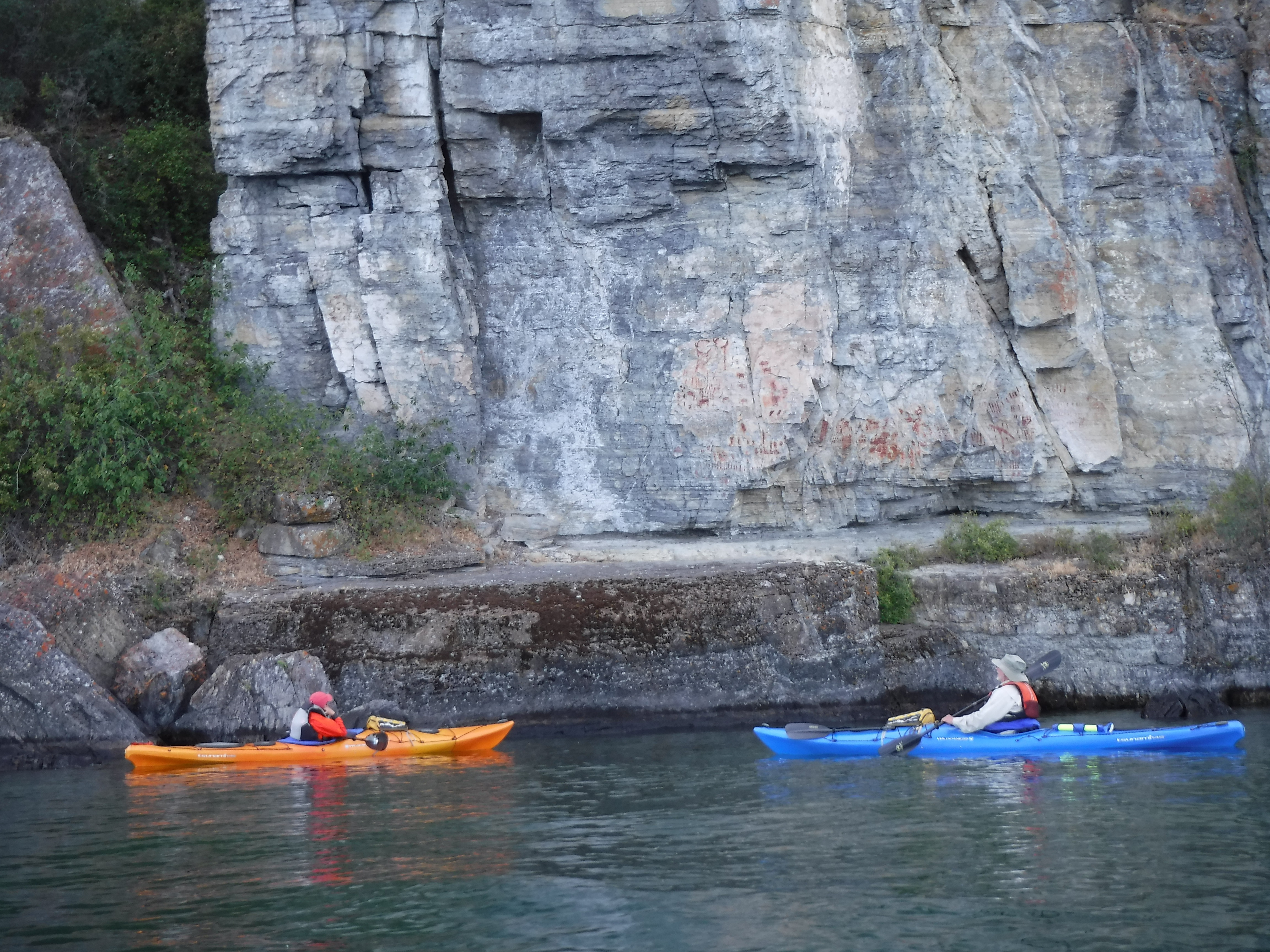
previously unseen panels of rock art and how prone they are to exfoliation and loss,

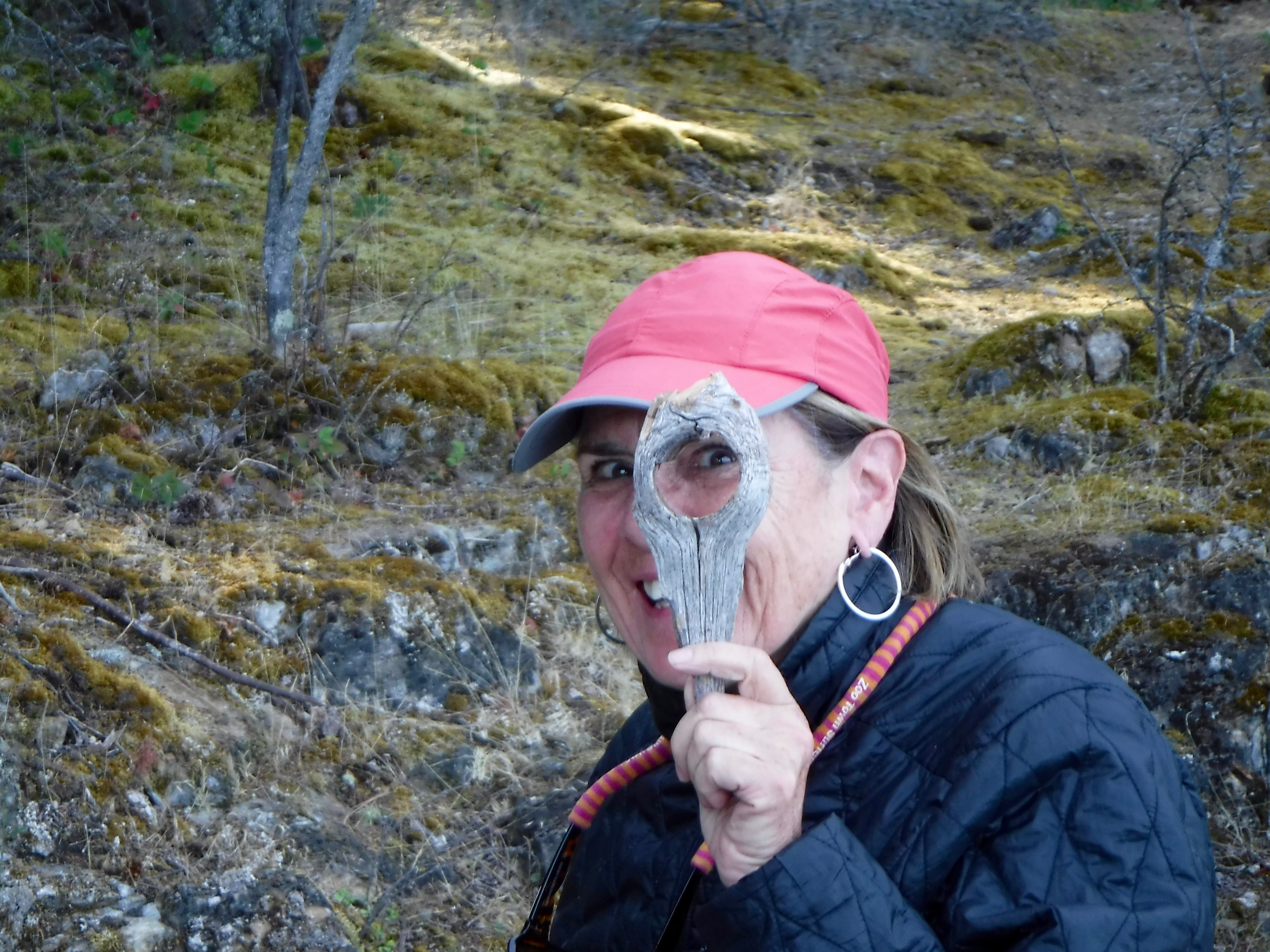
how to turn a knothole into a spyglass,

the beauty of black and blue ring waves during a hot morning but especially after sunset,

where eagles tend to roost and why it is extremely important not to set up a sleeping bag under those trees (I’m not providing a photograph of my mistake).

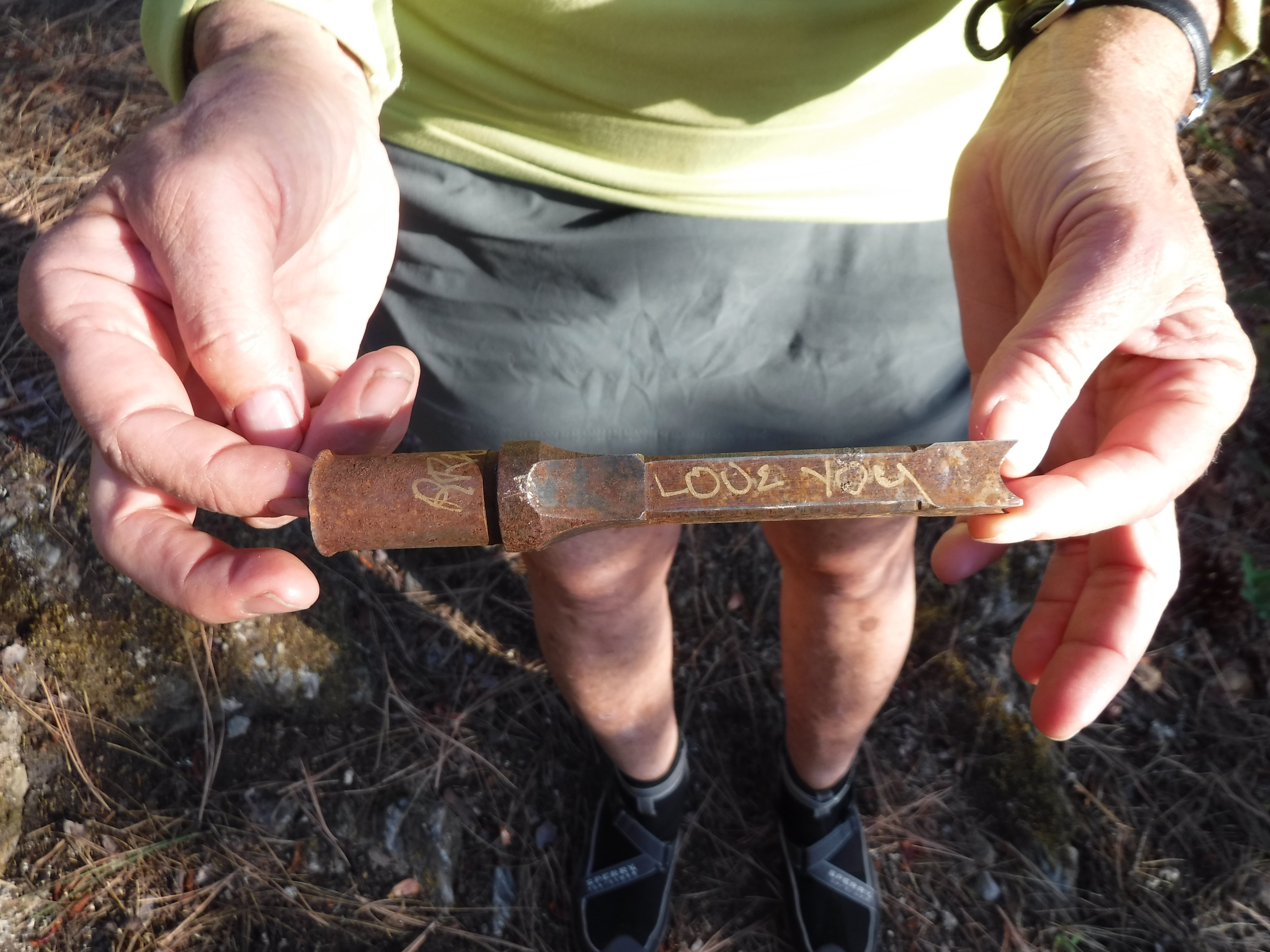
We also discovered a memorial to a young man. People who loved him wedged a painted tribute between opposing pieces of rock. Later, my friend Jeanne spotted a remnant from his tool collection. Walking between her tent site and the beach she saw an anomalous piece of rusted steel pushed level with the surface of dry moss and stone. Curious, she withdrew it from the ground and showed it to me. I explained that the object was a hollow chisel, a tool used to chop mortises so two pieces of wood can be joined with a tenon. Using gold-colored ink, someone painted messages of love and the man’s birth and death dates. Seeing this tribute, we speculated he might have been a woodworker. After we admired the tool and its subtle placement, we put it back exactly as we found it.

Passing through the gap between islands or crossing between island and mainland we also made discoveries about each other, learned things we did not know. We braided an invisible cord between and among us of understanding, memory and anticipation. For the rest of our lives we may tow each other along, connected by the stories we tell and create.

Though I am far-removed from childhood, the lake keeps teaching me to maintain the mind of a child, seeing the world as if for the first time, paying attention to it as if it might be the last.

Nighthawk Mountain


All the posts in this blog focus in one way or another on sea kayaking. This post, however, has nothing to do with my boat. Strangely, though it seems to belong in Ospreypaddler. After writing this piece I realized that I approach a river, a mountain, and a bird in much the same way as I approach a paddle on Flathead Lake. With each encounter I have the sense that there is something to learn as I slide my boat into the water. In much the same way there is always something to learn from a river, a bird, and a burned over mountain.

I step out of the unlit propane darkness of the Magruder cabin into pale morning light. In this steep, rough country it will be a couple of hours before sunlight lands in the meadow. From the bottom of the valley where the Selway River flows through granite cliffs and burned timber toward the Lochsa River, I look at the terrain above me. I hear it calling. Instead of fishing with my friends I decide to try to hike to the top of one of countless high knobs above the river. I am happy to leave the cutthroats in the river undisturbed. Instead, I need to test myself, need to see if lungs and heart are working as they should. Before this trip I had not been feeling well. I’d lost energy, felt listless, unmotivated. Was this the result of two weeks of days in the nineties and air choked with smoke from surrounding fires or something more serious? This hike, I tell myself, will help answer the question.

I cross the wooden bridge over the river, taking a moment to look down into the deep green pool below. Just past the bridge the “Kim Saddle” trail leads up through charred timber, thimbleberry, mountain maple, and fireweed. For the first few hundred yards the trail swings back and forth across a vernal stream sliding through a downward fold in the topography. Eventually the trail crosses the trickle for the last time and begins to switch left and right across the slope of the high place I want to reach. I pause now and then to listen to my lungs and heart, waiting for the engine to wind down. In time I crest a saddle and can see the upper reaches of the valley of the Selway and on toward slopes devastated by fire. Even from a distance I can see initial stages of recovery. The sun turns bare spires into pointed pencils of light.

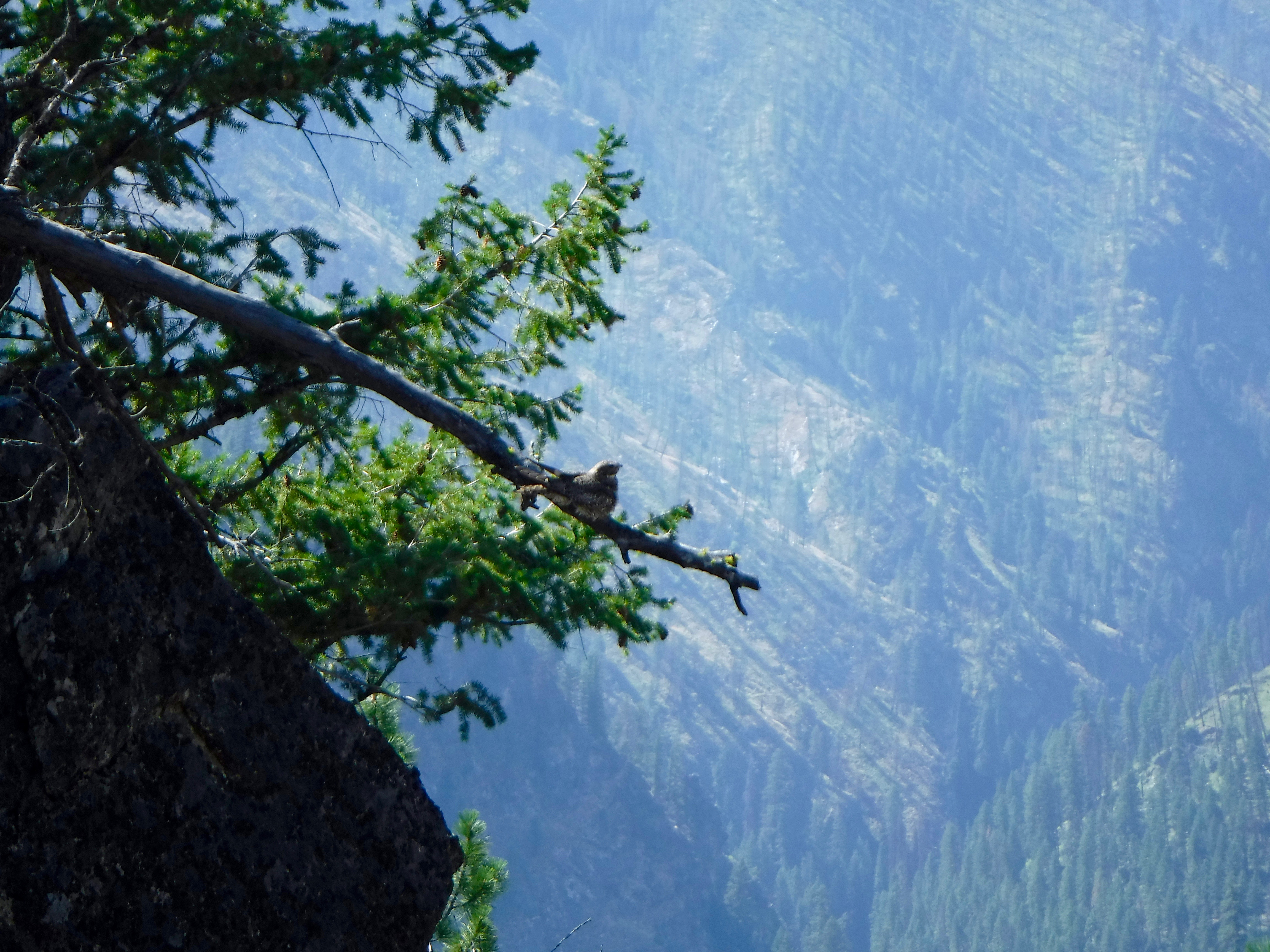
I leave the trail here and turn left toward the rocky crest I saw from the valley about 800 feet below. I see a cairn that someone built on the highest knob and fit a couple more pieces of granite into the structure. I turn back to the rock pile that hangs above the valley and take a few more steps. Suddenly I see a mottled bird leave a rock and make a slow fluttering flight down toward the valley to the south, its tail spread open but almost folded under its body, making slow flight possible. Because of the bird’s coloring and almost silent flight I first think I have startled an owl from a daytime nap. Pleased to have had such a close encounter with a wild bird I proceed toward my goal where a big fir log, black from fire, teeters on the final rock.

To my surprise the bird circles back and flutters toward me. It is so close I can see its open mouth, long pointed wings and the distinctive white wing bar of a common nighthawk. At dusk I have seen them flying over the meadow down below. Each evening I have watched them dart, dip, and make their stutter flaps as they accelerate toward insects in the air. Up here, alone with the bird, I cannot tell what it is trying to communicate with its long silent wings and approach. In this extremely remote location is it unafraid and curious about a human being, or is it trying, without the unambiguous weapons of goshawk and eagle, to warn me away from its nest, a mere scrape in the gravel on the top of a mountain? I do not know the language of nighthawks but try to imitate its low clucks. It continues to make untraceable loops in the air, each time coming within a few feet of the hand I extend in greeting, arm and wing bearing a striking and evolutionary resemblance. I would give anything if it would land on my hand, but know this is unlikely. From time to time it pauses on a branch hanging over the void. Its long, pointed wingtips droop below its two-ounce body. If I do not see it land I cannot distinguish the bird from the flaky gray bark of the tree limb.

The bird comes to me several more times after I turn from the final rock. I flatter myself with the thought that it likes my company in this extreme, lonely spot in the wilderness; but being more realistic, I think it is trying in its gentle and harmless way to warn me to leave its mountain hideout. Concluding that I should no longer be a disturbance, I bid the bird farewell with a few soft whistles, turn my back and descend the mountain.

I know now that heat and smoke have sapped my energy and motivation, but these energies return when I decide to apply my legs to an ascent. I am all right after all. But more importantly, I have found the daytime resting place of a bird that otherwise ignores me as it plies the night, scooping its prey in the net of an orange and open mouth. I speed down the mountain, grateful we set aside places where two strangers from different worlds meet in the wilderness, try to understand each other’s language and movements, the human respectful of the needs and territory of the wild one it has unwittingly approached. We have met each other and caused no harm.

Not What I Expected

When I returned from my last paddle, a seventeen-mile solo and overnight from the south end of the lake to Cedar Island, I could not write what I had planned to write. Reminded once again by fires in The Bitterroot that the West is burning, I had intended to write about Cedar Island as a microcosm for the planet, our “fragile island home,” as the Book of Common Prayer puts it in Eucharistic Prayer C. But unexpected things happened during the trip that made the original idea less compelling. I came home uninspired and wasn’t going to write anything after the boat came to rest in the rack, but something keeps knocking on the door.

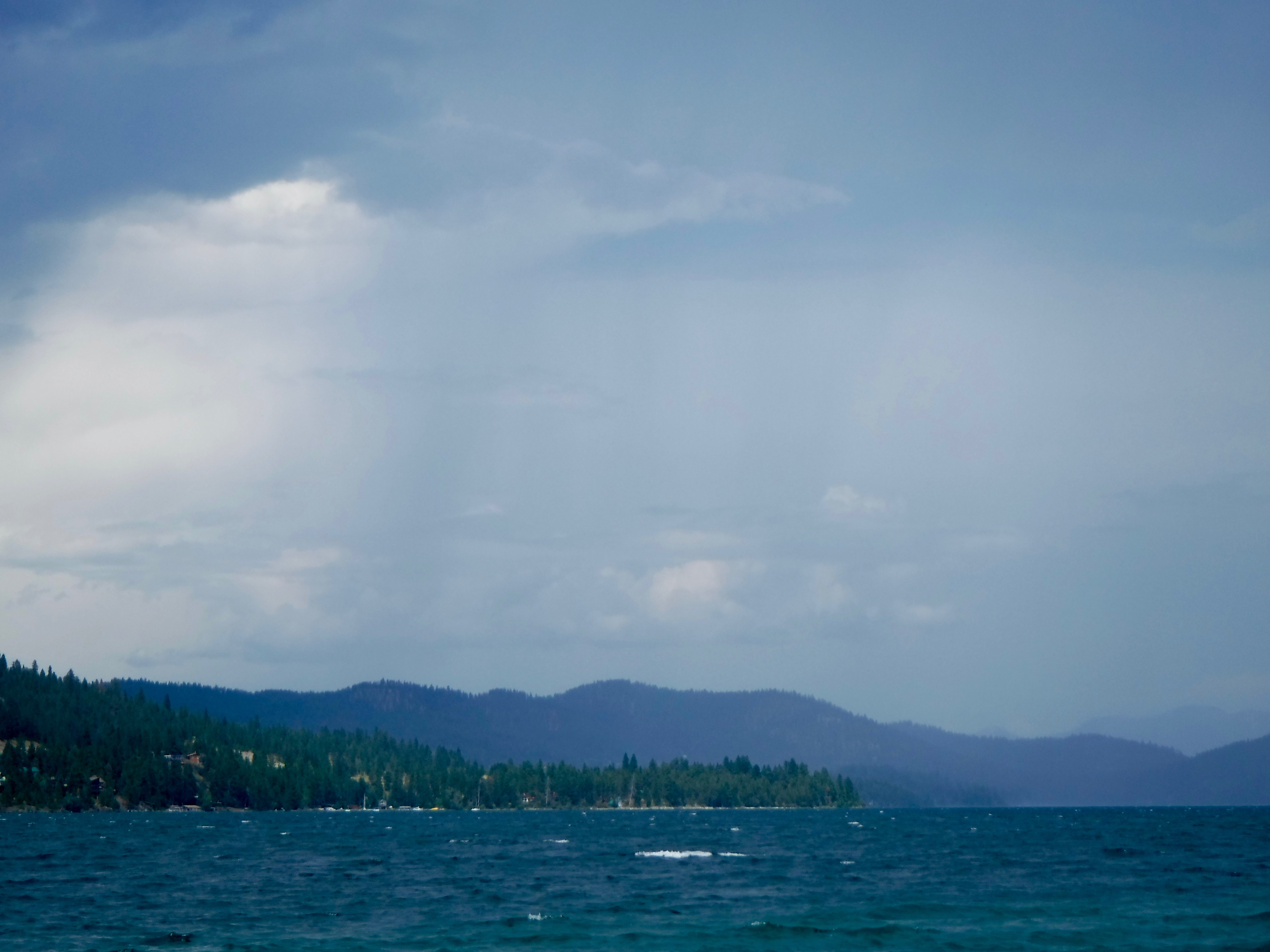
I knew from the weather report and the graphical forecast I always consult that I might run into thunderstorms on this trip. Years ago I got caught out far from shore in such a storm and resolved to be more cautious in these conditions and to take lightning much more seriously. When I drained my shoes, tucked myself in, and secured my skirt clouds were building off to the west, but the conditions did not seem dangerous. I pushed against a hearty headwind on the way to Wild Horse Island. By the time I rounded the point that protects Skeeko Bay the wind gusts were intense. It was as difficult to swing the paddle forward through the air as it was to make a stroke through the water. I paused to check on a couple of people in open cockpit boats who went for a short paddle from their anchored sailboat. Not having far to travel, they assured me they could get back to their boats. I decided to cross the bay and haul out on a gravel beach.

DSCF0204

I pulled lunch out of my mid-ship hatch, found a log to sit on and decided to wait and watch. Waves continued to build and break in the open water to the north. Thunder boomed and cracked overhead and lightning lashed the hills to the west. No one was waiting for me on Cedar Island. I had made no promises, and knew better than to push willfully toward my destination, no matter how much I wanted to set up my old Sierra Designs “Starlight.” It was warm enough that if I got wet I would be fine. While waiting for the lake to go through its paroxysms I did other things, stalked the island’s mule deer bucks, almost as big as elk, watched a hairy woodpecker ladder its way up a dying cottonwood, found a vicarious joy in watching a fisherman haul in a fat yellow perch. I climbed a bluff so that I could peer into the big gap between islands. Those three miles almost always feel intimidating. I wandered down to the bottom of Skeeko Bay to sign the log so that Montana Fish Wildlife and Parks has more information on how people enjoy this area within their care.

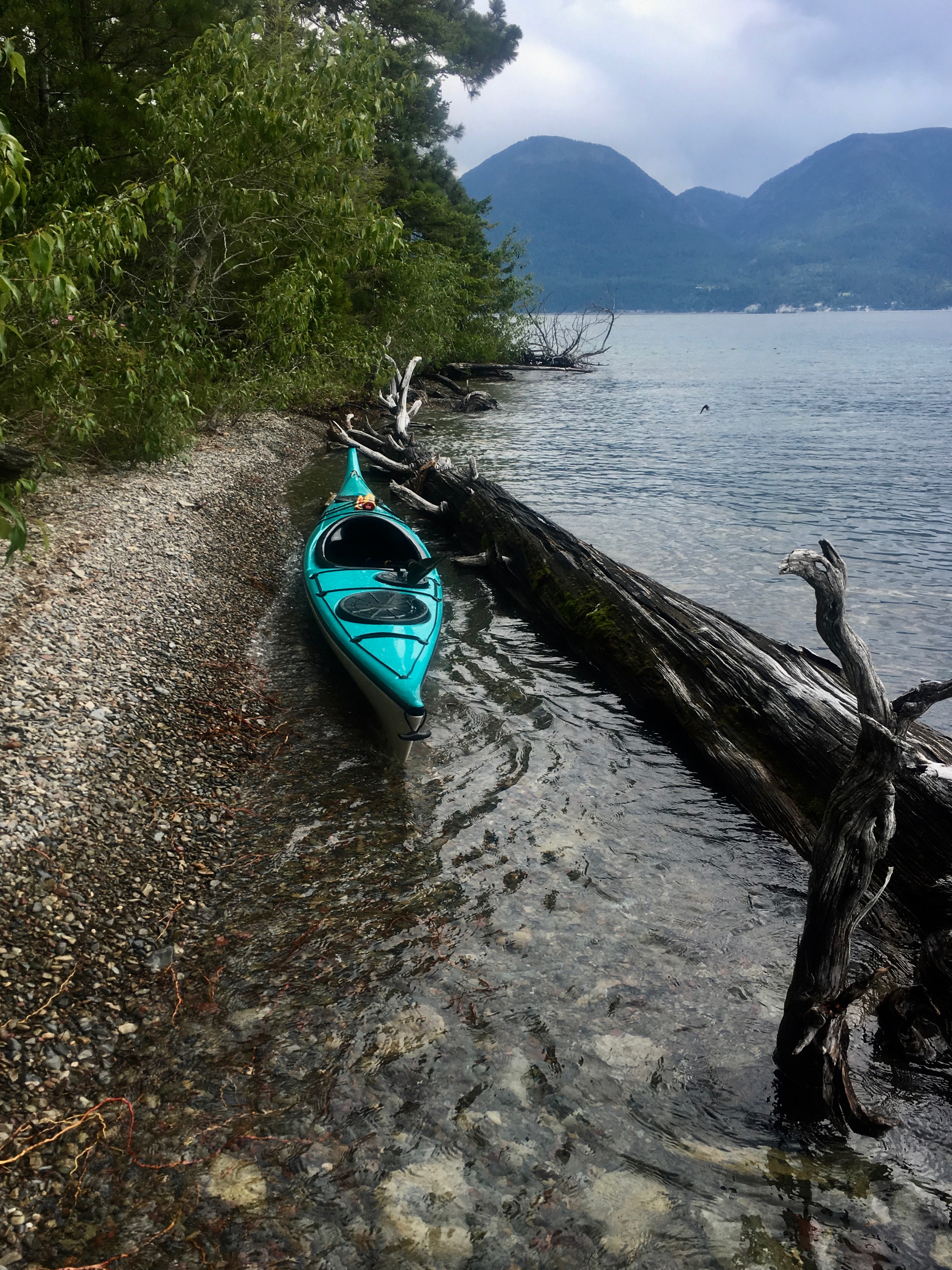
After a couple of hours I returned to my boat, found the conditions acceptable and pushed off for Cedar. Not wanting to linger in the opening between islands, I paddled hard, found “the box” of strong, smooth strokes and made very good time despite the headwind that eventually petered out. I dragged Bluebird up over the top of this year’s gray logs and began to imagine how I would arrange my camp and set up a place to make tea the next morning. Almost immediately a bald-faced hornet bit me on my left forearm and then proceeded to wedge itself between my watchband and wrist where it nailed me hard. It took several tries to dislodge the hornet and figure out why I had offended the beast. I stood still and looked around. I had unknowingly crossed the incoming flight path of these critters. They had built a nest under a log and wanted nothing between them and their entryway and escape route. Again, I had to back off my intentions. Yielding to hornets, I moved the boat a few feet north and chose a different route to the wind shelter where I would set up my whisper light stove. Fortunately, I am not allergic to these bites, but it was a long time before I could shake the sting that made my hair stand on end.

During the evening I wandered around the island, found desiccated cherries on the trees of the old orchard, a spot where a falling tree crushed the fence around the old wildlife enclosure, visited with a friendly blended family that had come up the lake by powerboat from Whiskey Bay. Toward dusk I found the almost unknown public access at Zelezney Bay and followed a water snake making its way to shore. Yes, I thought about our fragile island home and this island, deeply in need of rain. But now I think about how we sometimes have to abandon our plans and intentions in order to live with the world as we find it. We are no match for the force of the weather, not even for a hornet determined to protect its approach to this season’s home. In both cases willfulness would have meant trouble. Probably a better observation than the sermon I had planned.

DSCF0224


A Quandary

DSCF0184 Sometimes I paddle alone and sometimes with other people. When alone I like being able to focus my attention on the inner and outer worlds without concern for other people and their experience. When I paddle with friends I take pleasure in helping them discover a new bay or cove, or having the comfort of their presence when making a long crossing. But the two truths create a quandary.

I recently paddled twice in one week, once alone, once with a friend. The juxtaposition clarifies the quandary. In the first case I had a few hours at the end of a day to dash up to a small, nearby lake. Launching from a state campground, I pushed off while most people were settling into lawn chairs, beginning to prepare the evening meal, or as young people, told to entertain themselves, carried their hopes out to a dock to cast a line. I left the crowd and quickly found my way to the corner of an estuary where a mated pair of loons escorted their single offspring beyond the reach of predators and ski boats. The long necks of trumpeter swans stood above the reeds like goal posts, and by averting my eyes and laying down my paddle, I was able to put them at ease until they slipped off the bank and glided into the water. Then, beyond the mouth of the river and past willows full of warblers and flycatchers I was able to catch site of a doe leading her fawn into the lake for an evening’s dessert of water lilies. Alone, I was able to quietly approach wild creatures and slip past their wariness.

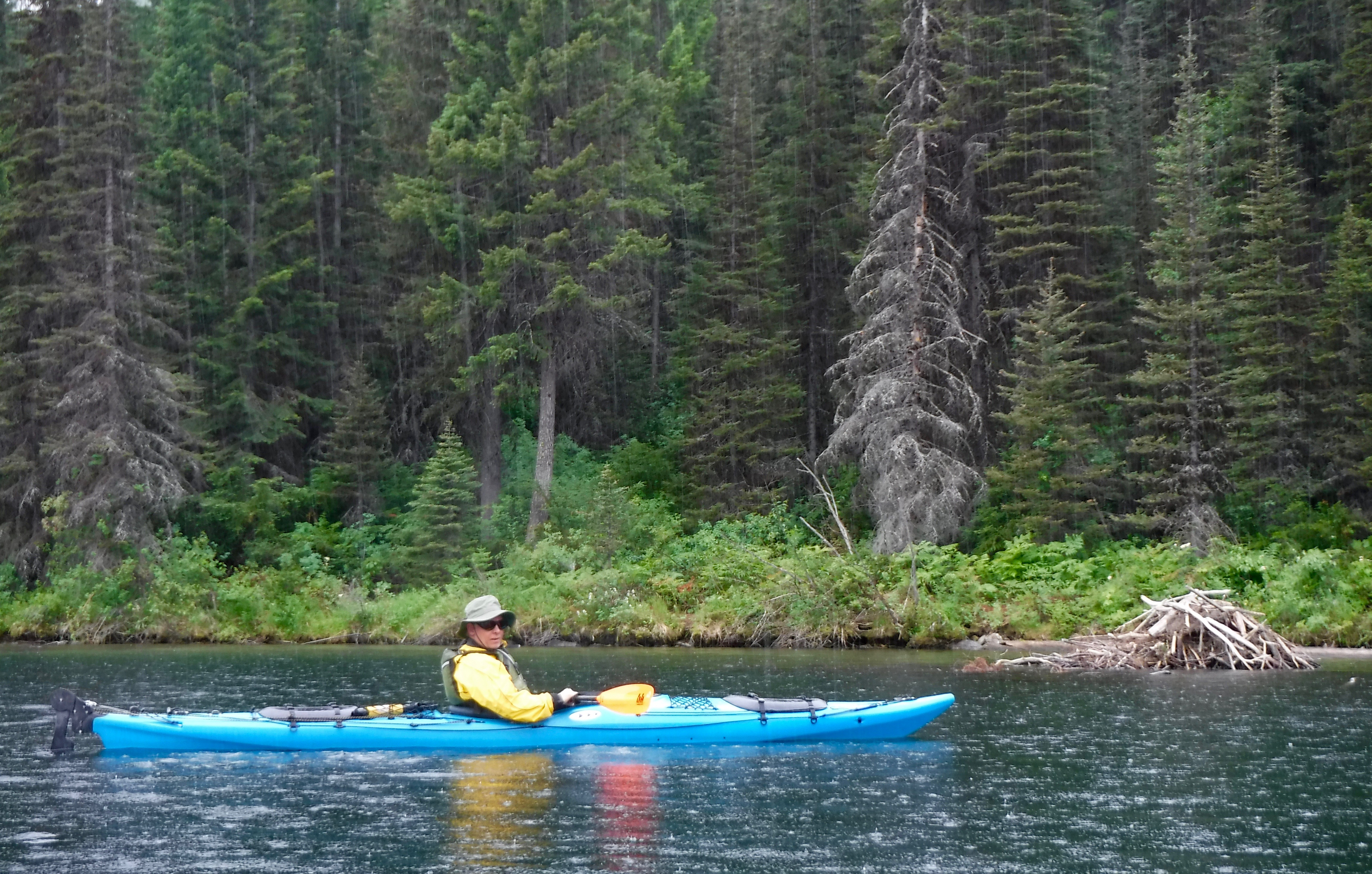
Later in the week I traveled with a friend to a different lake. Somewhat practiced at the ritual, and grateful for it, we helped each other with the loading and unloading of the boats, reminded each other about car keys and paddle floats. It was a pleasure to show him a hidden trailhead, an overgrown campsite, the way into a river mouth. Early in the paddle he pointed out a beaver lodge I might have missed, and together, we laughed at how the beavers saw fit to decorate their lodge with a crowning piece of green slate. Late in the paddle we approached a bald eagle and enjoyed watching it bend its bright white head around a branch so as to keep us in view. On the way home we pulled into a ramshackle ice cream station and enjoyed sweet treats at a picnic table. At the same time, drawn to conversation, I missed being able to pause and adequately consider the way rain drops, after they splash to the surface of the lake, create a bubble on the black surface, a metaphoric reminder that each of us is little more than a short-lived and bright bubble of awareness on a dark sea. Wanting to stay present to my friend’s experience I risked losing aspects of my own. Hence, the quandary.

At this stage of my life I know better than to resolve the tension too easily. I want neither to abandon the artist’s solitary way, nor will I cut myself off from the necessary stimulation and benefit of learning from others. People who are artistically inclined are often radically open to the world and how it registers in consciousness while at the same time being sensitive to others. It is not easy to maintain awareness of both simultaneously. Therefore, artists must continually navigate the tension. We strive to experience all we can and render it in words or paint or pixels, moving alone through the world where the perceptions are sharp, clear and undivided; at other times we carry on this practice the best we can in the company of other people without whom we would miss some of what the world calls to us to see. I know no other way than to paddle somewhere between the near point of solitude and the distant point of community.

DSCF0191

Finally, Close to Painted Rocks

Every time I go to the lake I am aware that I am passing through land that belongs to The Flathead Nation, the Salish, Kootenai and Pend Oreille peoples. This is not my land; it is theirs. Their roots in this landscape reach into the ground of at least 7,000 years of history and their stories reach back to a time before that. As I travel to the lake and pass over its waters, I wish I had a way of making a deeper connection with the people of this place. In an effort to make contact with the history of these people I have tried many times to approach Painted Rocks, a pictograph site on the west shore of the lake. Whether I am paddling north or south I often find that the waves in this area of the lake seem to be focused on the cliff where these red markings can be found. In these conditions waves bounce off the cliff at odd angles and create a complicated, chaotic sea. Or, even if the waves are calm, wakes from passing boats make this a somewhat hazardous place for a kayaker to slip the paddle under a deck line to pause and wonder.

IMG_2717

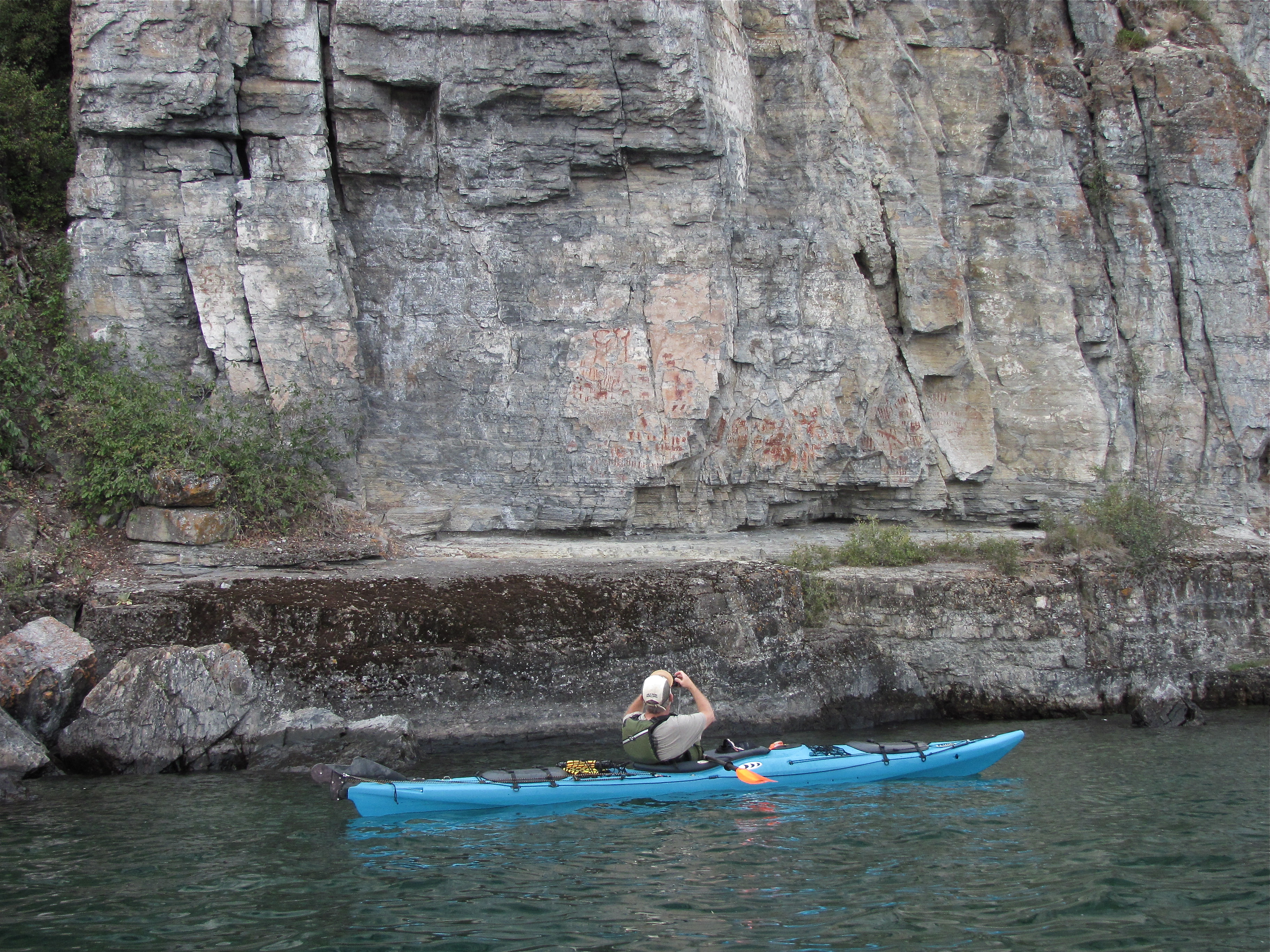
One Monday evening, however, when a friend and I had made arrangements to camp on Cedar Island, just south of the cliffs, the lake was so calm that we could safely approach the cliffs and their enigmatic markings. We were able to touch the wet dark rock under the limestone cliffs overhead and look as long as we pleased.

IMG_2695

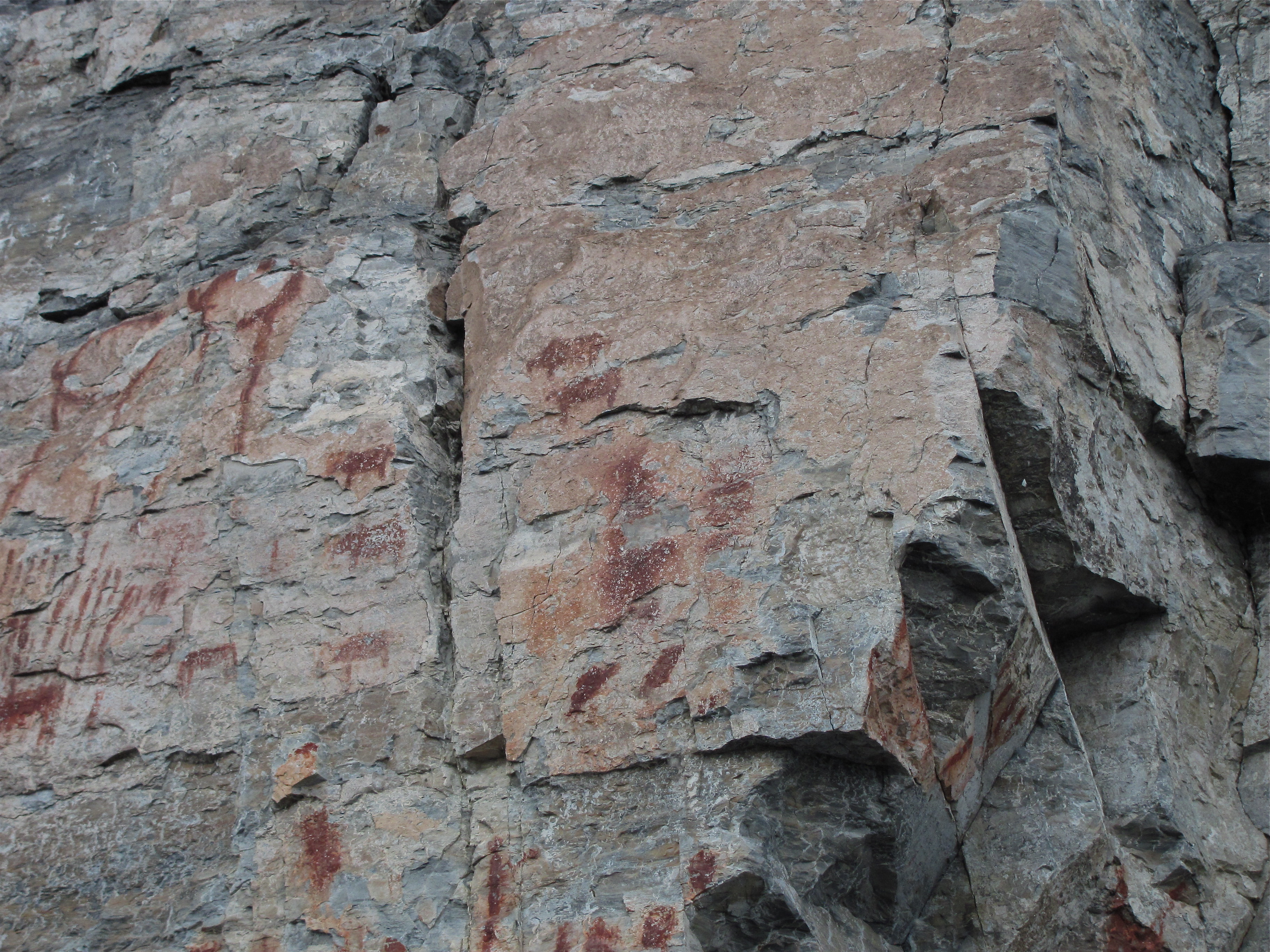
To untrained eyes it appears as if the cliff bears depictions of bison, perhaps bison headdresses, and tick marks, possibly indicating kills or visits to this site. A book by Sally Thompson, the Kootenai Culture Committee and the Pikunni Traditional Association, People Before the Park, makes very clear that bison were “real food” to the Kootenai. Despite the risks, they made seasonal treks over the mountains into bison country east of the Divide to obtain the kind of protein that would sustain them through long winters west of the mountains. No wonder bison appear on these walls.

IMG_2698

Thanks again to Sally Thompson, an anthropologist and ethnographer, I was directed to Legends from the Northern Rockies by Ella Clark. The book contains stories related to this area and a Kootenai story about Painted Rocks in particular. For anyone curious about this area and the deep memories of its original inhabitants, this story may be meaningful. Amazingly, it recognizes a time before and after the geological cataclysm of what we call Glacial Lake Missoula. I especially enjoy the humor in the characterization of Rabbit. In Clark’s words:

This myth about them (Painted Rocks) was recorded from William Gingrass. His Kutenai name, given him by his great-grand-mother, means “Grizzly Bear War Paint.”

 After the great flood long ago, no human beings were left in this country. But the spirits were left. Some of them were in the form of animals. They gathered together on a bench of land above where Flathead Lake is now. At that time there was no lake—just a big river coming down from the north. It wound around and flowed down through where the Hot Springs are now. All that country was under water; you can see the water marks yet on the east side of the Lone Pine country. A little stream flowed at the south end of the present lake. A long time after this story, Yawonick, something that lives down below the water, came up from the bottom of the river and changed its course. Then the lake was formed.

When the great flood went down, the spirits held a council there on the shelf above the old river. They had heard that new people were coming, and they knew they should decide what to do when the Indians arrived. While they talked, one spirit kept watch.

“The people will come in canoes from the north,” said the chief of the spirits. “We must have everything decided when they come, as to how we can help them. Each of you will have to have a special song that will help people. You will sing it and then put your picture or your name on these big rocks.”

“But why should we put them up here?” asked on spirit. “They will be so high that they will be hard to get to or even to see.”

“That is what we want,” replied Nupeeka, the chief of the spirits. Nupeeka means “spirit”; in the old days he was a kind of teacher also. “We want the people to go to the high places when they seek spirit power. Seeking power will be too easy if they can find it in the low places. They will have to climb to get to the spirit pictures and the writing in the high places.”

So the spirits sang their songs and painted their names in pictures on the rocks. The first Dawn of the Morning sang the first song and put his sign highest up on the rock; that spirit gave the strongest power. The spirits of Grizzly Bear and Cougar and Eagle—they sang their songs and painted their pictures. Each of them gives strong power. All the other spirits sang their songs and put their writing on the rocks—all except Rabbit. He just hopped around.

At last the lookout called, “We must end our meeting. I see the new people coming around the bend.”

“But I haven’t made up my song yet!” exclaimed Rabbit. “I haven’t a song yet and I haven’t painted my picture.”

“It’s too late now,” the other spirits told him. “The people are landing below the Painted Rock.”

So Rabbit was left out entirely. He has no power song. He gives no power to people seeking spirit power. He can do nothing but hop around.

The new people landed below the Painted Rocks, near where Rollins is now, in the Big Lodge country. It is called the Big Lodge country because of a vision two men had many years ago. Each of them saw in a vision where he should put up a lodge for a Sun Dance, for a sacrifice to the spirits. When they followed their dream, they came to the same place; each had seen the same spot in his vision. So they put one big lodge there for the two groups of people.

The harder a person had to work to get to the place for the power quest, the higher the spirit power he obtained. The spirit who appeared to a person in a vision recorded on the rocks how many days and nights he had been there and what power had been given him (149-151).

IMG_2699

Like first peoples, I, too, have had to work to get close to Painted Rocks, to the deep history the site depicts and to the long, almost geological memory of the people or spirits who left their marks here, recording and celebrating a time even before the lake.