When Things Are No Longer New

I was determined to go paddling before the thermometer popped the 100-degree mark, before fires grew worse and the air became unhealthy from fires to the west and south. Having paddled in honor of my mother in May, and having introduced one of my granddaughters to the lake and its largest island in June, I wanted to paddle within myself in July, returning to places that are no longer new.

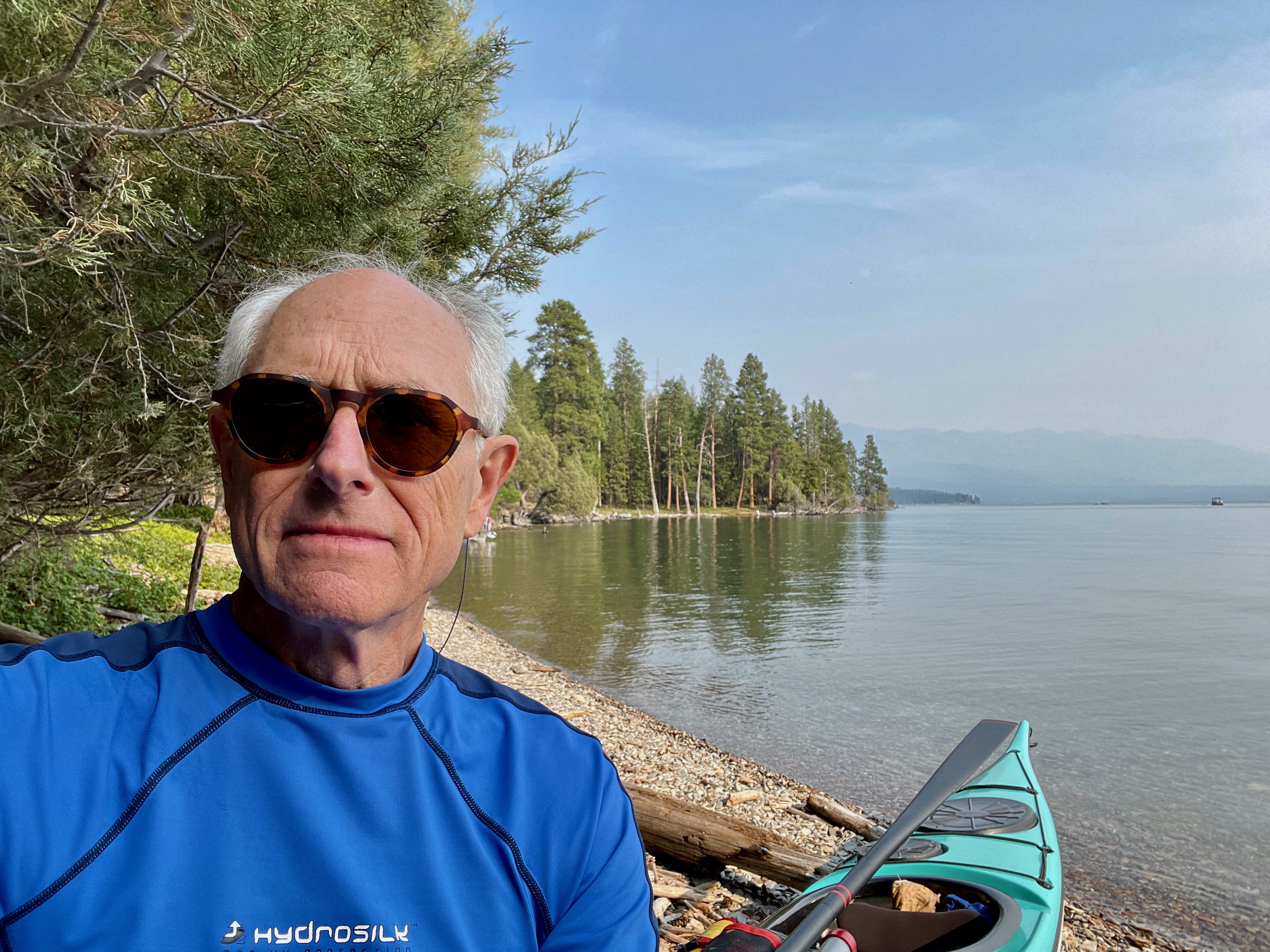
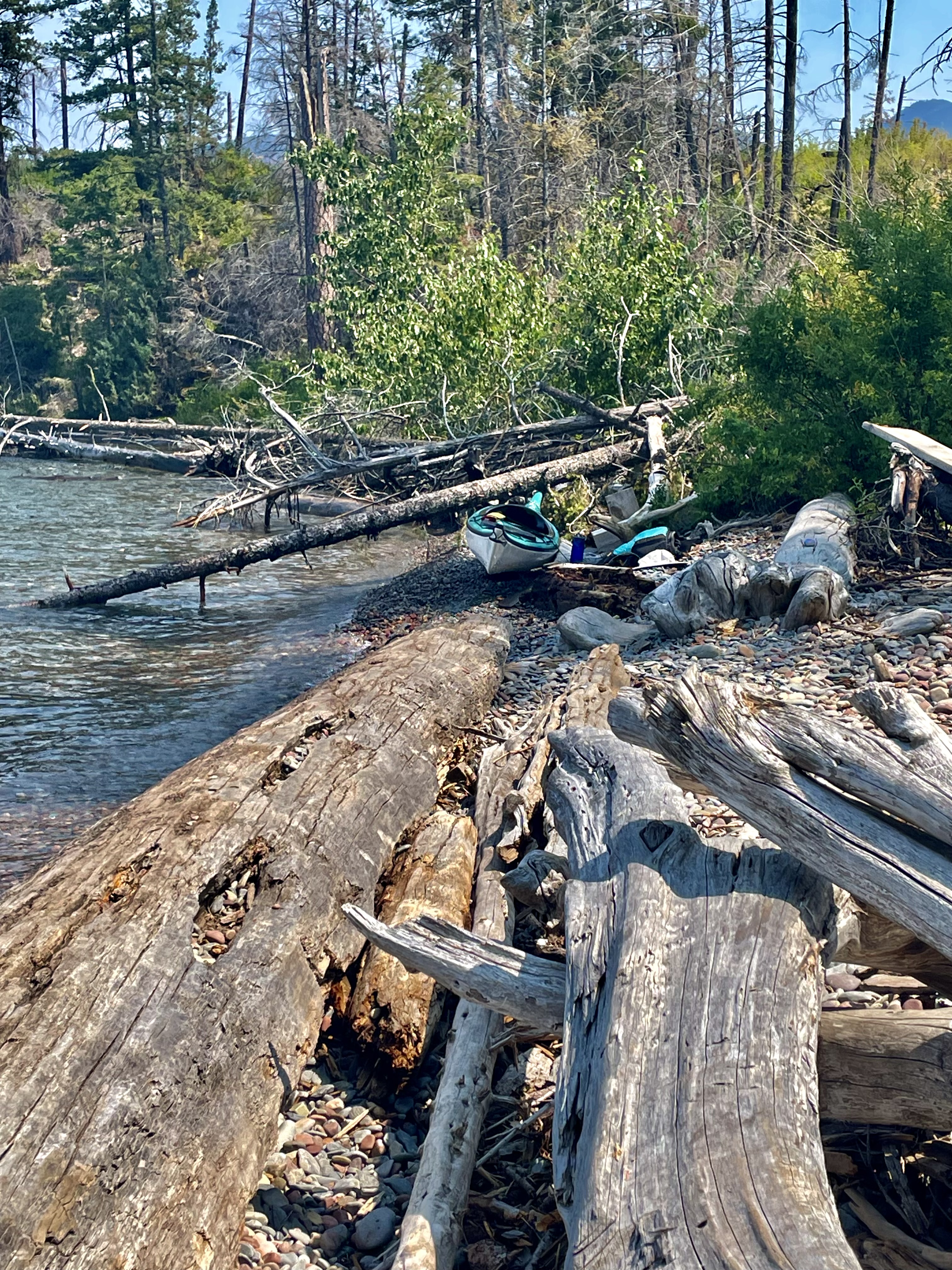
With the smoke in a blue-gray band above me, I stroked out of the marina at Finley Point, made a right turn and headed for Bird Island.  I quickly fell into that beautiful rhythm of harmonious breathing timed to the pace of my strokes. Though I have made this paddle countless times, something about the island was different. Through the haze I could see that Montana’s Fish, Wildlife and Parks had installed a solar toilet near the south end of the island, above the beach where many people come ashore. I applaud their decision to reduce waste on the fragile island. Continuing north I saw the black blocks of stone that mark the entrance to one of my favorite coves near the opposite tip of the island. Rounding this angular corner I saw a cove I hardly recognized. Instead of a little bay with an incredible view and an accommodating beach, this half circle of shelter was choked with logs that had washed down from the north, trees that had fallen since the island burned, a massive, bleached post, and lots of lumber ripped from docks, nails in the air. There was barely enough room to slide my kayak into a secure position while I walked over the debris and dove into the water from one of the blocks of stone.
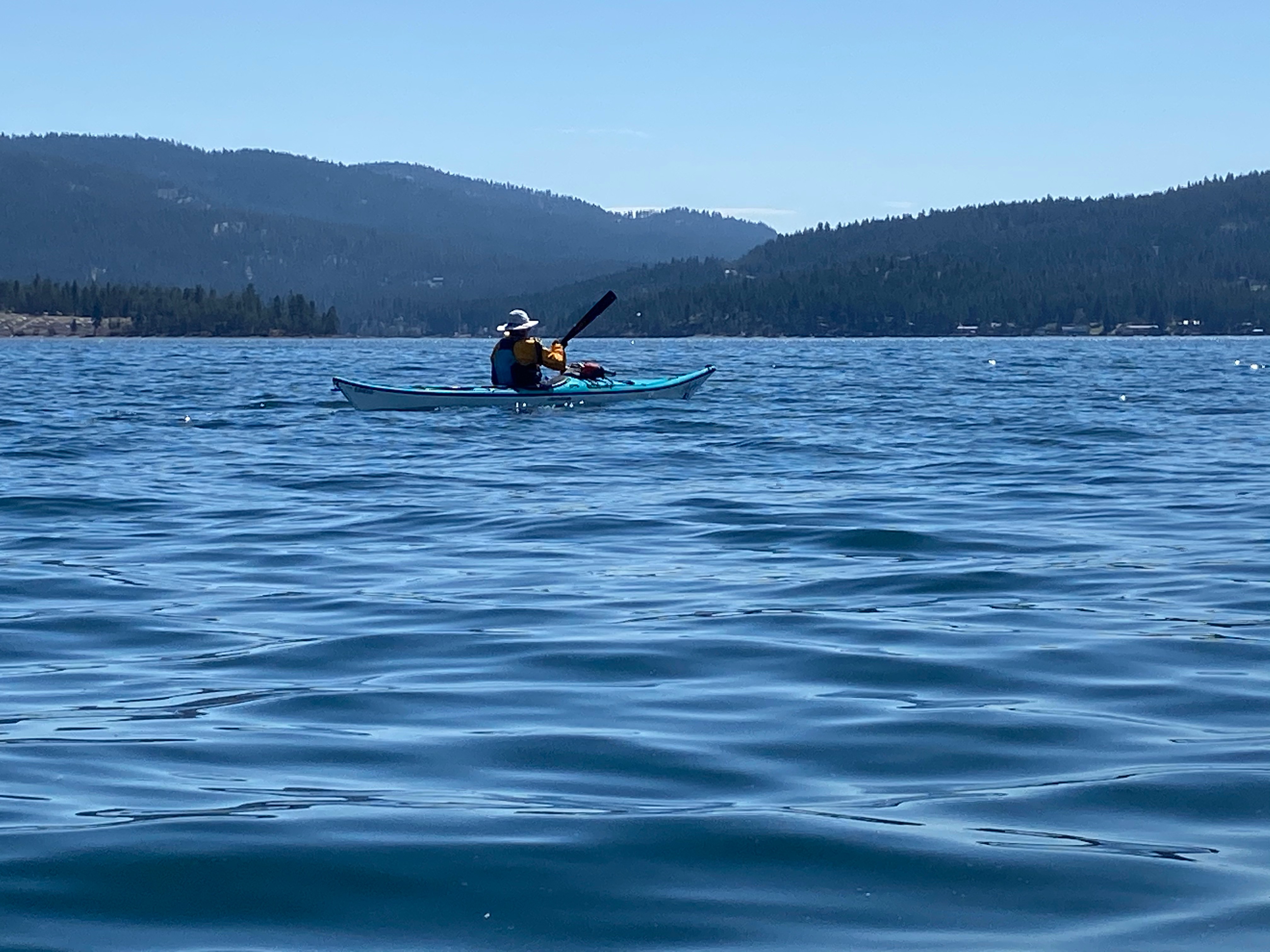
Refreshed by my plunge and a little hungry, I ate a peanut butter and jelly sandwich and a couple of delicious rolls of baklava left over from a party we attended Sunday night. Since the lake was calm and with no change in the forecast, I decided to try something I had never done before—paddle from Bird Island across the width of the lake to Wild Horse Island. As often as I have paddled to Wild Horse, I had never made this eight-mile crossing. I drank half a water bottle charged with electrolytes and settled into a sustainable pace. In the thick haze it was hard to pick a target that would keep me moving in a straight line, but I aimed for a faint wedge of shade on the northeast corner of the island.

The miles seemed to fly by as I concentrated on rhythmic strokes. In mid-July the surface of the lake is usually clean; pollen has settled onto the bottom and tree roots and branches have come ashore. But this year the surface of the lake was covered with a yellow substance that I first thought was pollen, but then realized was dried algae. Throughout the crossing I made small adjustments to my course to avoid floating woody debris, branches, roots and bark. Eventually, it dawned on me that this year’s high lake level had lifted material from beaches and riverbanks across the watershed and set it in circulation. This was a different lake surface.

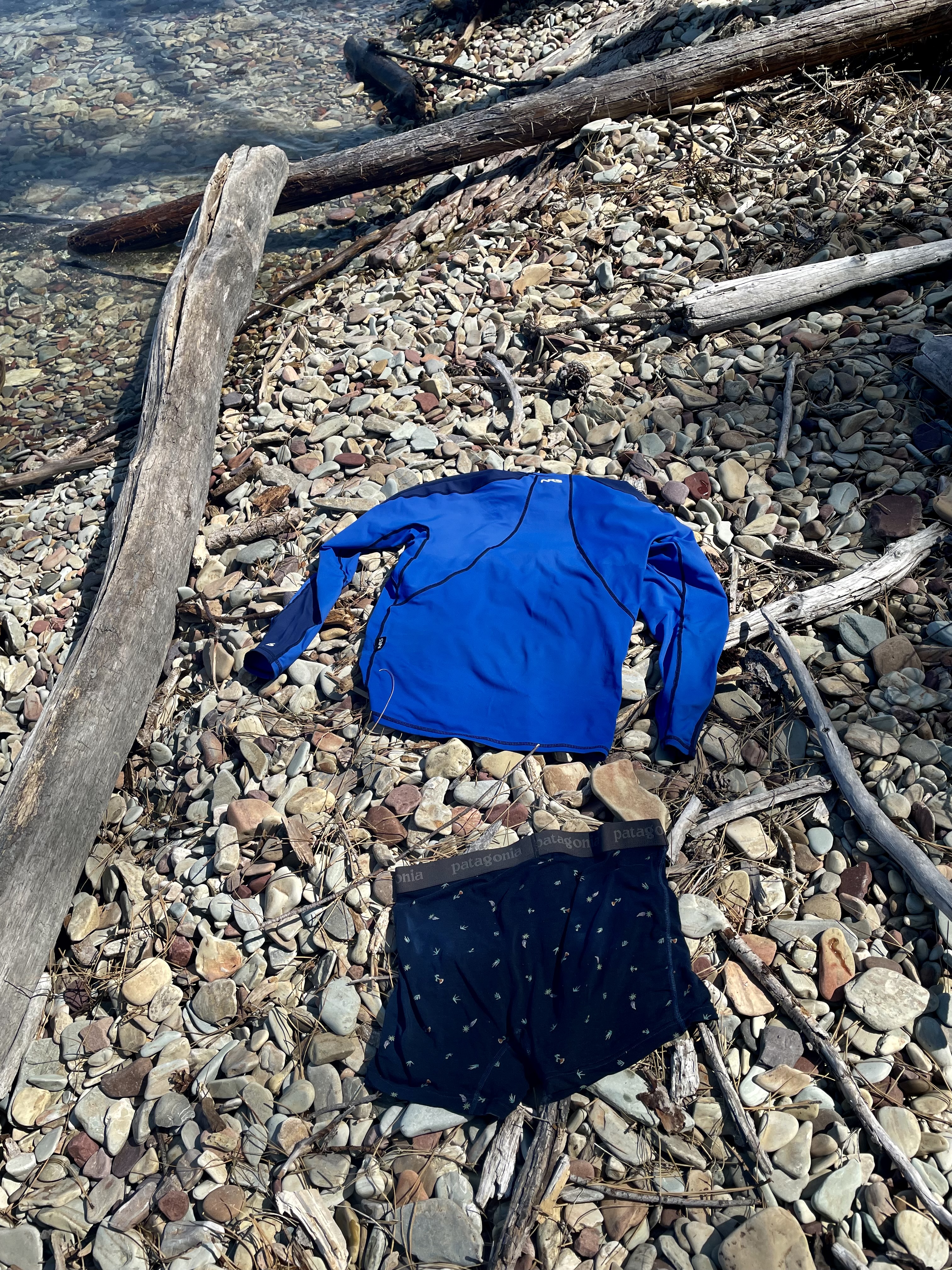
When I finally landed in a small indent on the east shore, I was sweaty from the effort. Not hearing the sound of boats and their engines, I stripped my clothes, left them to dry on hot stones and made a few breaststrokes out into the viridian. I thought to myself, all of us should swim naked more often and not leave this experience to children exploring water for the first time.
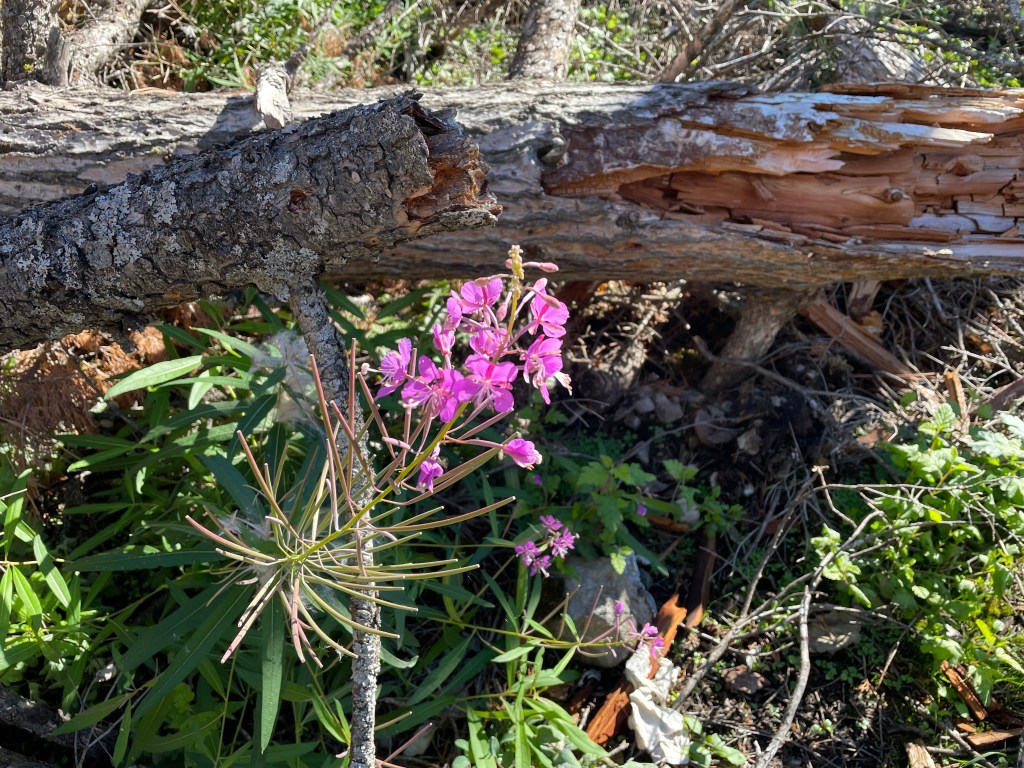
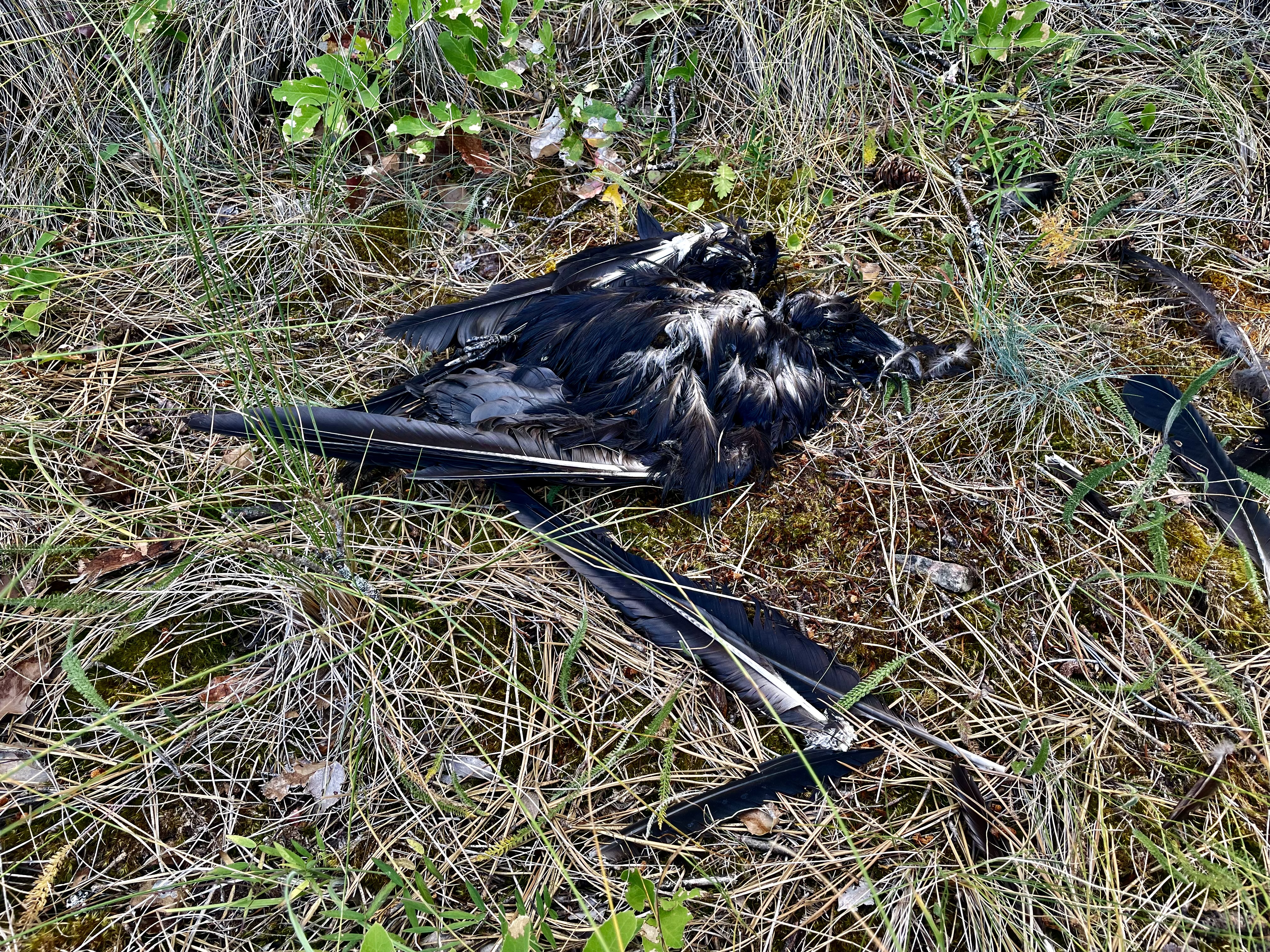
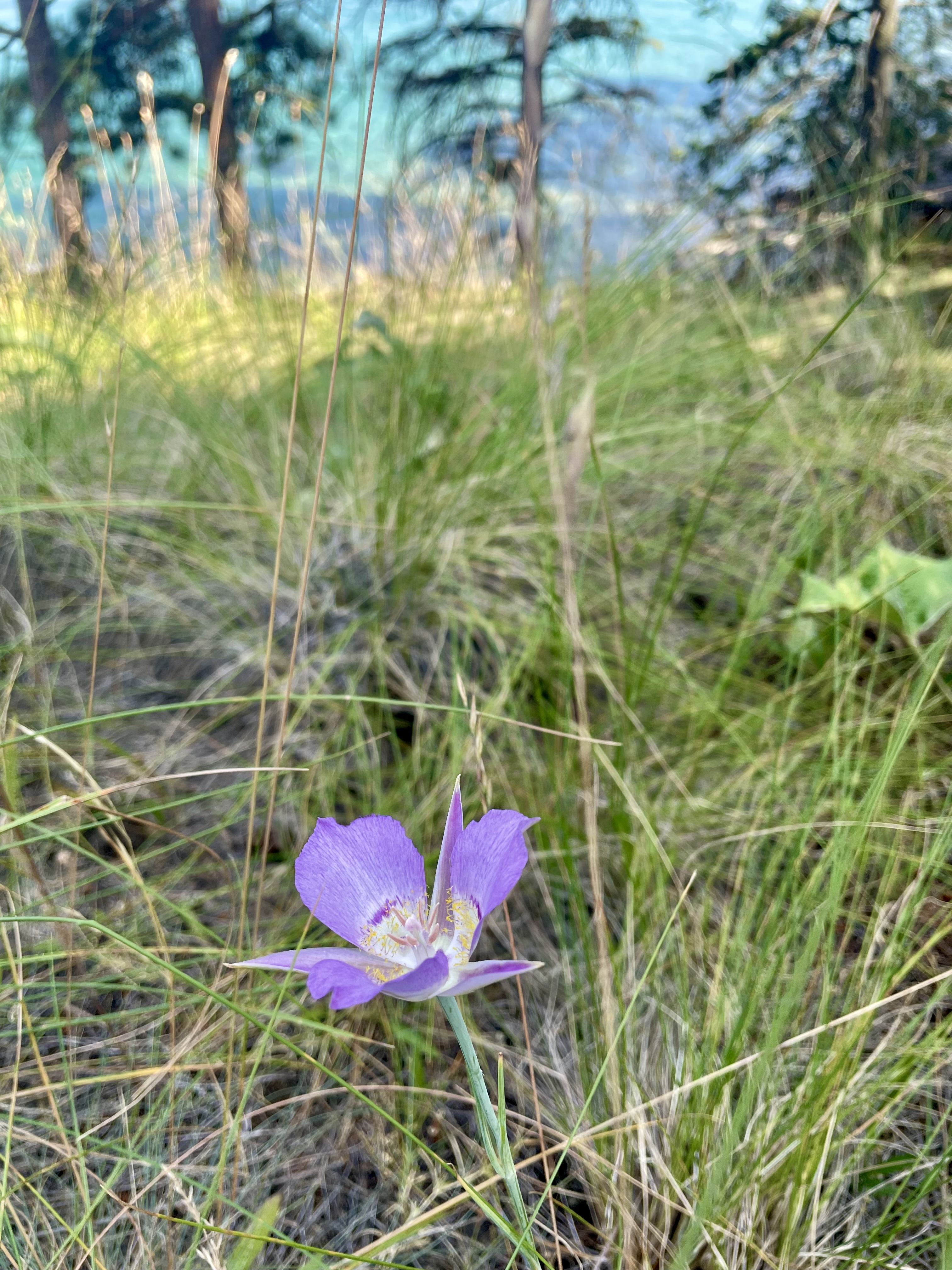
Curious about this part of the island, I dressed again and began to explore the forest above the narrow beach. I found a premier pink Mariposa lily. Having once found several white ones, I regretted having once mislabeled this plant as a sago. I also found a dead raven. Though I could not be sure–since the breast of the bird had not been consumed—I wondered if the big black bird had been knocked out of the sky by the fist of an eagle.
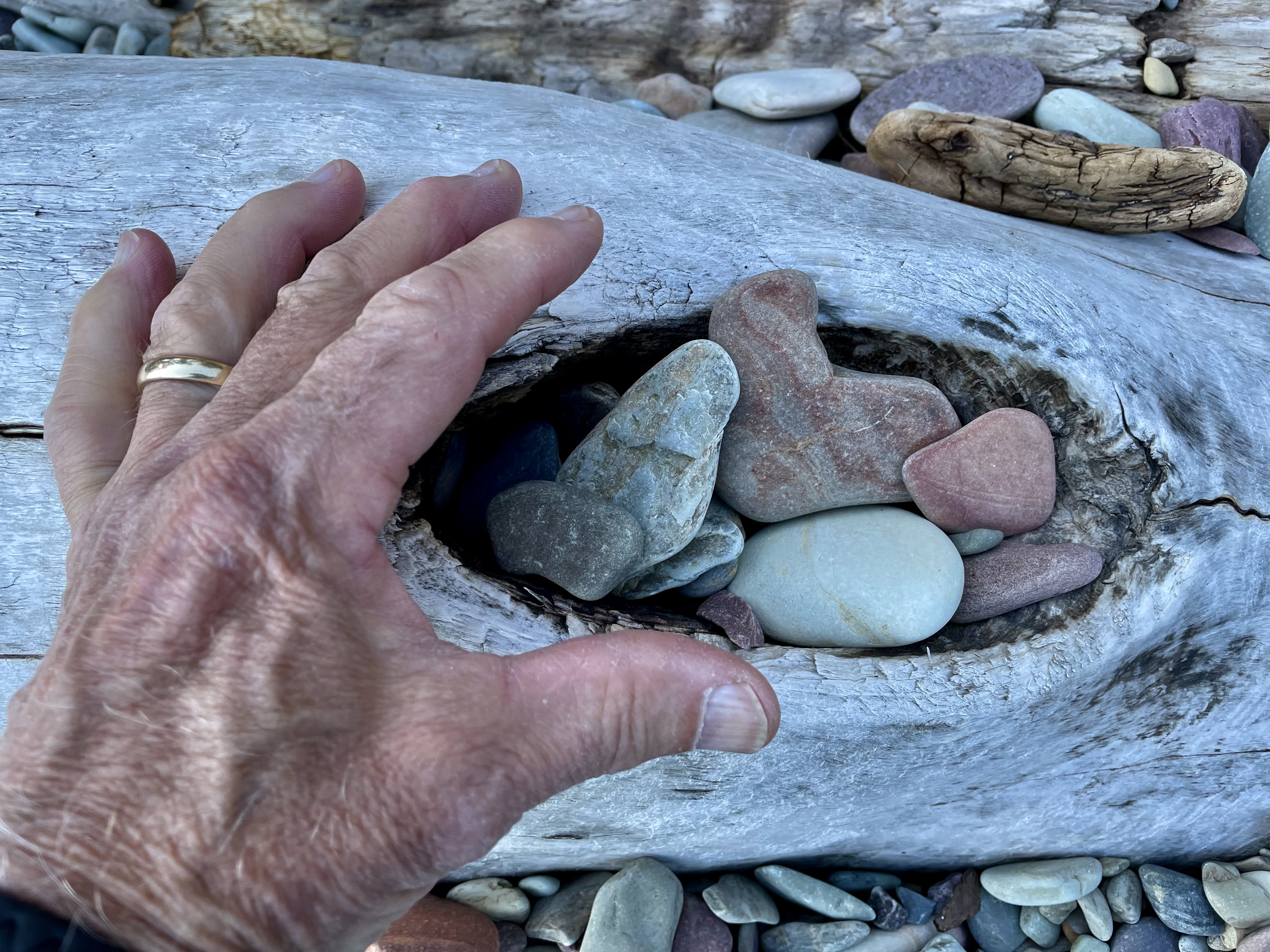
Back at the beach I found half of a broken stone that because of its color and dimensions reminded me of a cookie, but then found its other half in another location. I tested the fit and found it perfect. I think I have an eye for cookies. Together the stones reminded me of the ancient Jewish practice of cutting a covenant or the practice in English jurisprudence of cutting a contract. Once again, I realized that a familiar place seen with fresh eyes can be full of discoveries.

I returned to Bluebird, ate a wedge of my favorite Manchego cheese, salty crackers and the last of my baklava. In planning my return to Finley Point I decided to paddle down the east shore, cross to Matterhorn Point, then Black Point, the east side of the unnamed island in The Narrows, then cross to the last spindly cottonwood marking the mouth of the marina at Finley campground. This route would give me a brief period of shade every time I passed a point or island. In the heat of late afternoon I craved shade. I added sunscreen, filtered another bottle of water, ate a dried apricot or two, and settled into the next leg of my journey.

When I finally landed at the concrete boat ramp at the marina a woman came rushing up to me.

            “Was that you way out in the middle of the lake? We watched you come across.

            “Yes,” was all I managed to say, tired from almost 27 miles of paddling and not quite ready for human interaction after seven hours of solitude.

            Strangely eager, she asked, “Would you like some help lifting the boat out of the water?”

            Never before had I accepted such help, but conscious of many new things in a place that has become familiar, I stretched myself and said, “Sure. That would be wonderful, but we need to set the boat on the grass so I can unload my emergency gear.”

This friendly and strong woman seemed to enjoy offering this assistance and I confess to being grateful for her help. After we set the boat away from the concrete she said, “My husband and his friend will come over and help you lift your boat onto the saddles of the rack.” Not quite at ease with this change in myself, I simply said, “Great.”

I piled wet gear, emergency bag, phone in its Pelican case, and first aid supplies in the bed of the truck. Turning around I saw two guys coming toward me asking for directions. One carried my Greenland paddle that I had tossed on the grass. The other lifted the bow into the back saddle and helped me slide the boat forward into place. It was a joy to have help. This was as much a discovery as the changes to my favorite cove, the pink lily and the raven. All that was new was beginning to find a place in a life I know by heart.
Dear Mom,

Yesterday I was able to make my memorial paddle in your honor, a paddle I try to make each year between Mother’s Day and your death day in late May, now fourteen years ago.  When weather and time permit, I like to make this almost-annual paddle out to Wild Horse Island on Flathead Lake, a place you always wanted to see; yet for health reasons, this visit remained an unfulfilled desire. I would like to tell you about the experience in the simply human hope that our separate worlds might touch in some way, perhaps as gently as two twigs on a cherry tree. I am still writing you an occasional letter.

When I arrived at my launch site, wind poured off the Mission Mountains and ran through the strait between Melita and the big island. Conditions were brisk but safe. After crossing the strait, I approached the island and paused to watch a couple of Bighorn ewes nibbling on fresh plants and bending to the water to drink. They were so shaggy in the remnants of their winter coats that I could not tell if they had delivered their lambs.

After paddling up the west shore of Wild Horse I rounded the point and dropped into placid conditions in Skeeko Bay. After pulling my boat onto some driftwood and out of reach of rising water, I began to hike up the trail to the saddle. I was astonished by the quiet. In the first few hundred yards I heard one meadowlark and the wings of a robin. At the saddle I turned left onto what Fish, Wildlife and Parks calls “The Heritage Trail,” a path leading to some of the last signs of a brief agricultural presence on the island. Not far along I found the horses for which the island is named, but I did not approach. One of the horses swayed in an odd fashion. As the horse was not under stress, it may have been ill.

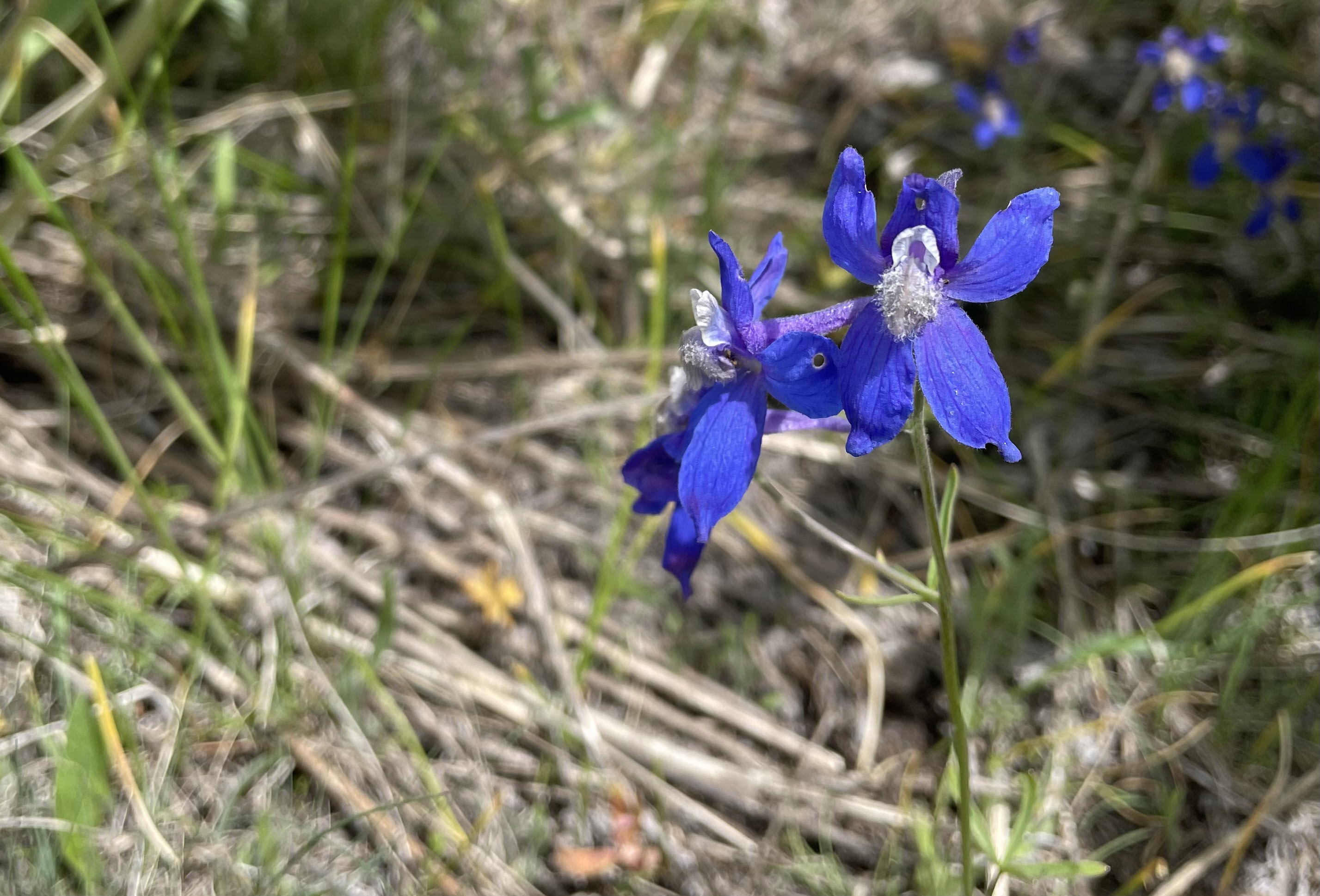
After I gained some elevation, I chose my own path through tall grasses along the edge between meadow and forest, hoping to find an animal trail and see a greater variety of flowers. As I walked along, I picked you an imaginary bouquet. As there are no rhododendrons and roses like you grew when you lived in in the Seattle area, I found the spring blossoms of the mountain west—arrowleaf balsamroot, larkspur, lupine, long-plumed avens, camas and the occasional shooting stars on the north-facing slope and forest edge. Near the top of the island I sat down and dangled my legs over a cliff. I had a perfect vantage point to look for more Bighorn sheep if they came into the small clearing far below, but they were elsewhere and not on the move. I ate my lunch and listened to the wind.

On the way down and back toward Bluebird I found scatterings of white bones in the spaces between tall clumps of fescue. On the island deer and sheep must simply die of old age as they are rarely pursued by predators like lions and bears who visit the island on occasion. Returning to the bay I gave a pair of eagles on a massive new nest a wide berth, hoping not to disturb them. I fear they may have nested in a location too frequently visited by humans and may not be able to bring their brood to the point of fledging.

Back at my boat I changed clothes for paddling in warmer conditions but knew I would face a strong headwind. I slipped back into the water grateful for the gift of my life, that I am still able to do these things at this late stage of my own life, and that I spent another day thinking about ways you taught me to appreciate the beauty of the world without ignoring its tragedies. In whatever way such a thing could come to you, I wish you a long slope of yellow flowers and the silence of birds on the glide. Love, Gary

Reasons to Celebrate

I sometimes ask myself, Why do I do this? Why drive 160 miles round trip to get wet, windblown or sunburned? Why burn about six gallons of gasoline at a time when we are warming the planet faster than it can absorb the carbon dioxide we produce? Why deal with the aggression on the highway of the big-truck crowd? Why do this when so many things demand attention at home, especially in October when we are trying to finish outdoor chores before winter slams the door on light and comfort?

Midway through my paddle out to and around Wild Horse Island I realized a couple of possible answers to my questions. On September 15, I tested positive for the Omicron variant of the Covid 19 virus. My case was relatively mild compared to others whose coughs linger for weeks, who lose taste and smell, who suffer lasting fatigue, or even die. Paddling against a north wind reminded me that I have recovered, that my body has restored itself to health. In the two-hour beat against the wind, without distraction and in the company only of my thoughts, I remembered something else. On a recent visit to see my youngest son and his family I told Kyle that getting older does not necessarily mean things get easier. He looked at me squarely as we hugged one last time at the airport and said, “Stay strong, Dad.” I think he was telling me, “Dad, I need you in the world. Stay active. Don’t leave too soon.” Perhaps I drove north and paddled north for these reasons—to celebrate the recovery of health and as part of the process of staying strong for those who need me in the world.

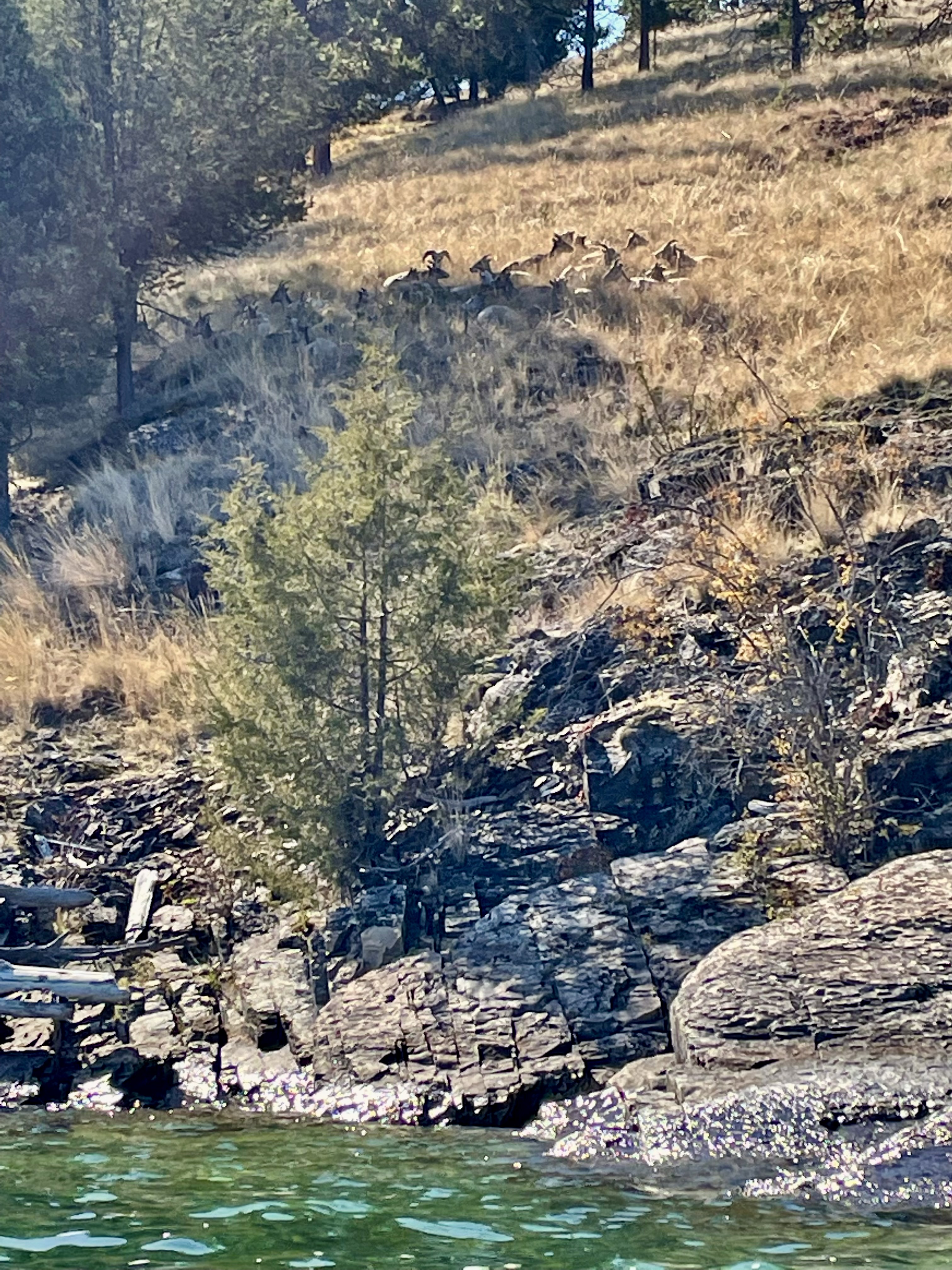
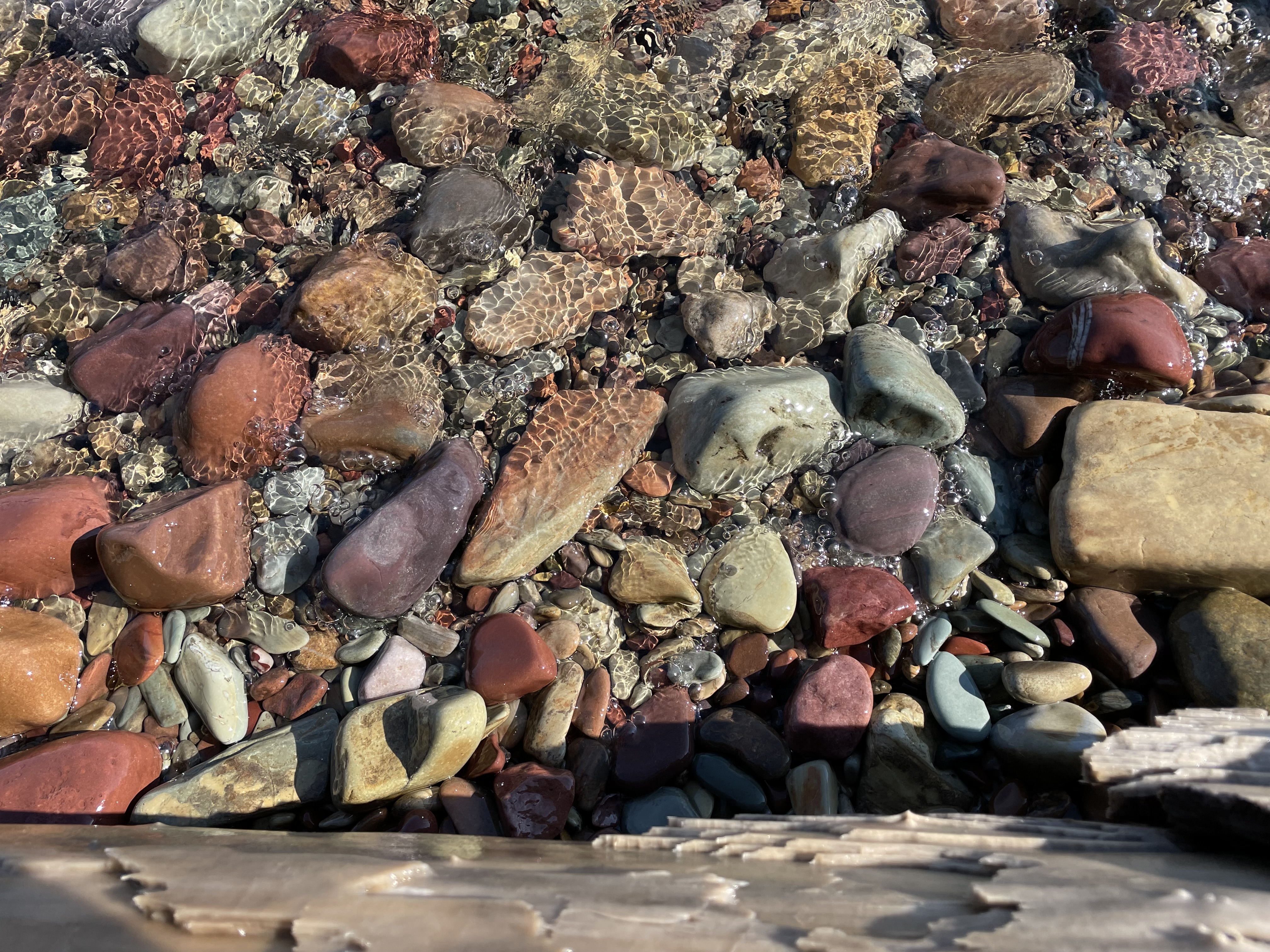
In my circumnavigation of the island I looked to Osprey Cove as a refuge where I hoped to rest and eat lunch, but the landing did not feel safe; waves had pushed the gravel into a steep and sliding slope. I backed out of the cove and headed south where I hoped to find a more protected place to land. I found such a spot at the East Shore access to the island. I got out of Bluebird without spilling and wedged the boat between two drift logs. Thanks to my beloved I enjoyed a massive and spicy Beach Boy sandwich from Tagliare and Smyrna figs. After lunch I wandered the shoreline, climbed into the dry grasses and yarrow. Along the way I discovered a Big Horn sheep skeleton, bleached and barren. I took time, too, to marvel at the clear water of October, all the sediments and pollen settled out. At this point in the season the water seemed like a pure distillation. Once back in my boat I continued south, avoiding the ramps of stone along the shore because the reflected energy of waves created rougher conditions a few yards off shore. When I saw sheep resting in the shade of a pine tree, however, I could not resist approaching for a photo. I rarely see these animals in the open. This was their time to build reserves before winter makes life more difficult.

At the south end of the island I turned west and enjoyed several miles of assisted paddling as wind and waves nudged me from behind. In the face of things I felt I should do, I left home, but returned feeling as though my body had been washed clean as October gravel near shore. The lake offered an image to the imagination. This is something to celebrate.

Thank You

Thank you for the end of September.

Thank you for light among the stones.

Thank you for a clear blue sky and calm water after the smoke and trouble of summer.

Thank you for flocks of geese passing overhead.

Thank you that many smooth strokes lead to miles of exploration.

Thank you for green and blue depths.

Thank you for the lone cormorant and for the loon calling invisibly from the shadows.

Thank you for little swell waves from yesterday’s wind.

Thank you for proof that fire releases nutrients which awaken a succession of plants that will eventually lead to a new forest.

Thank you for the man in silhouette who reads calmly on his dock next to his wet and happy dog.

Thank you for a campground that is quiet after many people have gone home.

Thank you for a faint, waning moon in the west that drifts down like a white feather.

Thank you for how the lake stores summer’s heat and slowly releases it through the fall, a safer season to paddle than spring.

Thank you for time, for life after responsibility, for freedom to go.

Thank you for oatmeal raisin cookies on the counter when I return.

End of Summer?

July 29, 2021

We are still trying to bear up under the heat dome that produced temperatures in the 90s, and occasionally the 100s, and a pall of smoke from fires all around us. One cannot help but wonder if 2021 will be the end of summer as we know it, historically the season of recovery for us who live in northern latitudes, the season of leisure and lounging near the water. We need these three months and it now seems as though our actions across the globe will take them from us. Though I read hungrily in this field, I do not know how we will manage the necessary transition in time.

With company at the house and plans for a dinner deck party for friends visiting from Iowa, I decided to go paddling. Aware of a host’s proper duties, I had abandoned my plans until I saw a radar image showing powerful thunderstorms sliding west to east across the lake early in the morning. Anticipating a slight cooling effect and perhaps cleaner air, I loaded Bluebird mid-morning and packed the truck for a day on the water. When a big truck passed me on a straightaway and rainwater sprayed across the road and into the air, I knew I’d made the right decision. One can stand only so many deck parties.

When I arrived at Finley Point State Park the campground was unusually quiet. I suspect people slept in after enjoying the sound of rain on the roofs of RVs. Knowing I had the whole day, I took my time to prepare for being on the water. It was hot enough that I changed into my bathing suit. Because planning reduces anxiety, I took time to carefully stow truck keys, phone, and emergency contact information. I also planned to have food and water readily available for a long paddle from the state park to Wild Horse Island. Fortunately, conditions were perfect for a paddle of slightly over 20 miles—variable winds, waves less than a foot, water like liquid mercury.

This would be my first long paddle using the Greenland style “Kalleq” paddle. The catch of the blade is noticeably easier on my less-than-perfect left arm. As the miles slid under me I sensed that the design of this paddle allows for hours of strokes without strain. I soon rounded Black Point with all its security cameras, crossed the gap north of Cat and Taylor bays and pulled into the rocky shelter at the tip of Rocky Point where I stood in the shallows for a few minutes to grant hamstrings a reprieve. I got back in the boat and reminded myself to be patient with the four-mile crossing to the Wild Horse.

I aimed for a dense cluster of Ponderosa pines and a dock where friends spend part of their summer. After a long time in the deep blue, I felt glad for the green of the shallows. I took a few minutes to rest on the dock where I have permission to land, ate high-calorie food and pumped water back into my bottle. Heading back always seems easier than venturing forth, though the efforts are probably equivalent. In the mid-afternoon heat I decided to take a small detour to Bull Island where a swim seemed to be calling to me. Feeling charitable, I waved to jet skiers and pontoon boat captains when they waved to me and my quiet craft.

I pulled into the bay on the south side of the island buoyed by a host of memories—the memory of Joyce floating on her back in this bay, a memory of a friend who, taken for his first paddle in a kayak, fell out of my boat as he approached the shore and had to walk the last few yards to shore but seemed unfazed by water temperatures in May.

Wading ashore

I slid Buebird over some drift logs, shed skirt and PFD, stripped my sweat-soaked shirt, and dove into the warm water, warmer than any Flathead water I could remember—about 74 degrees. Though I sometimes keep my glasses on when going for a swim, this time I took them off because I wanted to immerse my head, dissolve the remnants of sunscreen and perspiration. It never felt so good. In fact, after coming ashore I turned around and dove in again.

Restored, I settled back into the boat for the last two miles home. This time I had to be a little more cautious. I was surrounded by pontoon boats and a vessel modified to produce a very large wake which allows people to surf the wave at the stern. Like an owl, I kept rotating my head so as to keep track of approaching waves, not wanting to be caught off guard.

When I finally pulled into the marina I passed a big dead fish floating over the boat ramp. I suspect the fish had died from the water’s high temperature. It seemed a troubling omen of days to come.

Taking the same time to organize gear for the drive home, I avoided the self-imposed pressure that goes with being in a hurry. In good time I slipped through the vale of smoke and traffic in town. When I pulled into the driveway I could not park near the garage, other cars having blocked my way. I carried Bluebird to its cradle and removed the wettest things from the bench seat in the back of the truck. I greeted friends on the deck, went back to the kitchen for a big bowl of chicken salad, and later, a huge helping of ricotta, blueberry and lemon cake with a massive mound of vanilla ice cream. As I returned to the deck the assembled women said, almost in unison, “Now that is more than a dollop.” Dollop must have been the word they used to signal their modest appetites for dessert. I ate the whole thing and soon fell into bed.

April Memories

I stepped away from planting perennials in the rock garden and found someone eager to paddle with me in April. On Flathead Lake in April the air can be warm but the water is close to freezing. Before the mountains begin to release their snow and fine sediment flows down rivers into the lake, the water is clear. The water is deep blue and aquamarine and a kind of yellow in the shallows. On the best day between days that were too windy we paddled out to Wild Horse Island and into the shelter of Skeeko Bay.

During the day I thought about saying:

  • This is where I found a Bighorn ram dead on the rocks
  • This is where I saw a ewe with her lamb among the cliffs
  • This is where I found an iceberg tucked inside the curled hook of a gravel bar
  • This is where eagles used to perch before a wind storm blew down their snag
  • This is where Native people found food in a starving time
  • This is where I have ridden waves back to safety
  • This is where we might find the horses
  • This is where I find flowers
  • This is the rock where friends and I watched a solar eclipse

But I realized it was better to be quiet. These are my memories, coins in my purse. I count them again.

Once Again

September 11, 2020

On May 4, I fell from my bicycle and broke my left arm in three places. At impact I also dislocated the radius and tore up muscles and nerves from elbow to hand. I could not paddle all summer. Like people afraid of contagion, I had to give up things I loved in order to stay safe and to heal.

On September 10, my wife and I took a little driving trip up through what we call “the Seeley Swan,” a long valley with a divide at the top where the waters flow either north or south. After settling into a motel, I drove down to the public beach and launched Bluebird into the clearest water I had seen all year, paddled to the wild west side of the lake and then north against a head wind that allowed me to apply muscles I had tried to maintain during months of recovery. The next day, September 11, after a breakfast of wild mushrooms, eggs, and Cambazola cheese, with fruit and a sourdough roll on the side, we drove down the Swan River and into the Flathead watershed, the Yang to Swan’s Yin.

We pulled into the campground at Finley Point, marked “Full” like every other campground in Montana this summer, as people from our own state and the rest of the nation head outside. We pulled into the day-use parking lot and left one space between us and a battered truck covered with red insignia and a flaccid flag. I unloaded Bluebird and placed the fragile hull on the rough boat ramp, stowed the bag for “what ifs?” adjusted the ferrule for the right degree of feather, and stroked out of the marina and toward Bird Island.

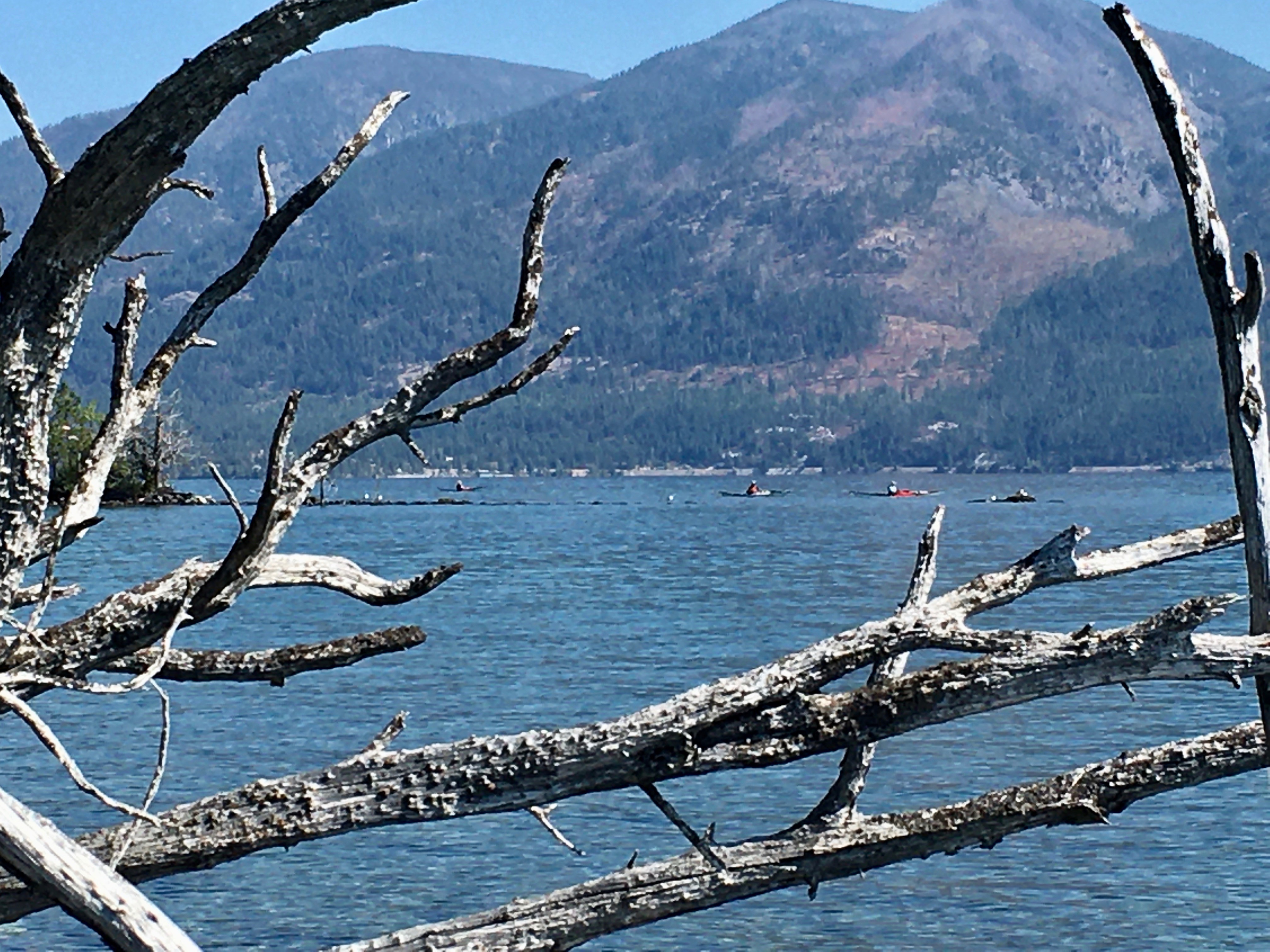
Earlier in the summer I learned that the island had burned. I first thought lightning might have caused the fire, but a friend later told me the fire was probably human-caused. During the long months when nothing in my arm seemed to be improving, I held out hope I would be able to paddle to the island before cold gripped the land. I wanted to see what fire had wrought. As I crossed Finley Bay I could see four paddlers about a mile ahead. They had launched a few minutes earlier and also wanted to see the island. I rarely see other paddlers on the lake, so this seemed like a chance to enjoy being part of a flotilla. Paddling hard, I caught up with them before they reached the tip of the peninsula and learned they were part of a paddling club out of Kalispell. We eventually split off from each other when I proposed to go counter-clockwise to their clockwise circle around the island.

When I reached the southern edge of Bird I saw the first of many signs erected by Montana’s Fish Wildlife and Parks asking people to stay off the island. Perhaps the department wanted to conduct archaeological studies in soil now exposed by the fire or protect the public from burned trees sure to fall in the next strong wind. Though I wanted to look for the first signs of recovery brought on by this massive release of nutrients, I accepted the restriction. Even without landing I could see that nearly all the undergrowth had been consumed by fire; trunks of larger trees had blackened; some trees had already fallen, root wads now in the air; only a few trees at the waterline seemed unharmed.

When the other paddlers and I next intersected, like electrons moving in opposite directions around a nucleus, we devised a plan to meet on the beach at Bare-belly, a tiny island a few hundred yards south. It was an ideal location to continue our conversations, to eat together at a respectable distance, to hear stories about paddles from the Washington coast to Sitka, Alaska. We identified the origins of our love of paddling, compared hull and paddle designs and shared where we were on the day we learned about jetliners crashing into the World Trade Towers. Gratitude for our lives and our connection to this clean, vast lake permeated every story.

Having left my partner on the beach at the campground, I felt internal pressure to resume my paddle, so I lifted Bluebird off the beach and stroked back to join Joyce for a picnic. She had spread out our red-check tablecloth and the remnants of snacks packed for our drive. As we ate, a tall, handsome man approached and asked where I had paddled and where we were from. Sensing his desire to learn, I answered his questions and then began to listen to his story:

We sold everything we owned, bought a truck and an RV and drove up from California. We are so glad to be out of there. My wife is a professional photographer. She talked to the state and offered to trade photos and drone video of the park in exchange for a reduced rate on our campsite. We’ll stay in Montana through September then head south just ahead of the cold until we get to Tennessee. We’re looking for a red state and a good deal on some land where we can park the RV.

 I resisted the impulse to tell him that even Democrats can be patriotic and we always take our lives with us. It was better to listen and to learn.

 As much as anyone, I know the joys of paddling through variations on blue and green, the peace of the running wave and flowing air, the exhilaration of driving a prow into wind and waves. I wanted to recover from my injury so I could experience these things once again. As much as I enjoy paddling a sea-kayak, I will remember this day for its people, for the stories we want to tell, for the way we humans long to explore what we have not yet seen and do not yet understand, for the way we want to congregate with people who seem to belong to our tribe or separate from people who are different and frightening. Like Bird Island after the fire, it will take a long time for the seeds of a new way to germinate and for us all to recover from things we have wrought.

Discoveries

In late August four of us left town for the lake. We wanted to escape the smoke in Missoula’s valley that made the simple act of breathing a health risk. Three of us wanted to go for a longer paddle. My wife preferred to read in camp and listen to lapping waves.

Joyce sometimes asks encouragingly, “Would you like to take a trip and paddle somewhere on the coast of British Columbia?” I know this is one of the most beautiful coasts in the world but I appreciate having access to the largest and cleanest body of fresh water in the western U.S. and feel as though I still have so much to learn, even after more than ten seasons of paddling Flathead Lake. I am content to keep exploring close to home because experience tells me, if I keep myself open and do not let my ability to perceive grow dull, I will make discoveries.

This trip confirmed that belief. Over the course of our two days we discovered how to have  fun while helping each other get ready to launch,


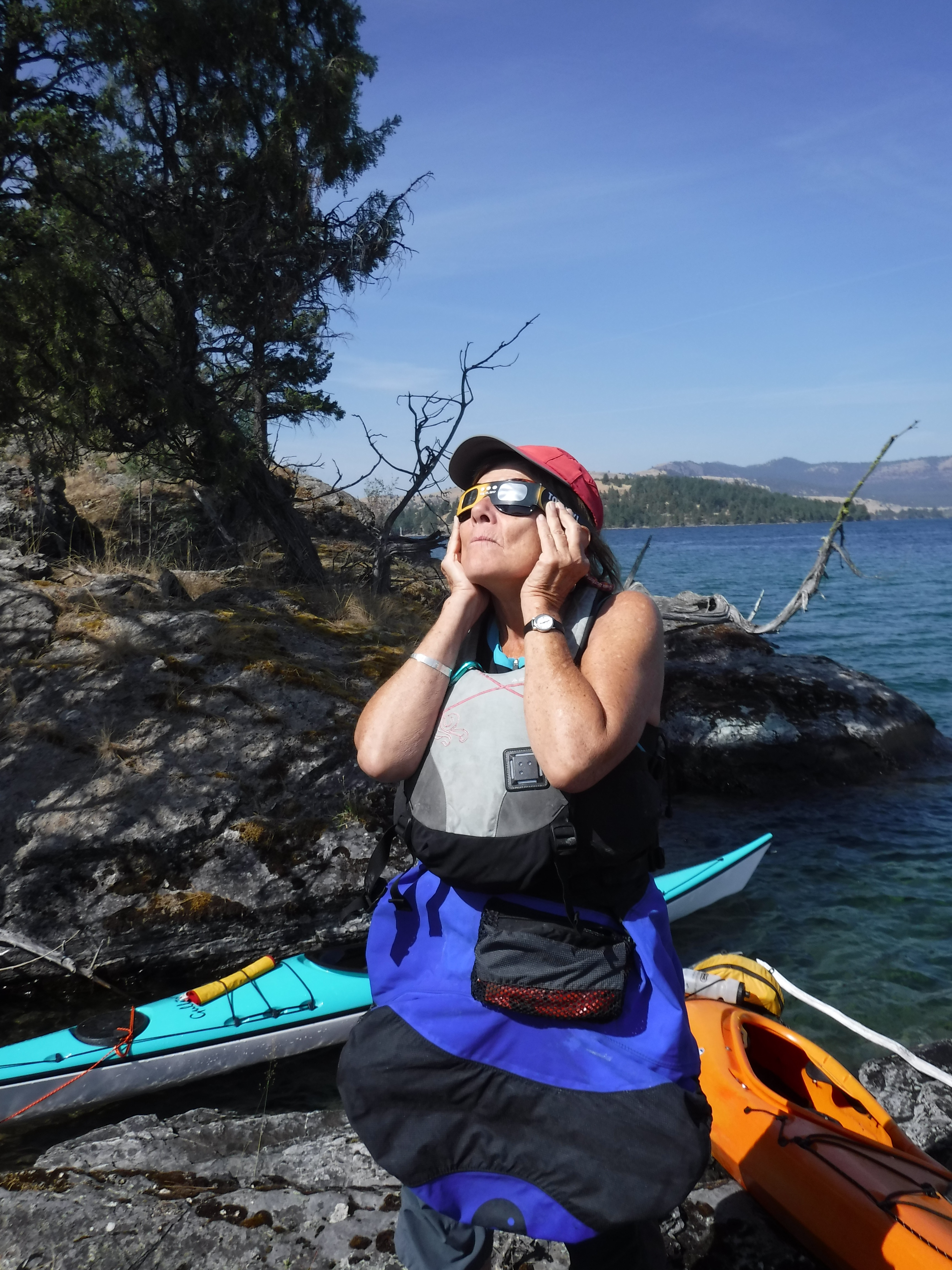
a rocky point for viewing the eclipse of 2017,


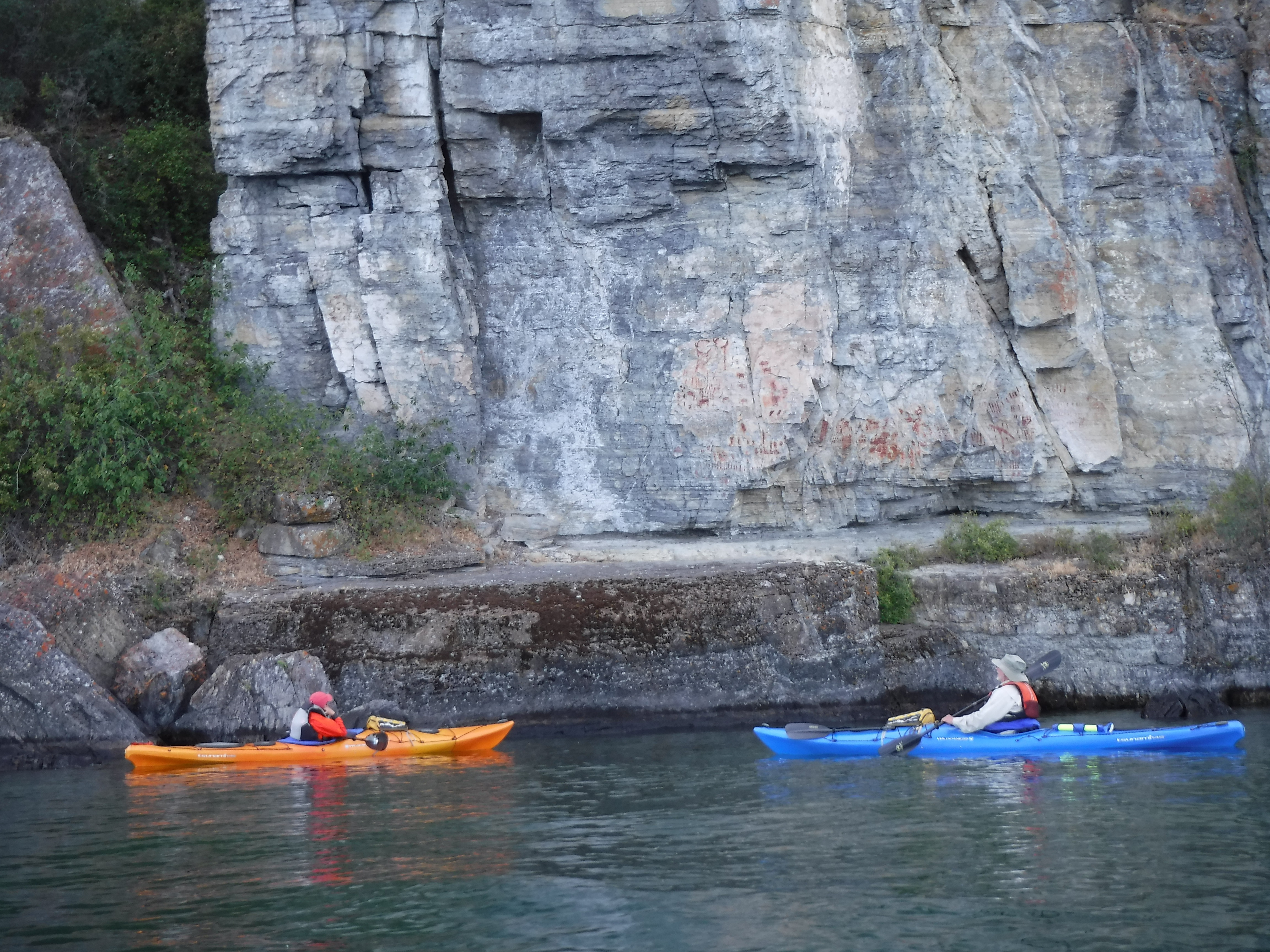
previously unseen panels of rock art and how prone they are to exfoliation and loss,

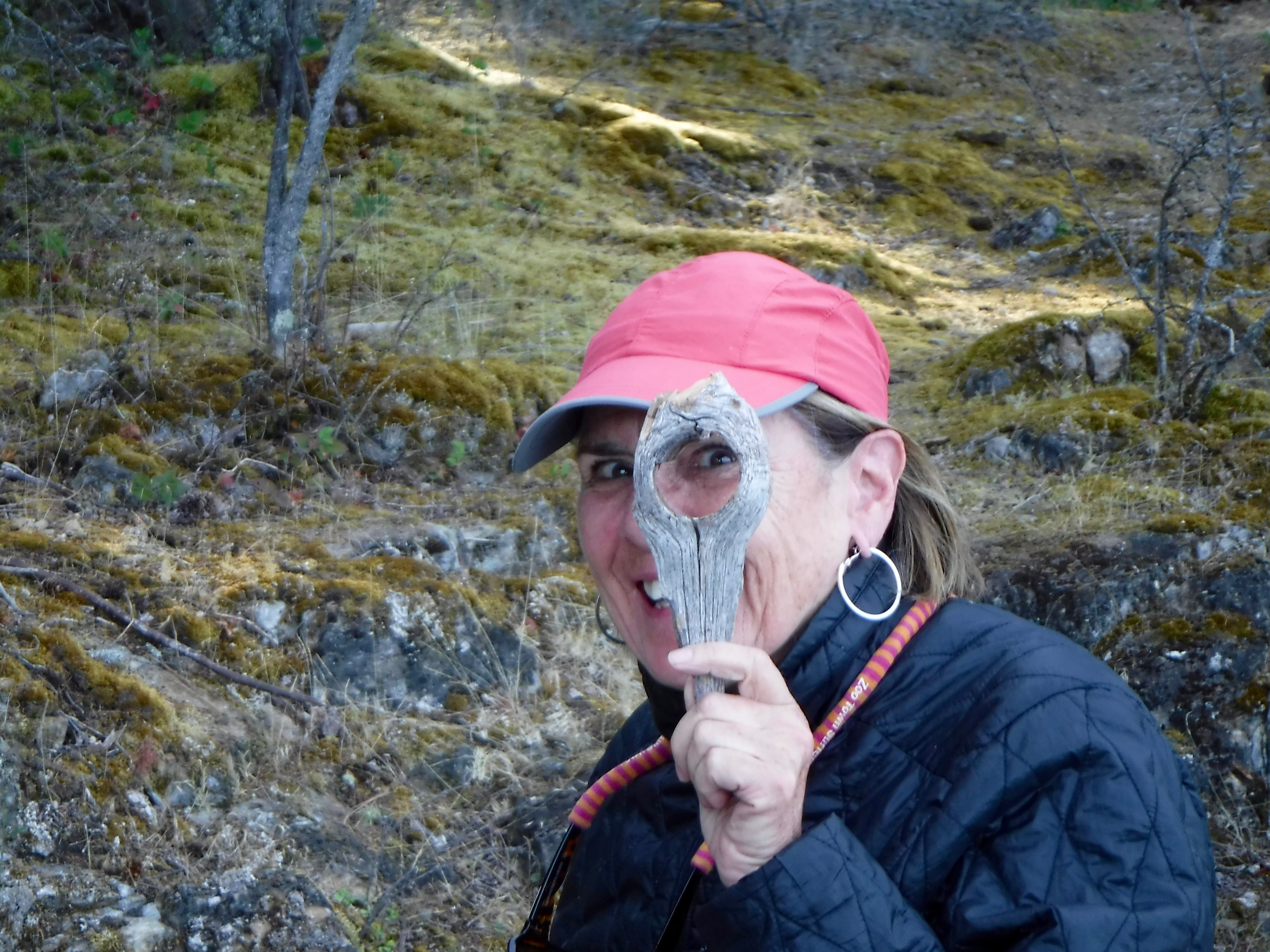
how to turn a knothole into a spyglass,

the beauty of black and blue ring waves during a hot morning but especially after sunset,

where eagles tend to roost and why it is extremely important not to set up a sleeping bag under those trees (I’m not providing a photograph of my mistake).

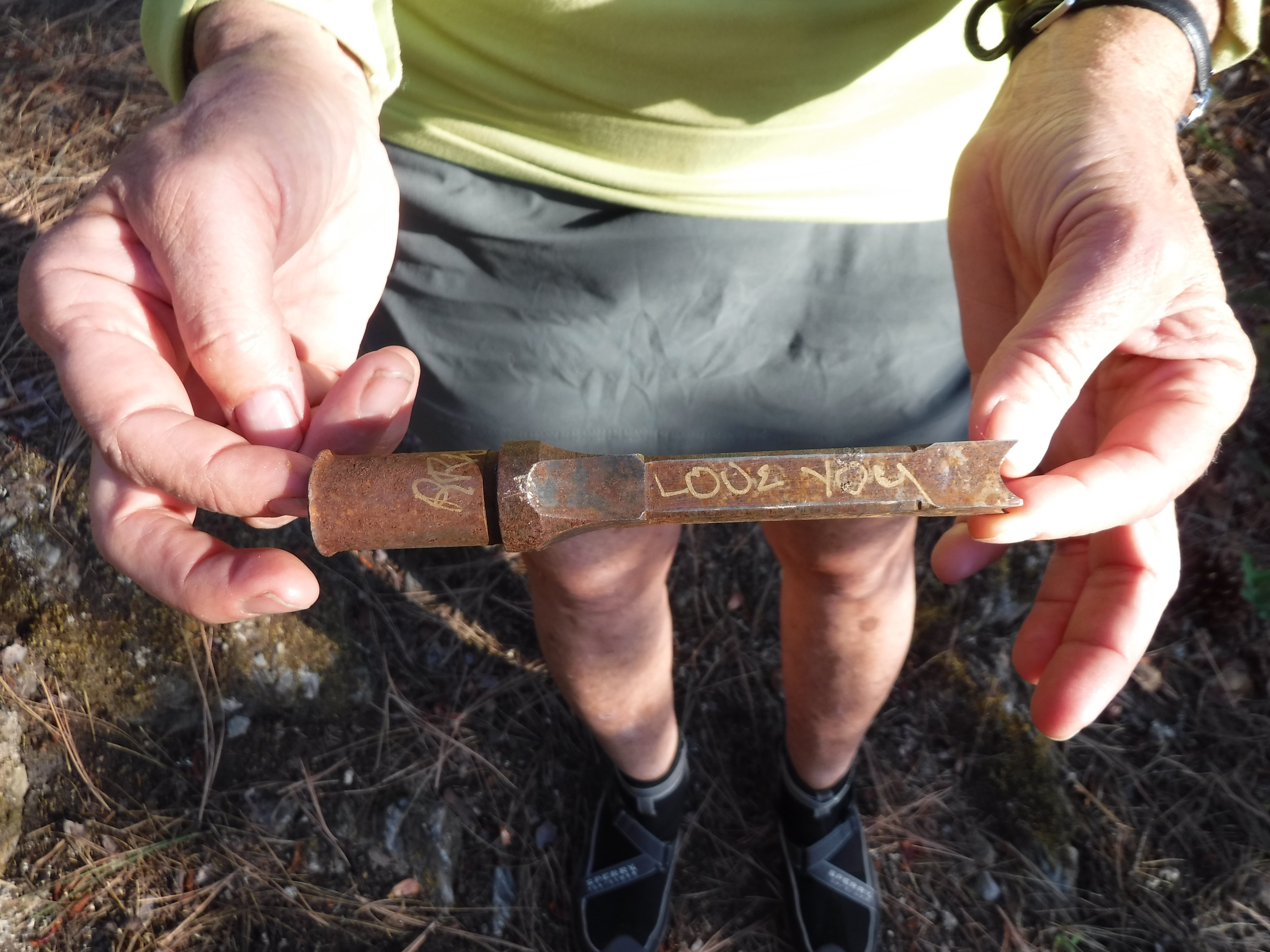
We also discovered a memorial to a young man. People who loved him wedged a painted tribute between opposing pieces of rock. Later, my friend Jeanne spotted a remnant from his tool collection. Walking between her tent site and the beach she saw an anomalous piece of rusted steel pushed level with the surface of dry moss and stone. Curious, she withdrew it from the ground and showed it to me. I explained that the object was a hollow chisel, a tool used to chop mortises so two pieces of wood can be joined with a tenon. Using gold-colored ink, someone painted messages of love and the man’s birth and death dates. Seeing this tribute, we speculated he might have been a woodworker. After we admired the tool and its subtle placement, we put it back exactly as we found it.

Passing through the gap between islands or crossing between island and mainland we also made discoveries about each other, learned things we did not know. We braided an invisible cord between and among us of understanding, memory and anticipation. For the rest of our lives we may tow each other along, connected by the stories we tell and create.

Though I am far-removed from childhood, the lake keeps teaching me to maintain the mind of a child, seeing the world as if for the first time, paying attention to it as if it might be the last.

The Tender Time

I find that perfect pair of days in early May when I can leave town in good conscience, pack minimally for an overnight, and drive up to the lake. This is the tender time.DSCF0121

The lake lies down and does not flash its summer sword of wind and waves. The grasses are soft and supple. I can walk barefoot between campsite and picnic table where I fix evening tea and morning coffee. In a cove I find an osprey nest and a fallen feather from one of the two birds overhead as they make banking turns through the trees, testing each others desire.DSCF0129

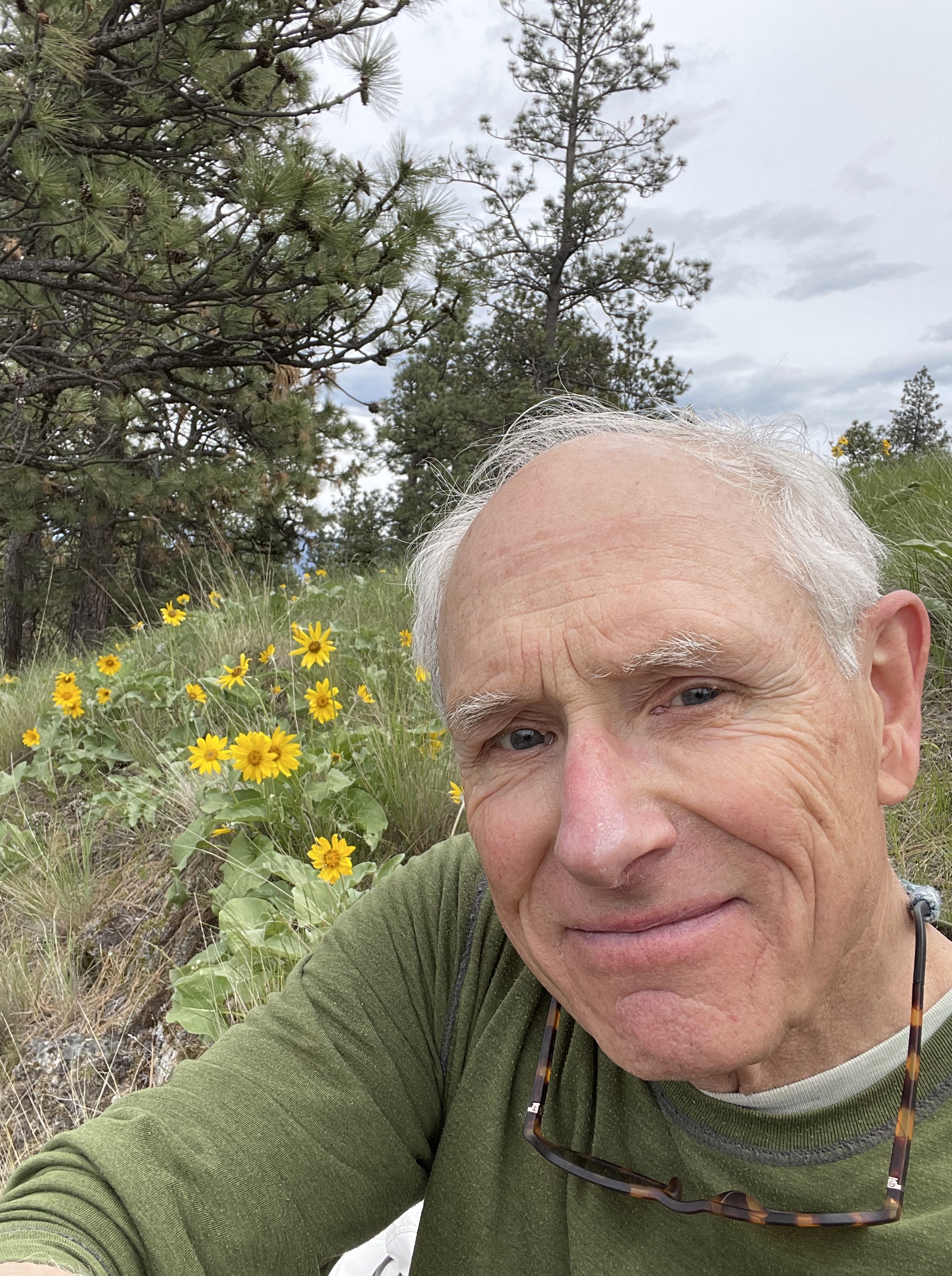
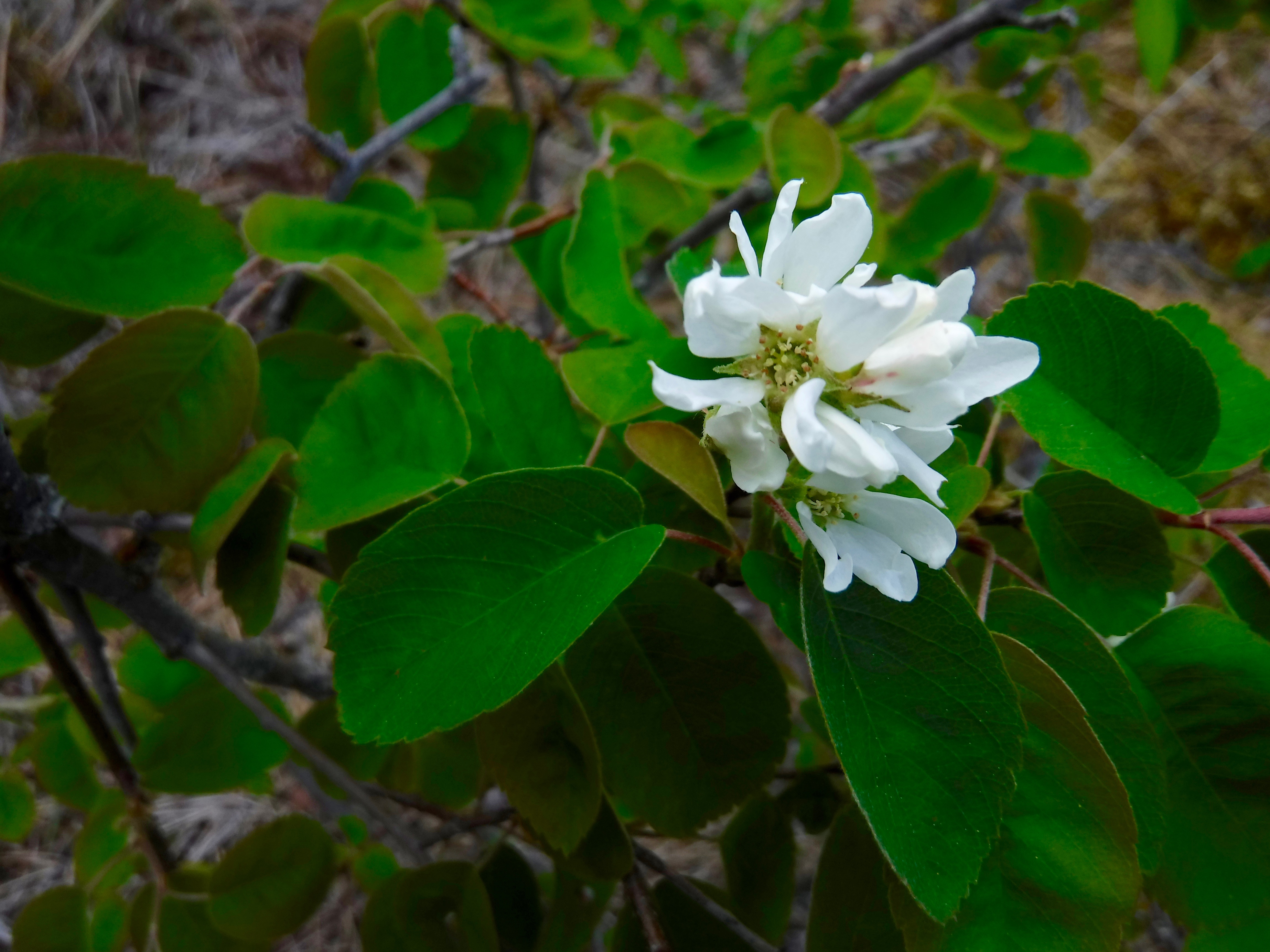
Arnica and balsamroot are in full bloom and their leaves do not crackle underfoot. Western Serviceberry wears its wedding dress.DSCF0118

One evening I paddle from Finley Point out to Black Point and then around the corner to what the old map calls Matterhorn Point. I look across the strait to Wild Horse Island, but do not cross: on the first paddle of the season muscles are also tender and do not yet have the hardness I associate with late summer or early fall. The next morning I paddle to the end of Finley Point, round its tip shaped like an adolescent molar, descend deep into the calm water of Skidoo Bay and return. The few other campers in the quiet campground must have been watching me return from the islands and points. After I lift my boat onto the grass, straighten my back and sigh with satisfaction, they say, “Welcome back.” Even the people are tender at this time of the year.