The days around the solstice seem to flatten into a kind of sameness. In winter a curtain closes on light. A broad wash of gray flows across our lives, occasionally punctuated by clear skies and sudden cold. Then in mid-summer we experience the flatness of lingering light and heat. But around the equinox we come face-to-face with the dynamism of rapid change.
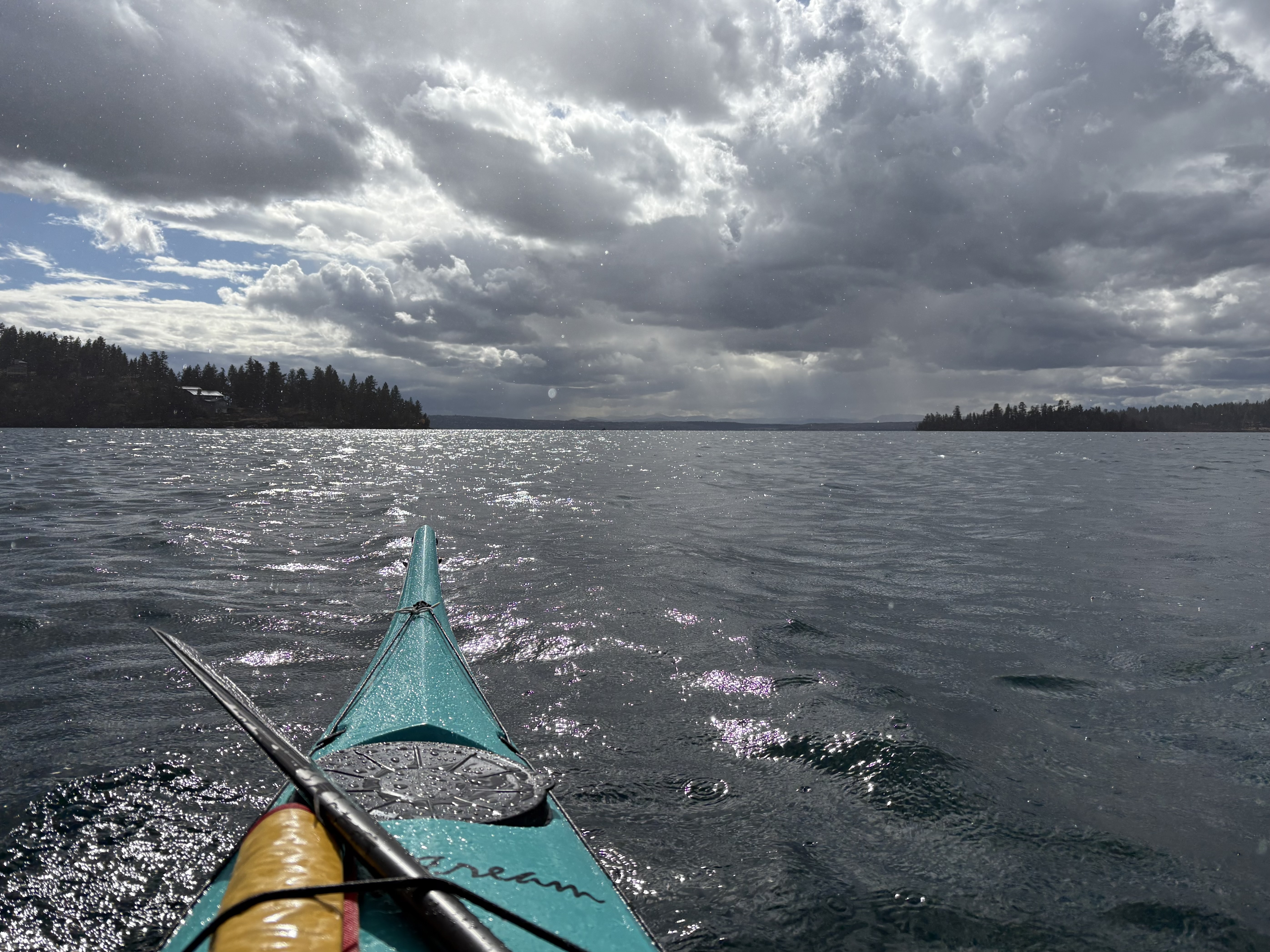
If possible, I like to paddle at these times. I feel especially drawn to the autumnal equinox. The water sits a few degrees above the temperature of the air and suggests a sense of safety that feels elusive in the spring. Autumn also reminds me of the season of my father’s death. I cannot help but think about him when chokecherries and red-twig dogwoods turn red and orange. But I also prize a paddle in early October because the sky can be wild. High, flying clouds sweep over the heavy, rain-laden clouds that stack up against the Mission Mountains and drop squalls of moisture through huge columns. As the clouds break over the crest and move toward the plains, the color of the lake changes moment to moment. Within a fifteen-minute span the lake can go from black to cobalt to green, from graphite to amber to pale blue.
I also sense the excitement of the birds. Geese form staging committees as they sense the migration to come. A double-crested cormorant with its long neck races one direction and suddenly returns. Then there are the waves. They shift directions as quickly as a swinging compass needle and may suddenly lay down as if for a nap, almost as if sensing a need for rest.
A few photos suggest the dynamism of this season, the improbable combination of rain and light,
the way mosses awaken,
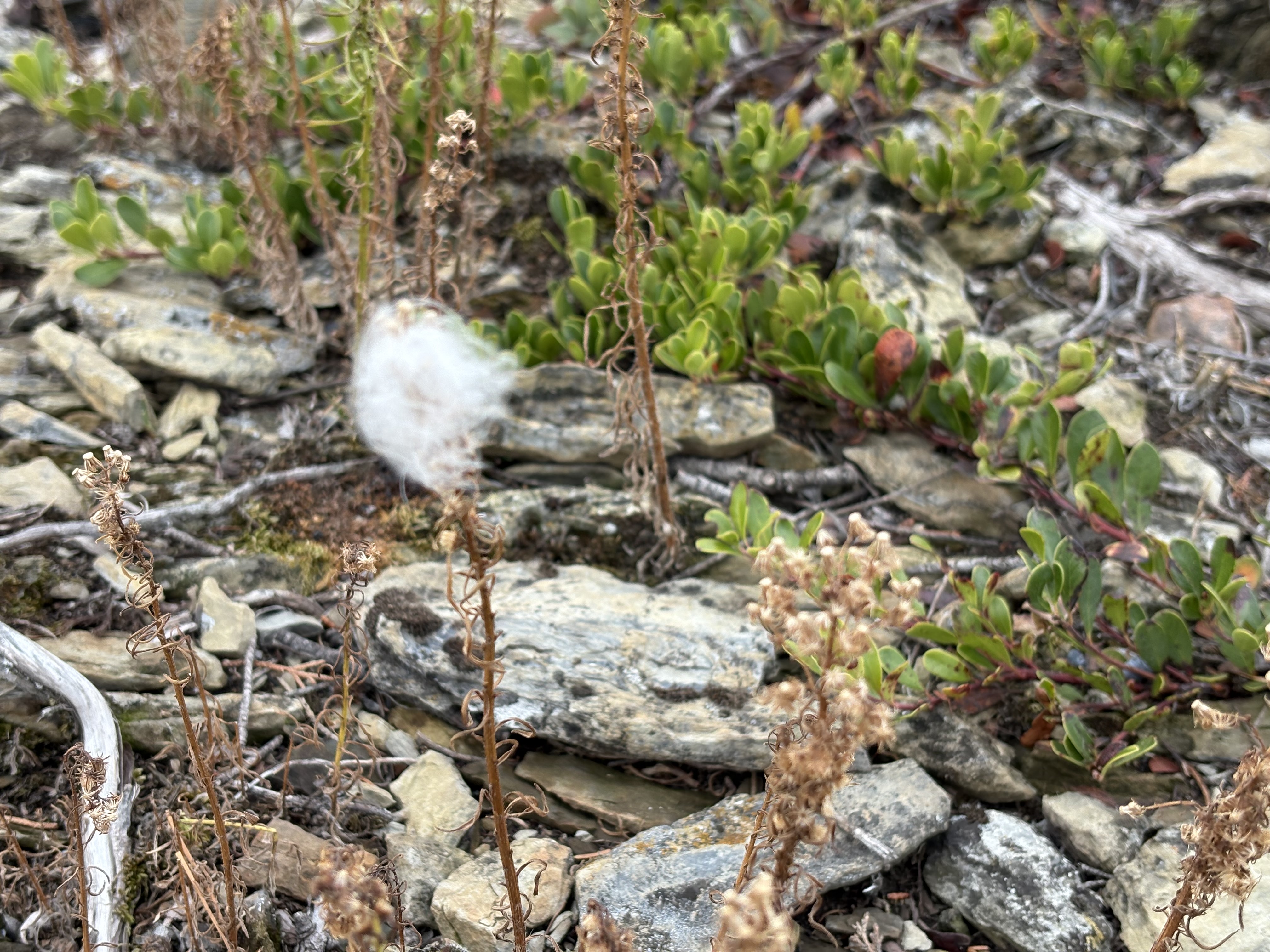
and how goose down catches on a dry stem and flutters so fast that the camera cannot stop its quivering. Welcome to the season of change.
In May we arranged to stay at an old resort for three nights on both sides of the summer solstice before desire to see other family members took us out of town. The first afternoon and the next morning I made a couple of paddles––south and then north along the east shore of the lake, covering about 26 miles in total. Everyone seemed anxious, however, about an impending storm.
When the sky turned gray and the temperature dropped into the 40s, leaving a distinct snow line on The Mission Mountains, people headed home, lost restaurant reservations, or tucked themselves inside with a book. Deck chairs sat empty as rain pelted the Trex. We were grounded.
Though I felt tempted to paddle in the cold conditions, having adequate clothing, my old skirt had begun to leak, and I did not enjoy the feel of cold water dripping into my lap. I relented. There was still so much to do. I watched a merganser mother teach six offspring how to chase little fish into a shallow corner between the dock and the storm wall. While the little birds pursued their breakfast, the mother kept a close eye on approaching swells and would eventually lead them toward a safer spot. I enjoyed watching big waves break against the sub-surface boulders marked by the weather station monitored by the Flathead Lake Biological Station. When their energies felt the boulders on the sloping bottom, they spent themselves in a white crash. From our second-floor deck I sensed the rhythm of the swells as they rose, rolled, and slid diminished up the shore. The lake had become an ocean. During the storm, a huge diesel-powered barge loaded with rock and a bucket loader gave the point a very wide berth before rounding it and entering the bay. I imagined interviewing a skipper of such a craft. Commissioned to build shelter all over the lake they would have weather stories to tell. Meanwhile, squalls like giant thumbs, pressed on the roiled surface of the lake.
In a brief interlude, I watched a man using a four-footed cane. While supporting himself with his sturdy prop, he worked patiently to make a transition from steep steps to dock to beach. With one hand he undid the knot tying the board to a stanchion, then positioned himself on the board so he could take a few strokes into the bay and back. He did not let the lack of adult-sized floatation devices stop him. I was pretty sure he would have been offended if I had offered to help. Later, I met him in the rain as he walked slowly up the driveway. He introduced himself and his Parkinson’s disease. He summarized his relationship to the diagnosis by saying, “I have learned a lot.” He did not linger or extend the conversation, however. Taking another step, he said, “I’ve got to keep moving.” I later learned that he had devoted his life to the protection of the Great Burn area along the divide between Montana and Idaho. It was a place he knew and loved even if he could not secure its final protection as wilderness.
I am glad I accepted my grounding. I know I would have enjoyed the thrill of paddling in a storm, but I was richly rewarded in my observations. Thwarted, we discover new doors and windows on a changing world.
On Father’s Day I am still thinking about taking my oldest Pennsylvania granddaughter paddling on Monday, June 10. Bodhi spends time in the gym, treadmills at a steep angle and lifts weights. She is broad-shouldered and almost as strong as her father. Even though most of her paddles take place on the lazy Brandywine where she and her sister look for turtles, I thought she might be able to paddle from the Walstad access to Skeeko Bay on Wild Horse Island.
After pulling into the parking lot, I walked down to the dock, the lake now full as my wife’s coffee cup. I saw conditions like those predicted by the NOAA site I faithfully consult—winds out of the southwest at 15 mph, waves less than one foot, locally up to two feet. The only catch was that we would have to contend with quartering seas that would consistently push us off our compass point.
We laid out our gear and placed the boats on softer ground than the concrete handicapped pad. I offered my boat to Bodhi, a little more stable and faster than my old plastic Perception Carolina 14.5. When she accepted the invitation, I put my head inside the tunnels to adjust four foot pedals. On the second try I got them right. Because of the wind I also suggested that we wear our blue paddle jackets.
I nudged her off the ramp and told her to hang out and get a feel for the boat while I made ready to launch. At first, she felt uneasy with the rolling motion as waves pushed her port stern quarter, so we advanced slowly into the lake, giving her time to adjust herself to the conditions. I could tell that she felt anxious because she paddled hard and fast, as if eager to get to the island. In the shorter, heavier boat I found it difficult to keep up with her. We worked in manageable conditions for a little less than an hour, but the waves kept knocking her away from the tail of the island that we needed to be able to round. I occasionally dropped off the mark, urged her back up and tried to match her fast pace. About fifty yards from the island, I could tell that I had not made myself clear: she was going to try to land on the south-facing shore of the island where waves broke against the blocks of argillite. I had not adequately explained that she would need to postpone her relief until we entered the slightly calmer conditions around the corner of the island. Even before I drew close to warn her about landing, her instincts kicked in and she began back-paddling. Gradually, she came away from the island and, sighing, followed me around the corner where we both could catch our breath, though the wind still blew.
Deep in the shadows a mule deer buck, still in velvet, foraged for still-soft greens. Sight of her first mule deer seemed to inspire her and we paddled on. Still, I had a hard time matching her pace. Eventually we rounded the gravel bar that defines the entrance to Skeeko and we relaxed inside the protection of the bay. Bodhi called out her amazement as two bald eagles circled above us.
With the lake much higher than on my paddle less than a month earlier, we pulled the boats up onto the driftwood. After we extracted ourselves from our paddle jackets it was clear that we had both worked hard. My NRS shirt was soaked, as was her long-armed bathing suit. A cooling breeze felt great. Hungry now, we lifted tuna salad sandwiches from the bear vault and agreed that a person would become strong as a bear from trying to rotate the lid past two spurs and their catch. Orange and apple slices were the perfect accompaniment to our sandwiches.
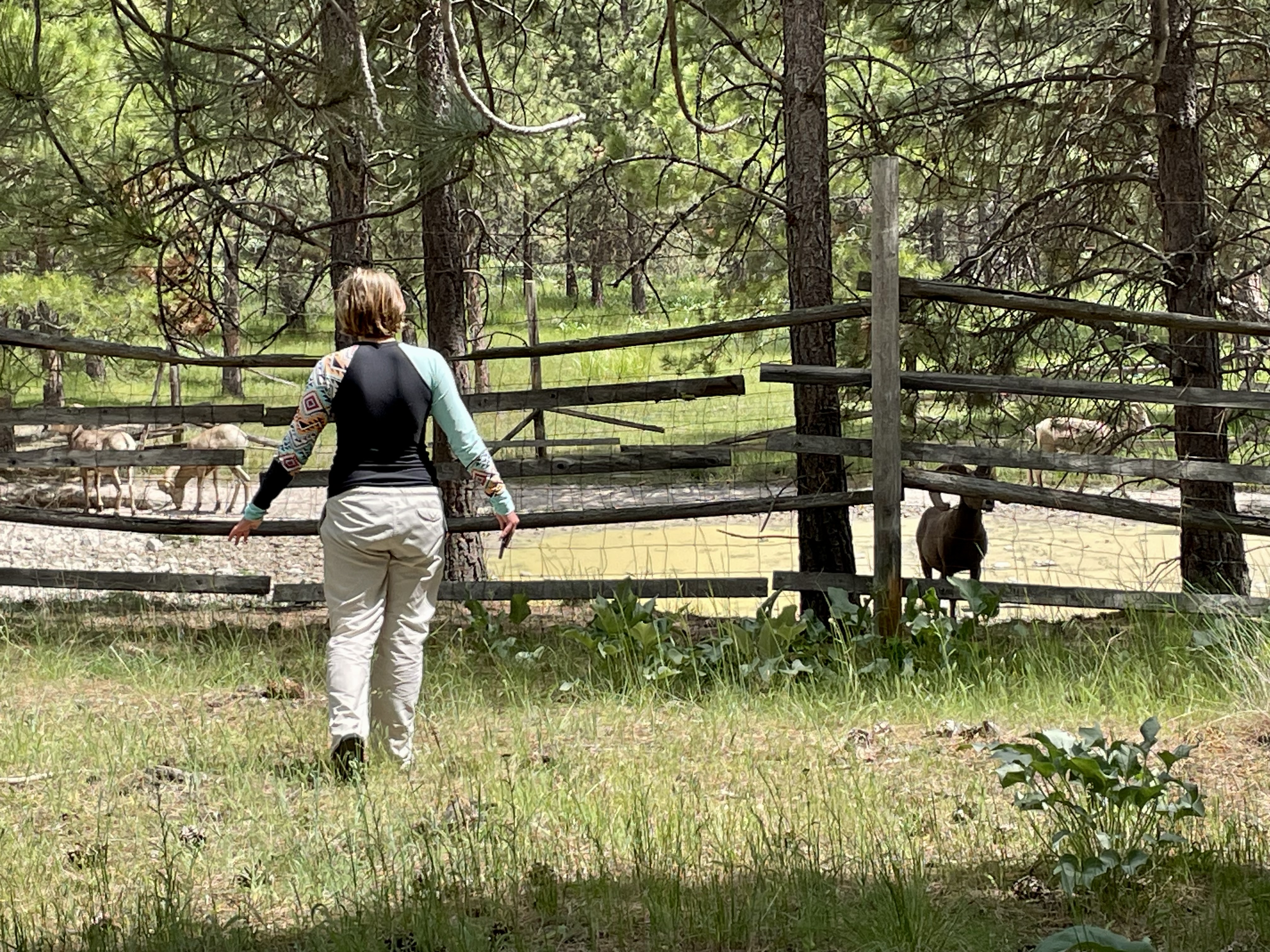
After lunch I proposed that we walk uphill to the island’s isthmus in the hope of seeing the wild horses who sometimes graze in the grass around an old and derelict corral. As though she were on the treadmill at home, she strode up the trail leaving me out of breath at the top where we paused and studied the slope below. Not horses but Rocky Mountain Bighorn sheep moved in and out of deep shadows cast by the pines. I said, “Let’s see if we can approach. We’ll use the wind in our faces to our advantage. They won’t smell us. Be sure to pause in the shade of each little cluster of trees.”
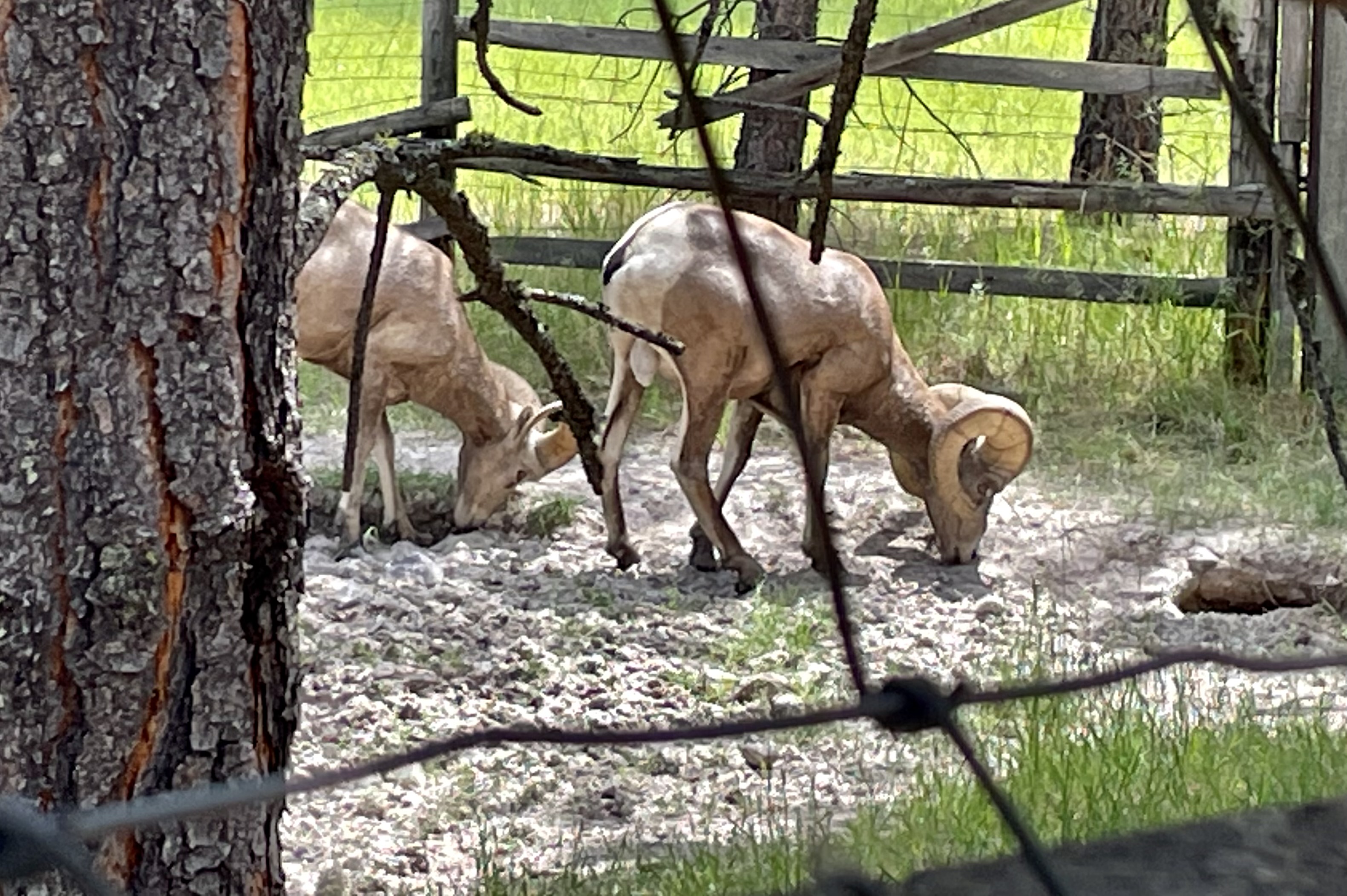
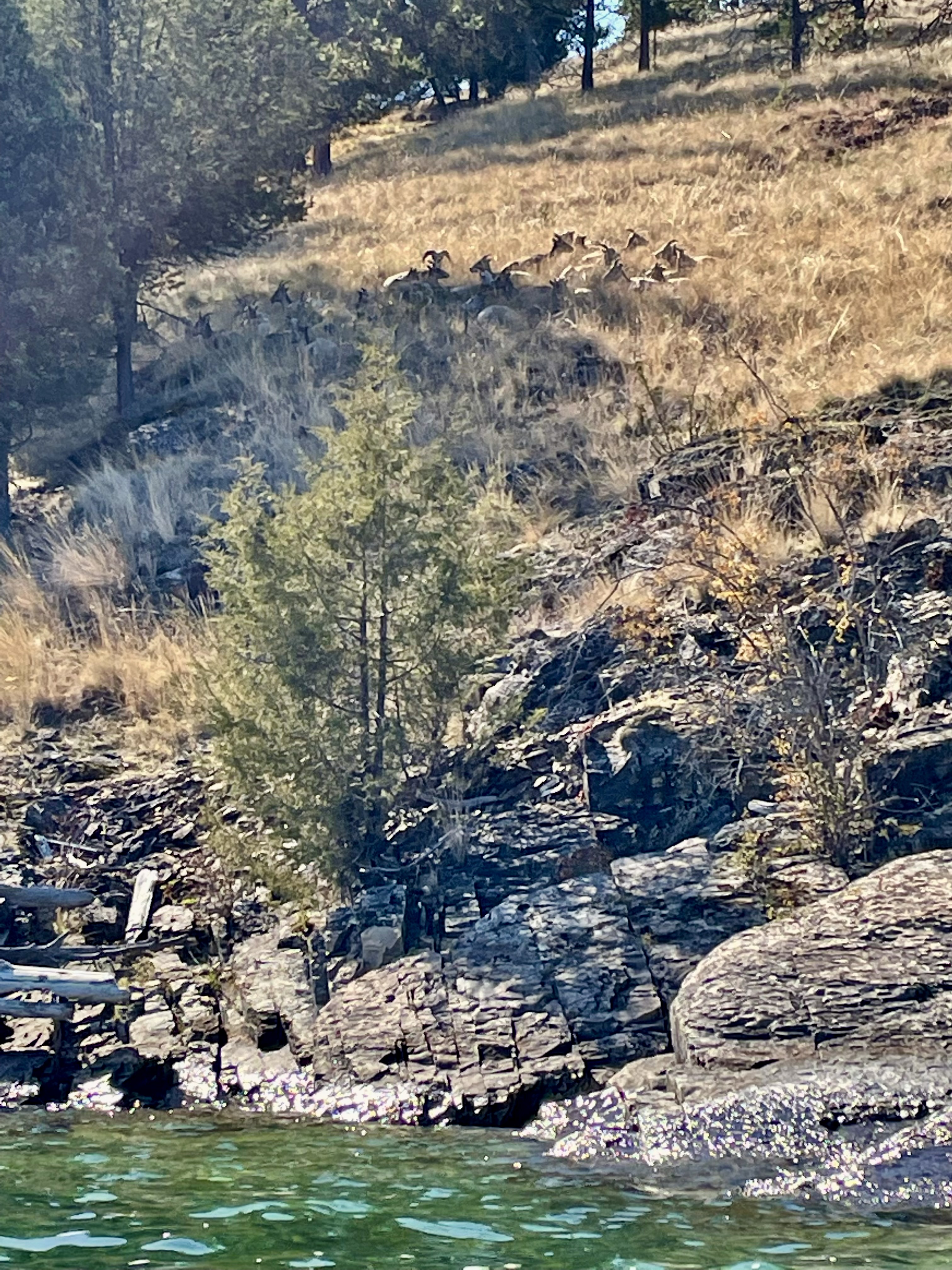
Like a huntress, she moved toward the animals who seemed nervous but did not flee. We got closer and closer until I realized that the big animals were drawn to minerals on the margins of an evaporating vernal pool. This was a magnet for them. As a wildlife biologist later explained to me, their exposure to green grass had elevated their potassium levels which could be re-balanced by consuming sodium in the drying soil.
Bodhi and I stayed outside the old fence and never blocked an opening where the rails had failed. One time the largest ram, the tips of his horns blunted by time and competition, faced us squarely and stared, setting off our own alarms. But we kept getting closer and closer until only the wire stood between us and animals we could smell. We watched for several minutes, astonished by the good fortune of having such a close encounter with animals that often elude detection.
More than satisfied, we climbed back up the slope, pausing to find a couple of tired bitterroot flowers still blooming on the hot and dry slope behind the solar outhouse. Back at the boats we enjoyed more slices of fruit and kept telling each other how lucky we were.
Though the water temperature was around 52 degrees, we knew we would stay warm while working against the wind and waves approaching us now from the southwest. I told Bodhi, partly for my own benefit, that we did not need to hurry. We needed only to paddle at a pace we could maintain as the waves, taller now, pushed against us from the starboard corner and occasionally washed over our decks. This time Bodhi took my advice, controlled her anxiety about the long crossing from island safety to the southern shore of the lake. Having learned a great deal in the morning, she remained calm in even rougher conditions, let the boat move under her and paddled just behind me as I led us back to Walstad.
After landing, reloading the boats and stowing two mounds of wet gear I felt incredibly proud of my granddaughter. This had been her first visit to Montana, her first long paddle in challenging conditions, and her first encounter with heavy-bodied wild animals. Due to the trajectories of our lives and other commitments I have never been able to give my sons this experience. But my granddaughter will carry this memory as a prize in the pocket of her vest for the rest of her life—a gift for me on Father’s Day.
Early last week I sensed an opportunity to paddle. By midweek a wave of tropical moisture that substantially dampened fires north and west of Missoula headed into British Columbia and Alberta. Canadians would be as happy to receive rain as we were. The remnants of the storm made it possible for me to make my favorite paddle—an open-water crossing from Finley Point State Park to Wild Horse Island—this time with a little help from winds out of the south.
When I arrived at the campground I saw what the lake looks like when it is 2.5 feet below its normal summer level. Boaters cannot use the docks at this level, so no boats were in the marina. Beyond the nearby islands and beyond the three fingers of Rocky Point my destination appeared as a rounded hump in the distance.
I have heard people complain about the lower water level, occasionally blaming the tribes for this disappointment. In fact, the Salish and Kootenai peoples who control water releases at the dam are bound by federal contracts. In addition, they cannot be held accountable for climate change and drought, both contributors to the lower-than-normal water level.
I stowed emergency gear and lunch and made ready to paddle. As soon as I crossed the mouth of the marina I felt the corkscrew motion caused by waves slapping the port stern quarter. I paused and took the feather out of my paddle. In these conditions I did not want to stroke air while thinking I would meet the resistance of water. A flat paddle would be better, the wave motion making balance a little tricky. Having made this adjustment, I settled into ten miles of water and the rhythm of countless strokes, eventually landing at the East Shore access on Wild Horse Island. From a kayaker’s standpoint the lower water level allowed me to come ashore on a broad beach normally unavailable unless one is willing to risk paddling in the cold conditions of April.
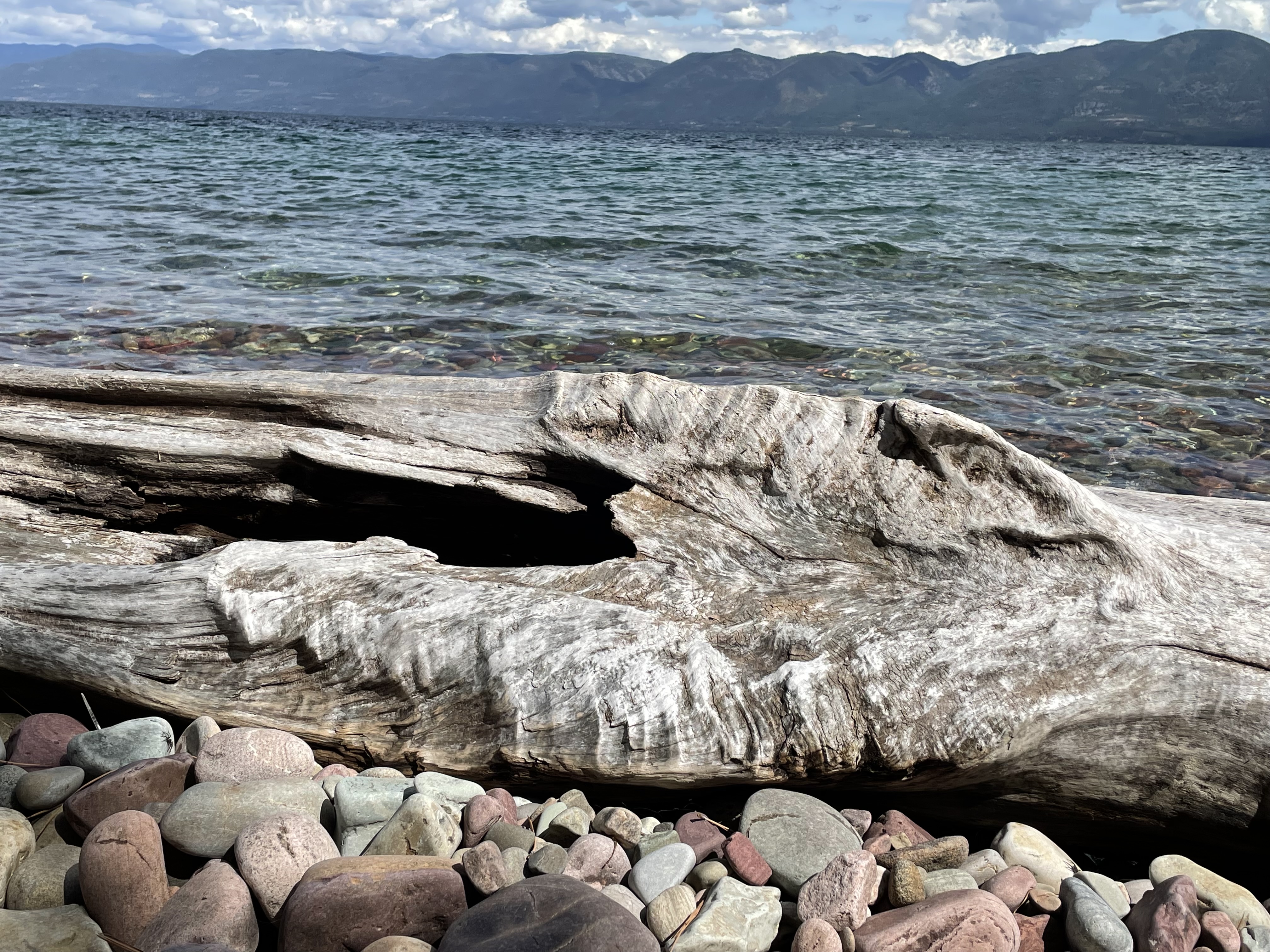
On the comfort of a big log I ate my banana and blueberry muffin and a thick triangle of Spanish Manchego cheese. I drained my water bottle, knowing I could filter a full bottle for the return trip. While I ate my eye was drawn to a long cottonwood log. At some point in its life the wind broke off a side branch that had once been married to the main trunk. Time, water, and stones polished the soft ripples in the grain.
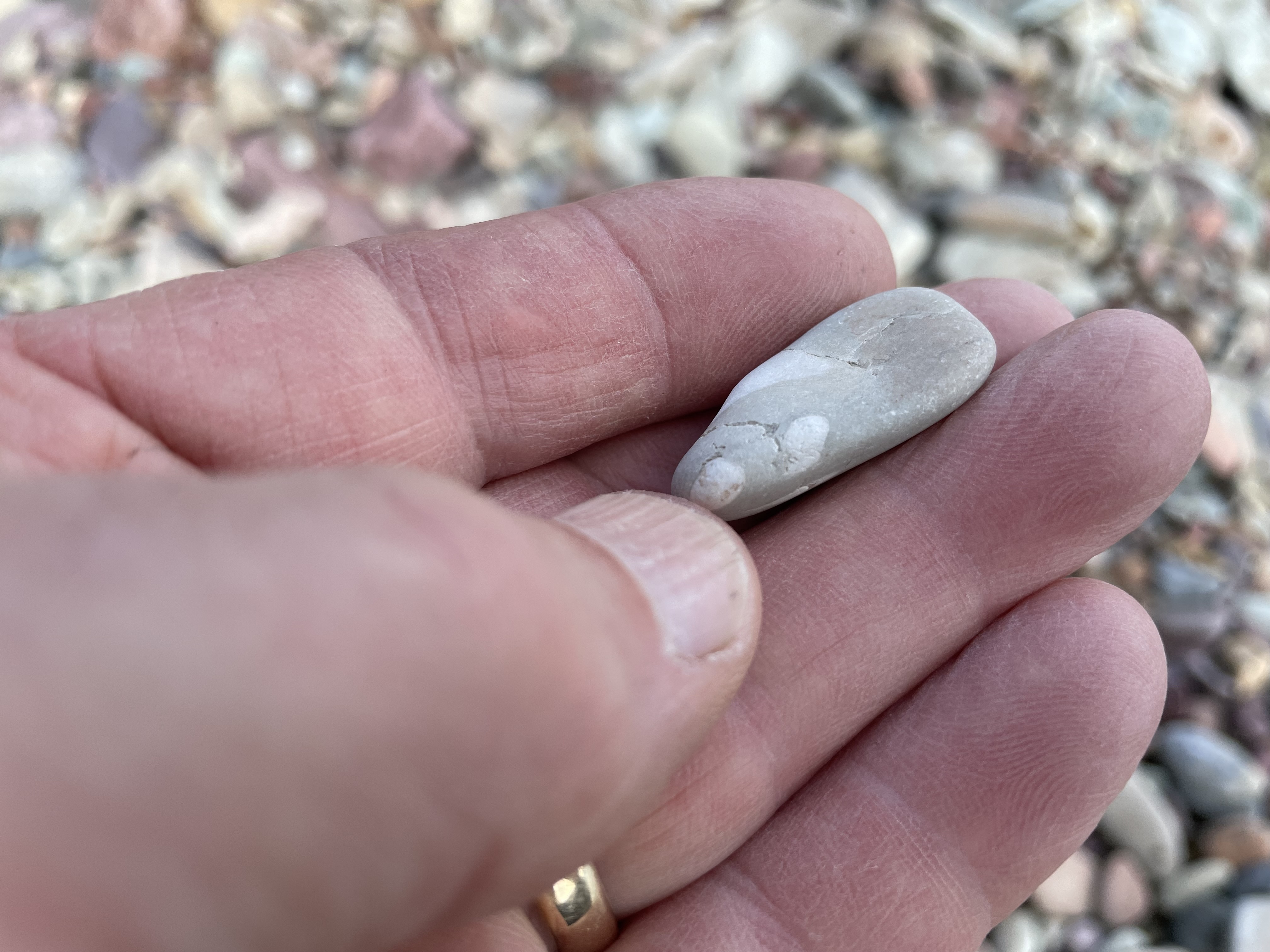
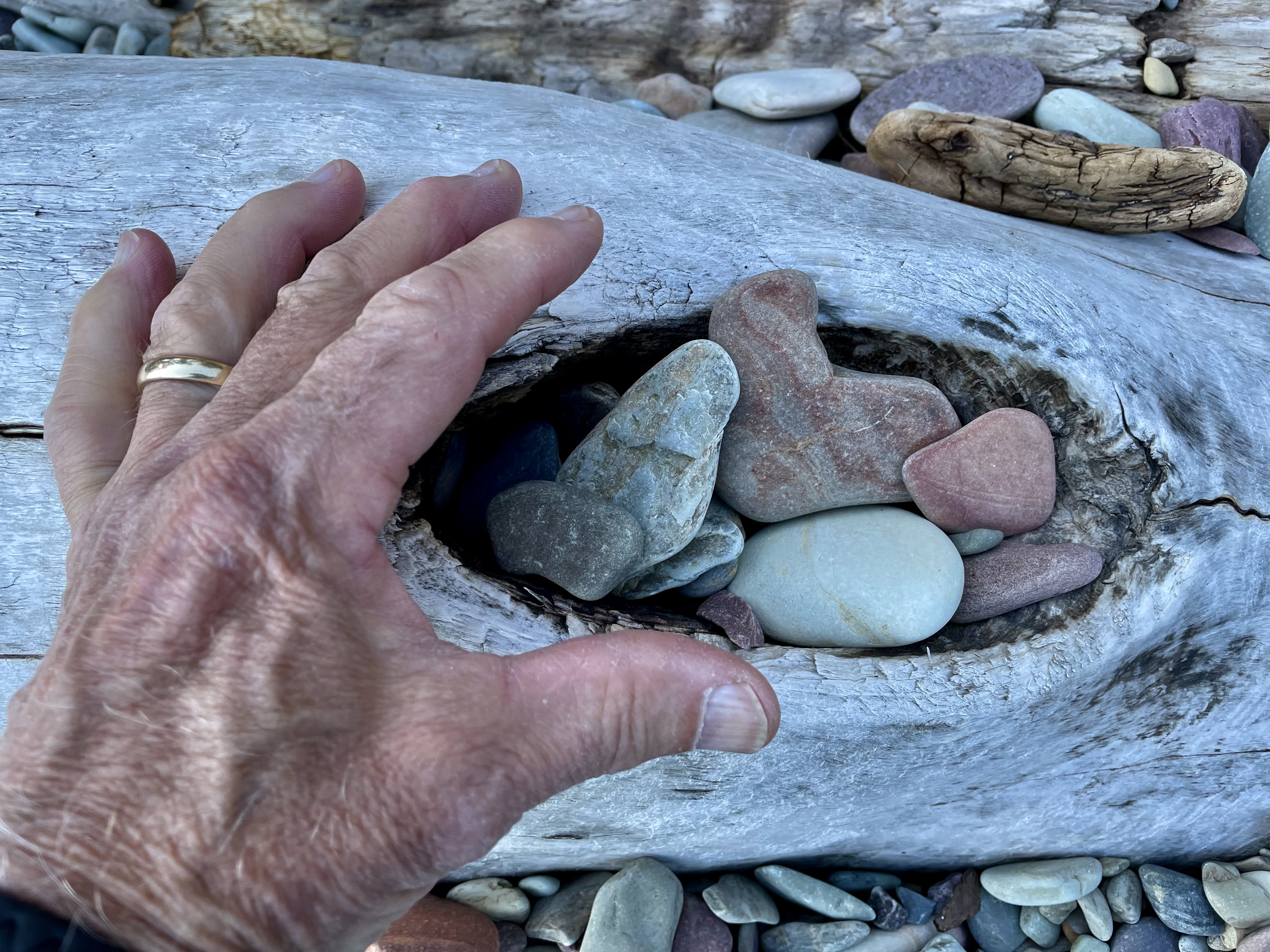
Though I had visited this spot several times, usually while circumnavigating the island, this time I decided to look more closely. I noticed many things I had ignored or overlooked. With the lake at a lower level I saw harder stones trapped in the mudstone ramps that once formed the floor of the lake basin and may have been part of the foundation of the mountains raised by shifting tectonic plates. I found a miniature version of the process among the countless stones on the beach.
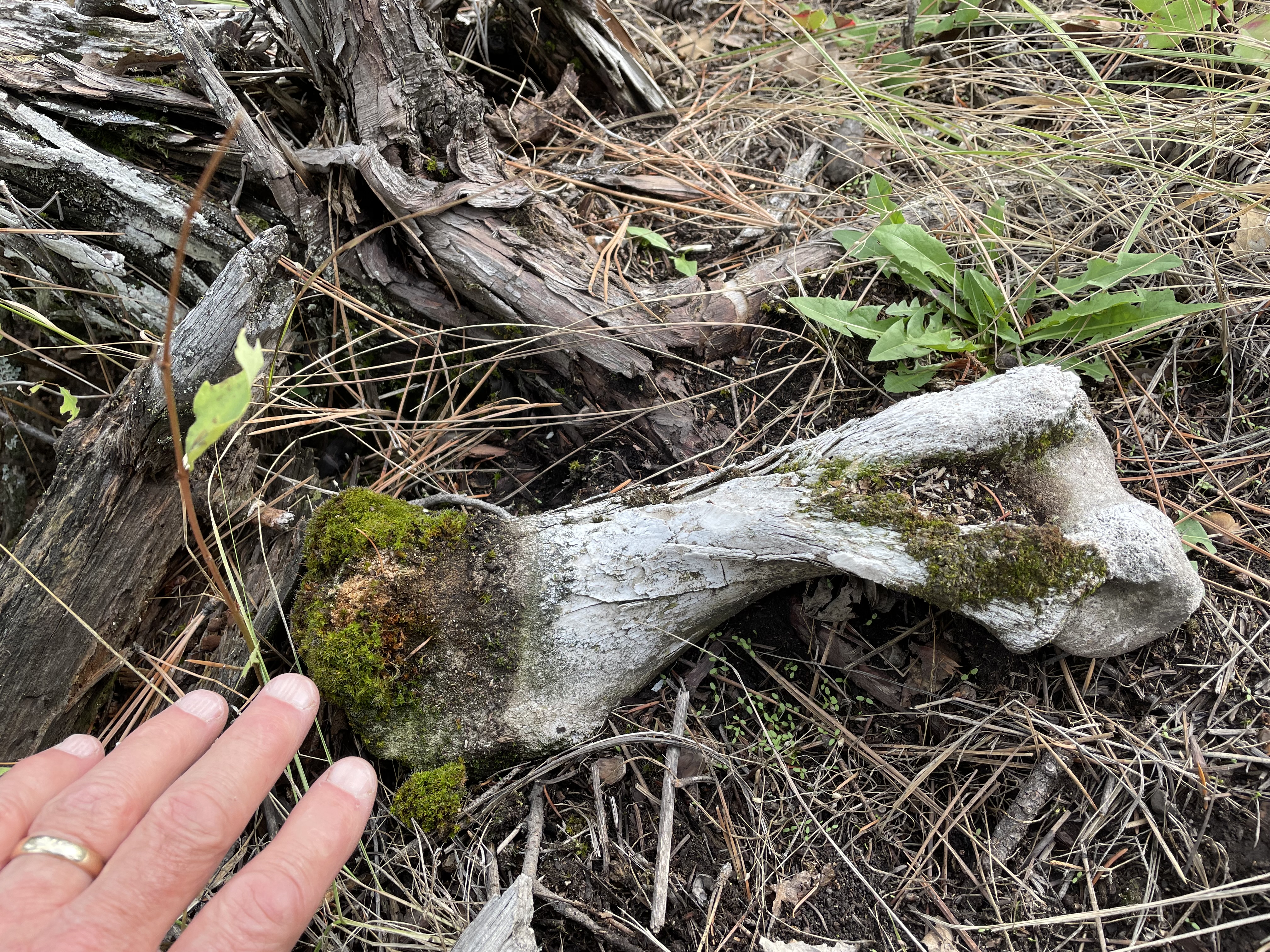
Climbing into the forest I immediately sensed the effect of more than an inch of rain. Within a day the patient mosses had swollen and recovered. Among the mosses I found the humerus of a horse that long ago had laid down its heavy bones.
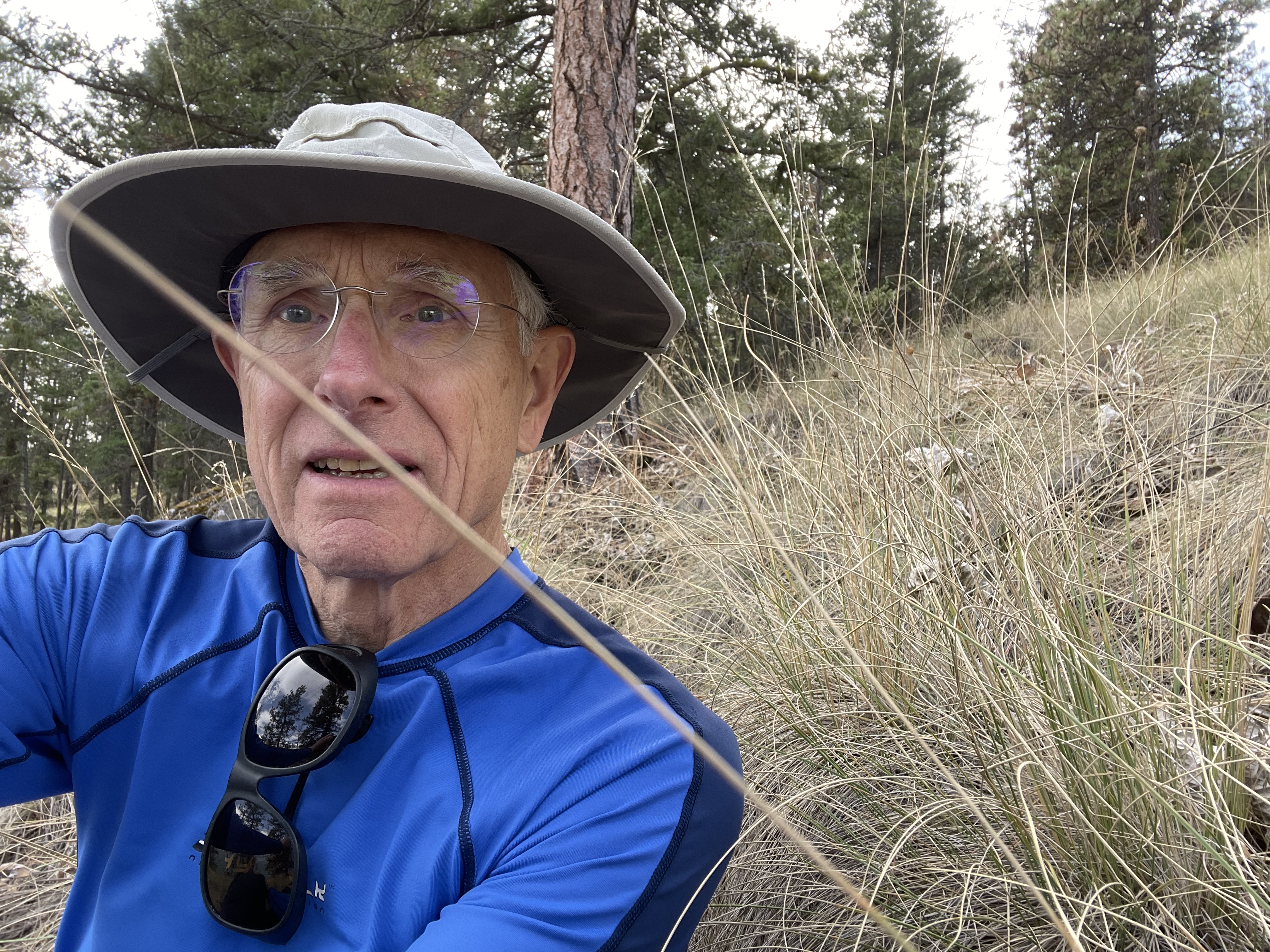
Bunch grasses were full and soft and invited me to sit down and enjoy them.
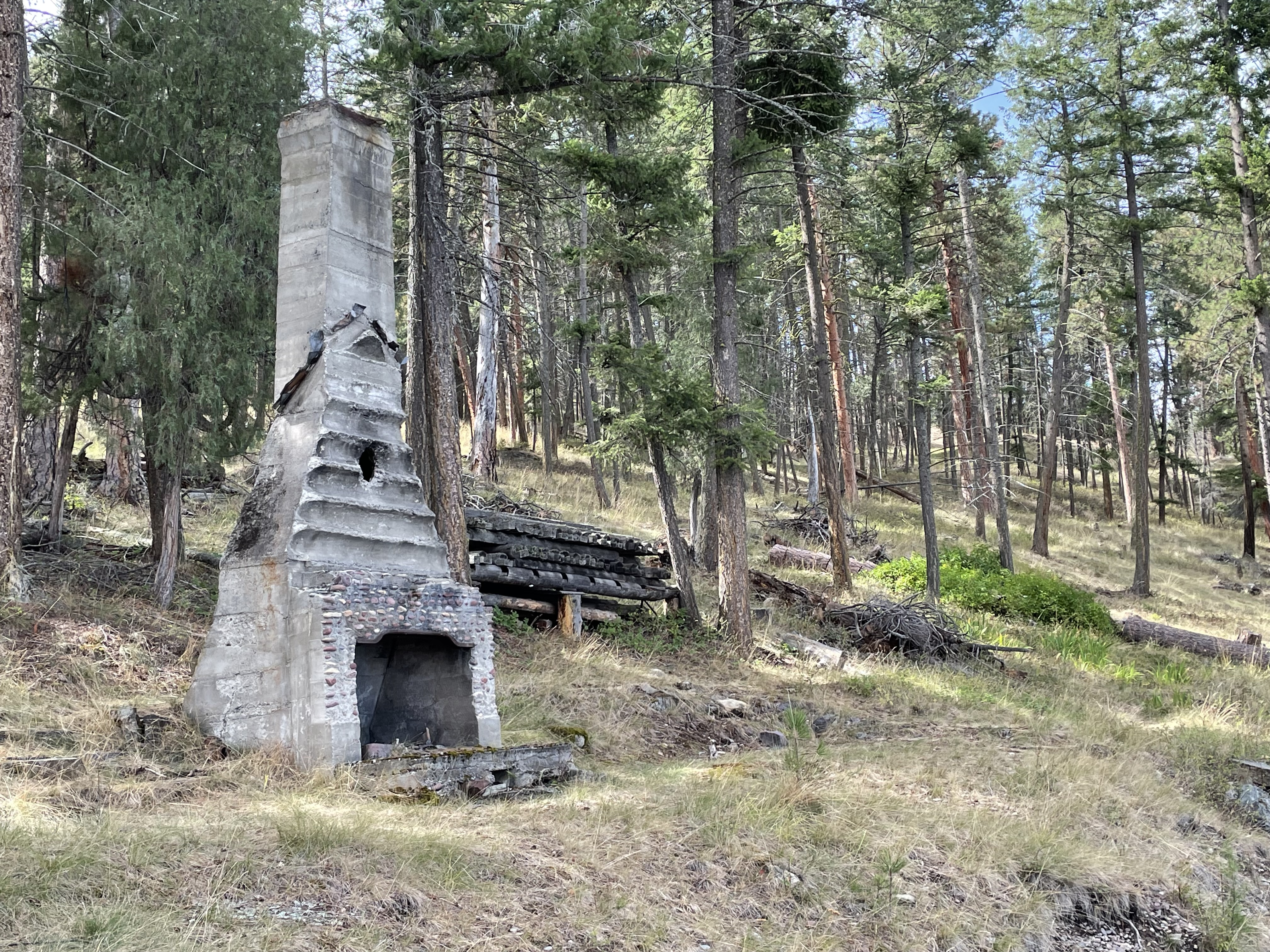
Hiking higher I saw massive pine trees thrown south by relatively recent storms. Dropping back toward the water I inspected more closely the chimney of a once splendid lodge that was built in a cantilevered fashion over the lake. The concrete had been poured against the log walls leaving horizontal flutes, and the face had been decorated with beautiful stones from the beach.
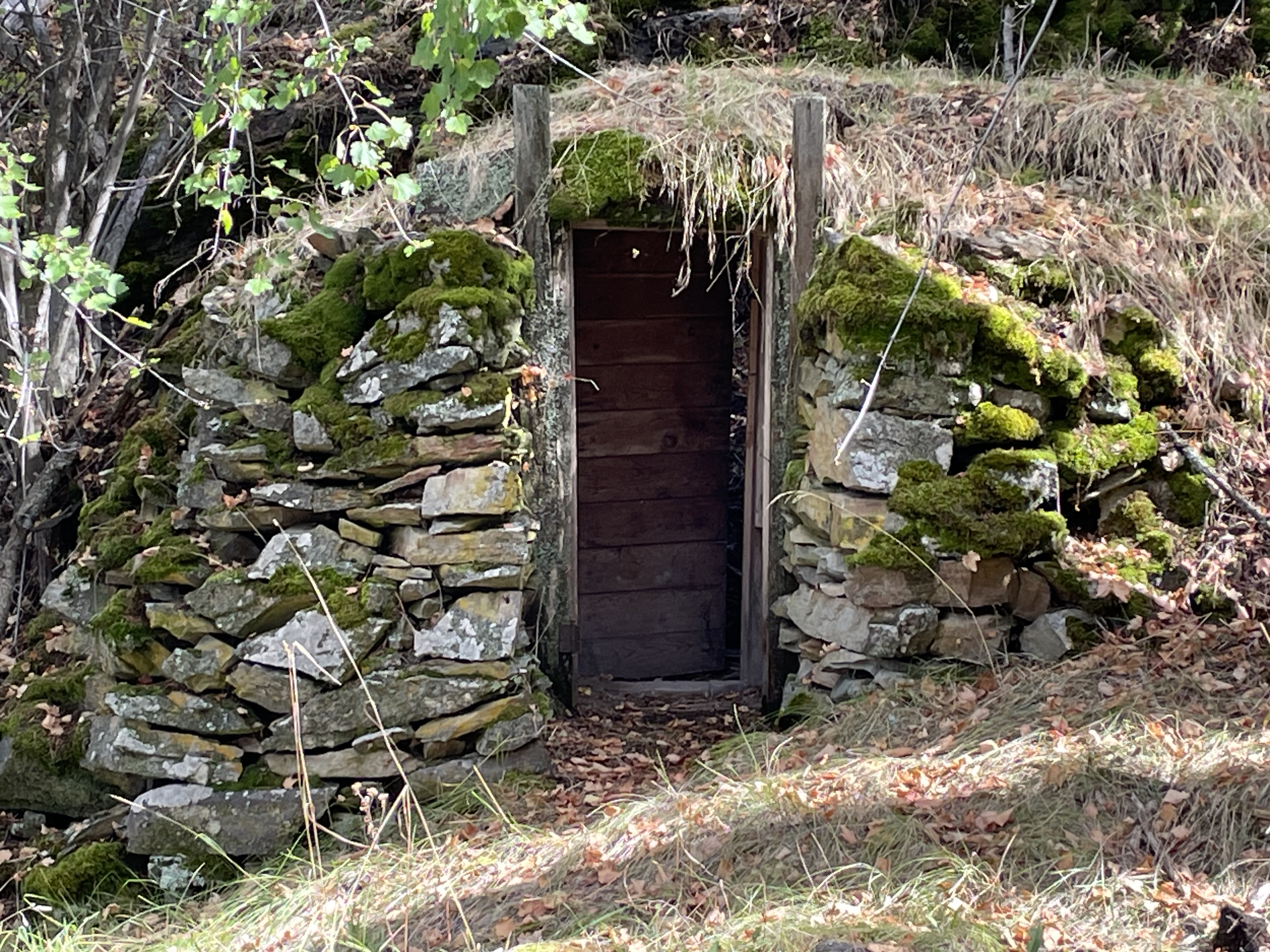
About a hundred yards away I found strands of an old telephone line, white ceramic nobs like flashlights in the forest, but telling the story of how people once communicated on the island. I also discovered a cold cellar that the lodge cook must have used to keep meat and vegetables cool for hungry guests arriving from the mainland. As the roof had fallen in, it seemed like a gateway to nowhere.
While wandering around I sensed that the wind was beginning to shift around to the north. If this change continued it would ease my paddle back to Finley Point but would again create quartering seas requiring my concentration. I went back to Bluebird, made ready, and headed home. Along the way I was careful to avoid the rocky spine now exposed at the northern tip of Rocky Point. Here the waves were actively breaking and seemed a hazard. In another hour I slipped into the marina and was relieved to be out of the rocking motion of endless waves.
Having a whole day and an evening to enjoy the experience, I put my extra food on the picnic table for an early dinner of sardines, Dakota bread from Great Harvest bakery and a crisp apple. Unfortunately, I was out of monster cookies.
Sometimes a paddle takes the form of a story. It has a trajectory, a narrative arc, and concludes with something that feels like arrival. But other times a paddle leaves one only with images, fragments and small observations that might eventually find their place in a story or simply sit in one’s memory like stones on a beach. I have learned that it is best not to force life into the form of a story. I am content with seeing clearly, looking more closely, enjoying the time we are given.
Every year I try to paddle to Wild Horse Island in May. I do this to honor my mother who died this month sixteen years ago. Some people have ideal mothers. My brother and I were not so fortunate, thanks to a surgery when she was in her 20s. Medical mistakes set her up for a life of pain, chronic illnesses and multiple addictions in response to physical and mental suffering. Despite these difficulties, and partly in reaction to them, I remain the recipient of so many things. In truth my mother gave me everything I needed—a wariness of intoxicants, desire for a conscious life, my love of language, and attentiveness to the world within and around me.
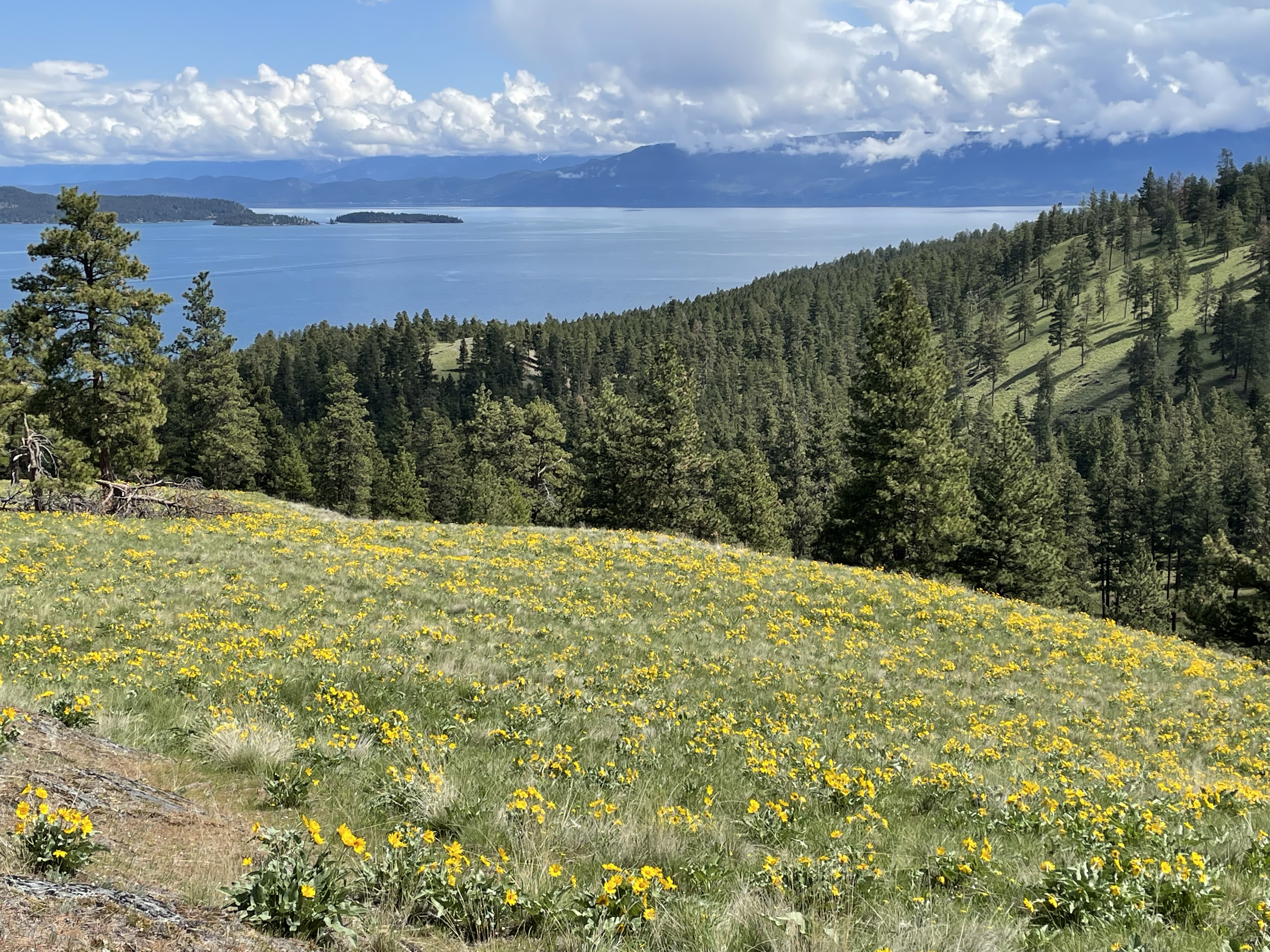
Because she gave me the gift of life I am able to paddle to the island, hike its ridges, explore its valleys, appreciate its wildflowers.
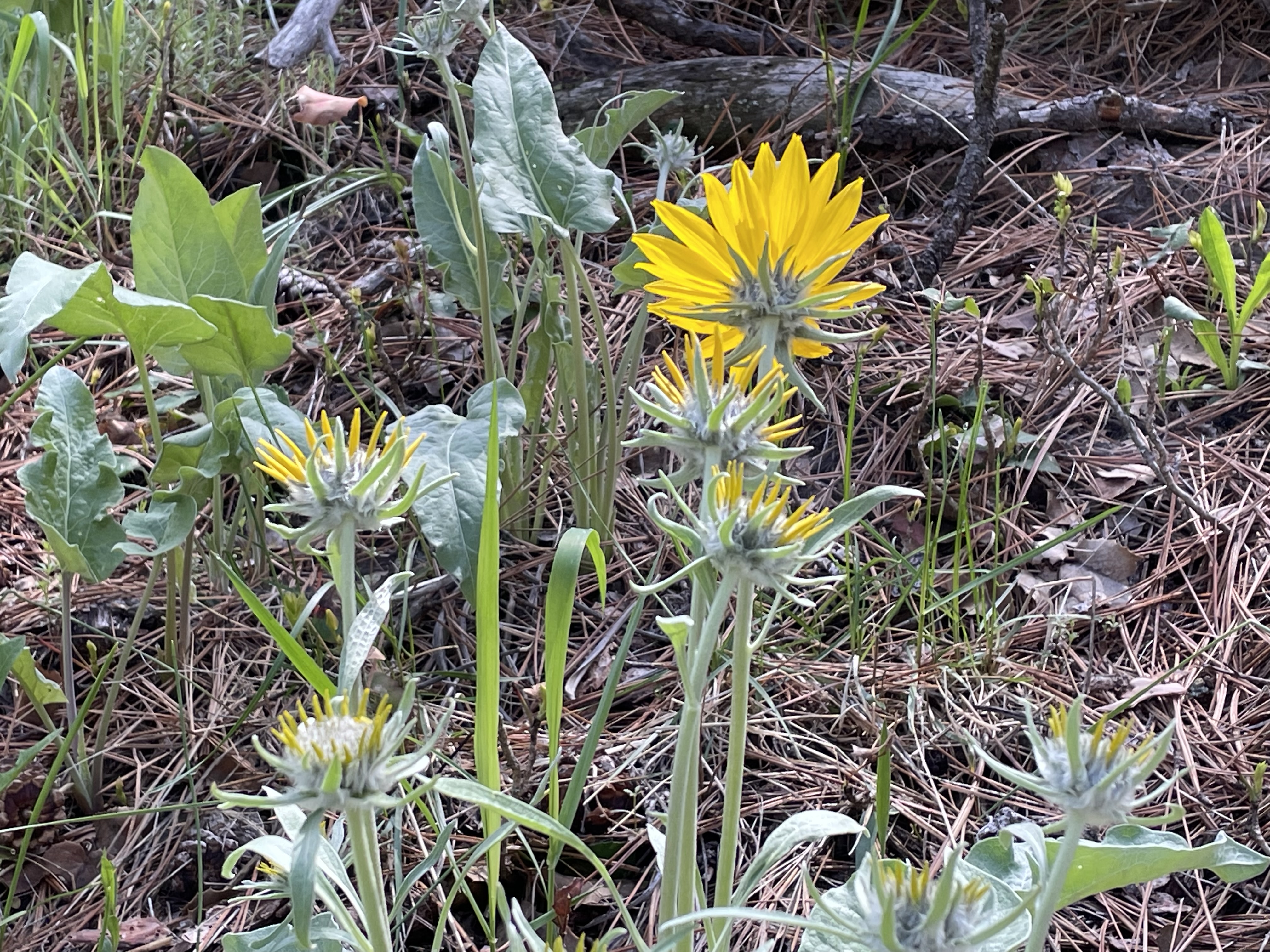
Almost certainly she would have noticed and called attention to the way Balsamroot turn toward the morning light,
the composition of stone and flower, hard and soft,
an owl feather still wet with dew,
a once-living tree suspended above the current of its journey and the storms that threw it there upon the stone.
Trained by her at the window of sunrise, I notice the way cumulus clouds form the central reflection in ovoids, see the kestrel, on its perch in a pine tree, step in a full circle as it surveys the world.
Given a perfect day for paddling and a chance at life, I am nothing but grateful. In response I offer her the the whole island’s bouquet.
Near the end of March it is still snowing, not in the fitful fashion of a spring squall but continuously, earnestly, as it usually snows in December. Once again the driveway is covered in snow and the back slope wears an armor of ice. We have been locked inside this winter for five solid months. Yet, the expansion of the light after the equinox has an effect on me in the same way that it normally affects the apple tree outside the south window. In a normal year, whatever that is, the buds would be swelling by now in response to the light if not the weather. Despite the weather, something in me is also awakening. Despite the snow and unseasonable cold, I am beginning to imagine paddling my kayak, negotiating wind and waves in a glassy vessel, exploring islands and coves, immersing myself in color, dissolving into the life of the lake.
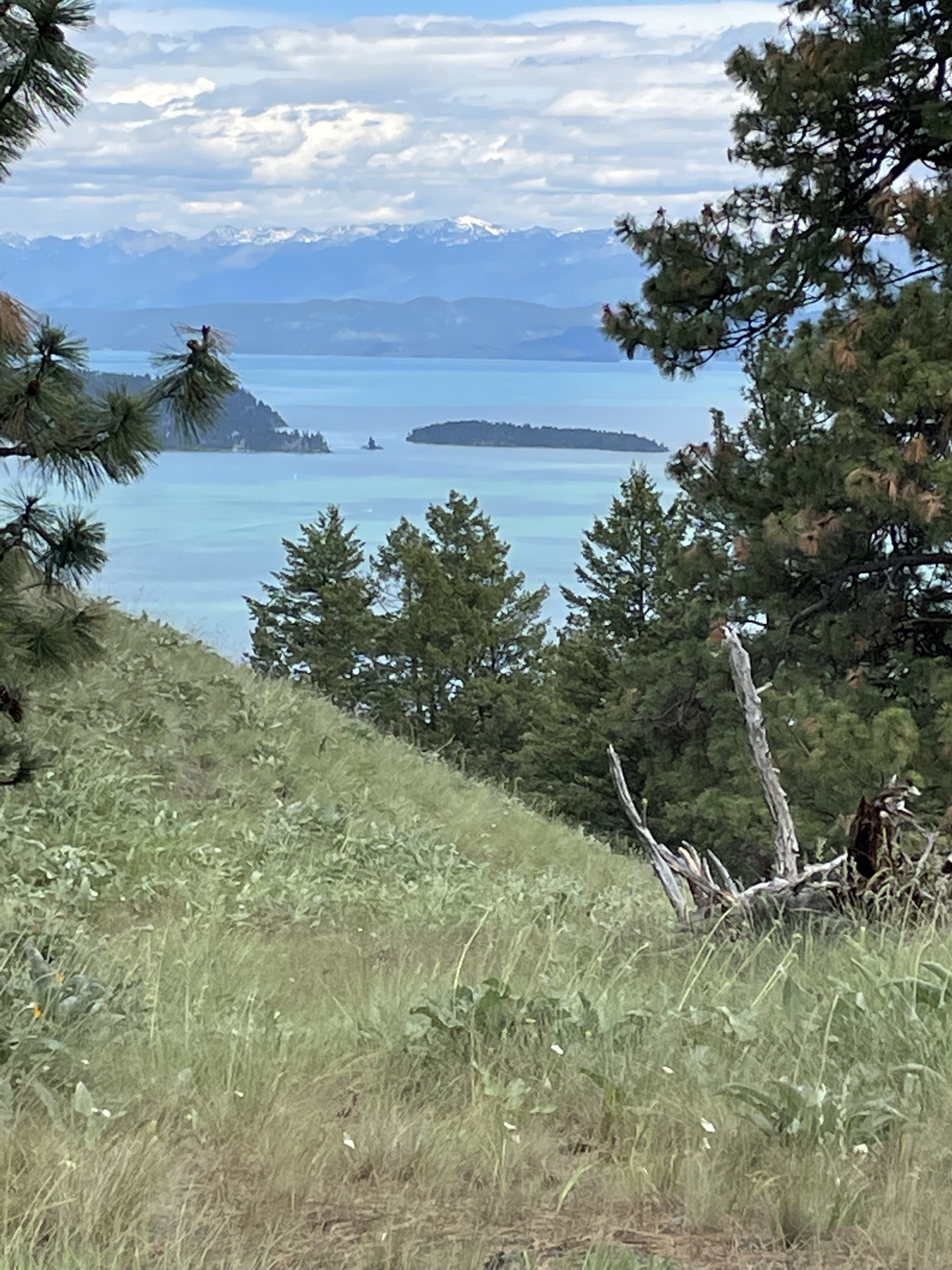
from the top of the Polson moraine
This weather that keeps me indoors also leads me to reach toward my shelf of favorite books where I find The Living Mountain by Nan Shepherd, a slim, white paperback that stands in the company of hardbound Wendell Berry, Annie Dillard, Robin Wall Kimmerer and Robert Macfarlane. The book tells the story of Shepherd’s first sight of the Cairngorn plateau in Scotland when she was a child and how it awakened a desire to explore its heights and depths. She recounts encounters with wild weather and hardy human beings. She traverses slopes, climbs peaks, notes birds, animals and insects, crosses streams confined by granite walls, traces their courses from uppermost springs to the valleys of the Spey, Avon or Dee.
First published in 1977 by Aberdeen University Press, the book was written in the years during and soon after WWII. After Shepherd received a discouraging response to the manuscript she tucked it in a drawer where it sat untended for almost thirty years. Meanwhile she continued to climb and explore her living mountain, but also the mountain that had impressed itself on her mind and heart. In a disturbed and uncertain world the Cairngorns were her “secret place of ease.” Then as an old woman she began “tidying out my possessions,” as she says. Rereading the manuscript, she found it still valid and felt renewed energy to see it published. We are so much the richer for the second wind of this writer and her belief in what she had written.
In some ways the book resembles a kitchen pantry nearly bursting with sensory detail. As Shepherd opens the door on this pantry, she describes the taste, touch, smell, sights and sounds of the mountain in all seasons of the year, both night and day. With her description of the taste of a berry, the texture of a plant or stone, what it feels like to walk barefoot over heather, the sound of an owl landing on a tent pole or a storm crashing into the walls, canyons and corries, she practically places us inside the mountain. Then in the final chapter, acting as our mountain guide, she takes us beyond all the details of weather, the colors of leaves and feathers, the varieties of animals, the intricacies of trails and routes, human pleasures and fatalities. She leads us up and out, or down and in, until we break into the open to consider the deepest things of all, the mystery of what it means to be alive, to be aware of one’s own being in the company of Being itself. It is as if the fog and mist of sensory detail suddenly clear and in her company we see an open sky above the summit. Rereading the final chapter of The Living Mountain I realize that what Nan Shepherd says of her beloved range might easily be said of Flathead Lake. One only needs to change a few words from her closing paragraphs to experience the lake that, like her mountain, is its own living being. If she had lived in Montana instead of Scotland, when she crested the last moraine heading into Polson she might have written:
…So my journey into an experience began. It was a journey always for fun, with no motive beyond that I wanted it. But at first I was seeking only sensuous gratification—the sensation of height, the sensation of movement, the sensation of speed, the sensation of distance, the sensation of effort, the sensation of ease: a kind of lust of the flesh, the lust of the eyes, certainly the pride of life. I was not interested in the lake for itself, but for its effect upon me, as (a cat) caresses not the man but herself against the man’s pant leg. But as I grew older, and less self-sufficient, I began to discover the lake in itself. Everything became good to me, (its long shoreline, its islands, its rocky hillsides and forests, its shades of color, its crevice-held flowers, its birds). This process has taken many years, and is not yet complete. Knowing another is endless. And I have discovered that the experience enlarges (the ramps and slabs of stone, deep, dark depths, turquoise shallows, great banks of gravel, deer and sheep drawn to the margins). The thing to be known grows with the knowing. I believe that I now understand in some small measure why the Buddhist goes on pilgrimage to a mountain (lake). The journey is itself part of the technique by which the god is sought. It is a journey into Being; for as I penetrate more deeply into the (lake’s) life, I penetrate also into my own. For an hour or two I am beyond desire. It is not ecstasy, that leap out of the self that makes a human like a god. I am not out of myself, but in myself. I am. To know Being, this is the final grace accorded from the (lake).
I do not know when this storm will end, when the ground will thaw, when the water temperature will rise enough to make paddling seem safe. But as the light changes, whatever atmospheric rivers flow our way, I imagine what it will be like to be on and in the living lake. Like Shepherd the hiker and climber, walking herself “transparent” to every living thing in her world, I hope to paddle myself transparent, clear of fears and concerns, empty of self, open to every resonating thing in a still-living world. As Shepherd’s knowledge of the mountains evolved, so, too, has my motivation and knowledge of the lake evolved. I will return to the lake not for myself but to experience the lake being itself.
I sometimes ask myself, Why do I do this? Why drive 160 miles round trip to get wet, windblown or sunburned? Why burn about six gallons of gasoline at a time when we are warming the planet faster than it can absorb the carbon dioxide we produce? Why deal with the aggression on the highway of the big-truck crowd? Why do this when so many things demand attention at home, especially in October when we are trying to finish outdoor chores before winter slams the door on light and comfort?
Midway through my paddle out to and around Wild Horse Island I realized a couple of possible answers to my questions. On September 15, I tested positive for the Omicron variant of the Covid 19 virus. My case was relatively mild compared to others whose coughs linger for weeks, who lose taste and smell, who suffer lasting fatigue, or even die. Paddling against a north wind reminded me that I have recovered, that my body has restored itself to health. In the two-hour beat against the wind, without distraction and in the company only of my thoughts, I remembered something else. On a recent visit to see my youngest son and his family I told Kyle that getting older does not necessarily mean things get easier. He looked at me squarely as we hugged one last time at the airport and said, “Stay strong, Dad.” I think he was telling me, “Dad, I need you in the world. Stay active. Don’t leave too soon.” Perhaps I drove north and paddled north for these reasons—to celebrate the recovery of health and as part of the process of staying strong for those who need me in the world.
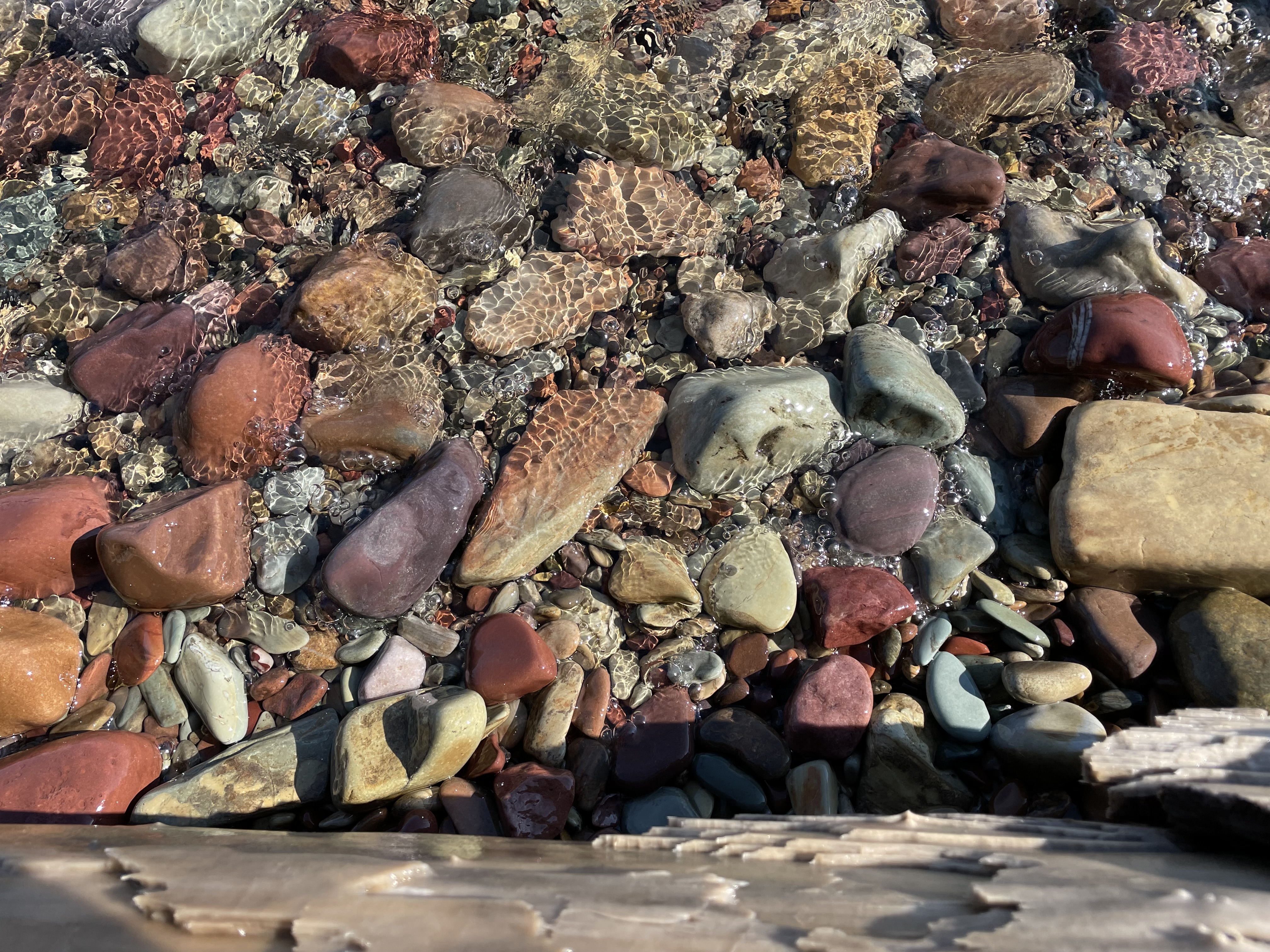
In my circumnavigation of the island I looked to Osprey Cove as a refuge where I hoped to rest and eat lunch, but the landing did not feel safe; waves had pushed the gravel into a steep and sliding slope. I backed out of the cove and headed south where I hoped to find a more protected place to land. I found such a spot at the East Shore access to the island. I got out of Bluebird without spilling and wedged the boat between two drift logs. Thanks to my beloved I enjoyed a massive and spicy Beach Boy sandwich from Tagliare and Smyrna figs. After lunch I wandered the shoreline, climbed into the dry grasses and yarrow. Along the way I discovered a Big Horn sheep skeleton, bleached and barren. I took time, too, to marvel at the clear water of October, all the sediments and pollen settled out. At this point in the season the water seemed like a pure distillation. Once back in my boat I continued south, avoiding the ramps of stone along the shore because the reflected energy of waves created rougher conditions a few yards off shore. When I saw sheep resting in the shade of a pine tree, however, I could not resist approaching for a photo. I rarely see these animals in the open. This was their time to build reserves before winter makes life more difficult.
At the south end of the island I turned west and enjoyed several miles of assisted paddling as wind and waves nudged me from behind. In the face of things I felt I should do, I left home, but returned feeling as though my body had been washed clean as October gravel near shore. The lake offered an image to the imagination. This is something to celebrate.
I have lived in Montana for nearly 40 years. Even before arriving I tried to learn about my state. The people who invited me here hoped, even expected, that I would learn something about the state’s history; read the books they put in front of me; learn to close gates behind me every time I had permission to traverse private land; come to appreciate the long tenure of Montana’s Native peoples and cultures; and take a few back roads far from the interstate. In heart and soul I became a Montanan.
In the last two or three years living in Montana has become more difficult, and not just because of a pandemic. I can’t get a campsite where I used to drive up, find an empty spot and throw down my pad and bag. It takes thirty minutes to drive north through town where it used to take me fifteen. In some cases a dinner reservation must be made a week in advance. The median home price in Missoula recently hit $534,000. Sometimes there are more out-of-state license plates in parking lots than in-state plates with county numbers. When going fishing I have had to learn to dodge trailers and rafts.
With all this in mind I particularly admired the spirit of Tom Dickson’s Sketchbook essay in the May-June issue of Montana Outdoors (https://issuu.com/montanaoutdoors/docs/momj21). Like me he feels the pinch of change, but he found it in his heart to say, “Howdy, new neighbors.” To be sure, he had some recommendations for people from Utah, Arizona, Washington, Texas, Florida and California, things like not building a trophy home too close to a river or stream because of the impact of septic systems, or plopping one on a hilltop. But he even went so far as to propose that we give newcomers a welcome basket that contained a few things like a can of bear spray and a copy of the stream access law.
On a Wednesday in late June I pulled into a fishing access point along the shore of Flathead Lake. There were boat trailers and a car from another state. Under its open hatch a couple of women showered in a mist of bug spray. They launched an inflatable tandem kayak just ahead of me and began their own exploration along the shore. Meanwhile, I prepared to paddle out to Wild Horse Island, trying to remember every thing I might need, especially if predicted winds forced me to stay on the island until dusk when the wind usually drops.
Anticipating windy conditions I chose to bring my Werner Camano paddle because the blade gives me a little more bracing power in waves. But almost immediately I felt the absence of my Greenland-style paddle. More than I realized I have grown accustomed to being able to slide my hands up and down the loom for different kinds of strokes. I missed the faster cadence and the way the paddle is gentler on my joints. Adjusting myself to the unexpected, I crossed the strait to the island, made my way north to Skeeko Bay and pulled Bluebird ashore over a mass of floating driftwood. Even though Sélîs Kasanka Q’lispe dam is releasing over 50,000 cubic feet per second, the lake currently sits 5 inches above full pool as rain-swollen rivers pour into the basin.
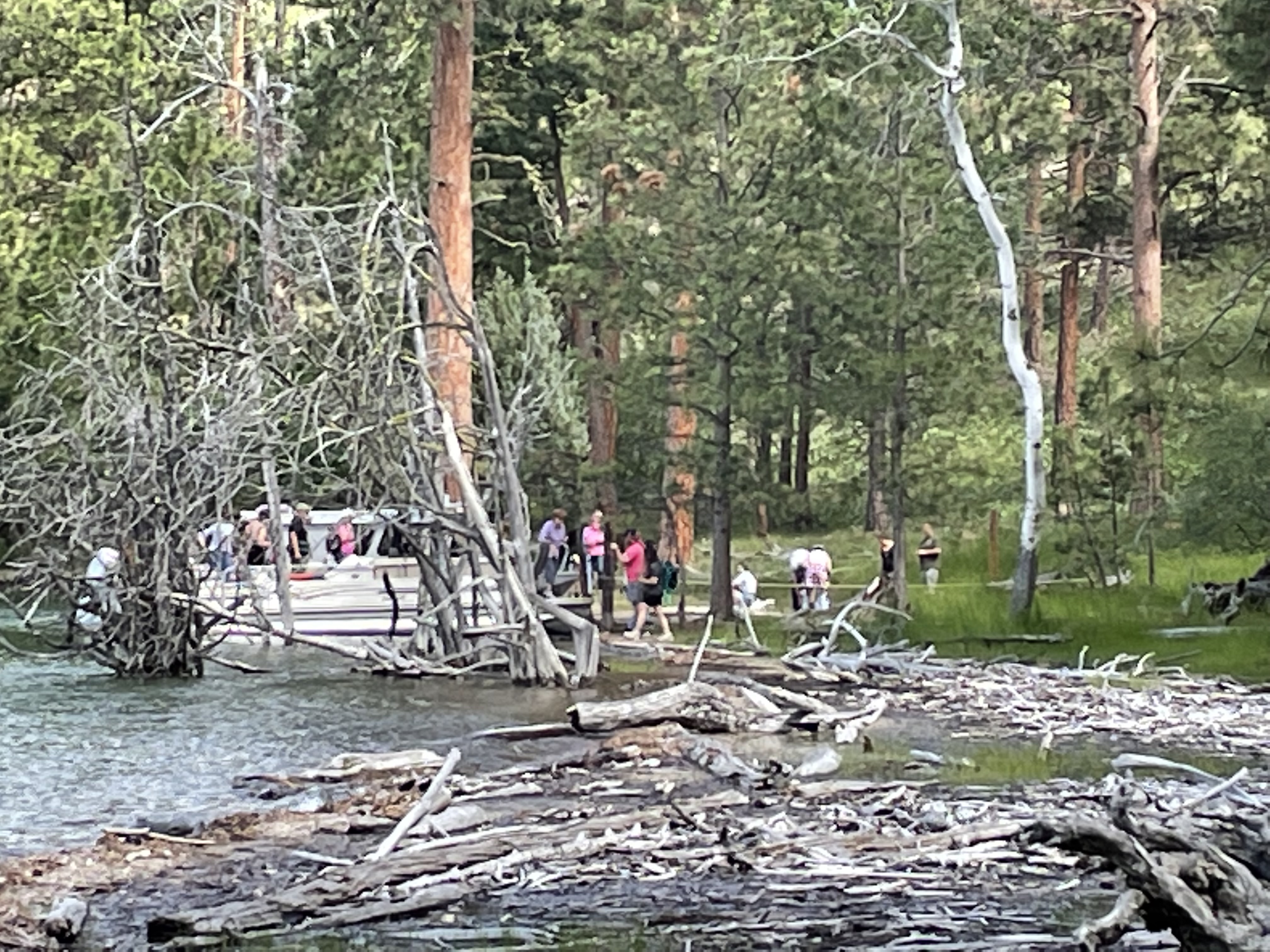
Once ashore, I found a big log where I could sit, eat a peanut butter sandwich and change clothes for a hike. Even on a Wednesday several pontoon boats had already run up onto the gravel shore and disgorged a pile of passengers while more of these vessels approached from Big Arm and Dayton: I would not have the island to myself.
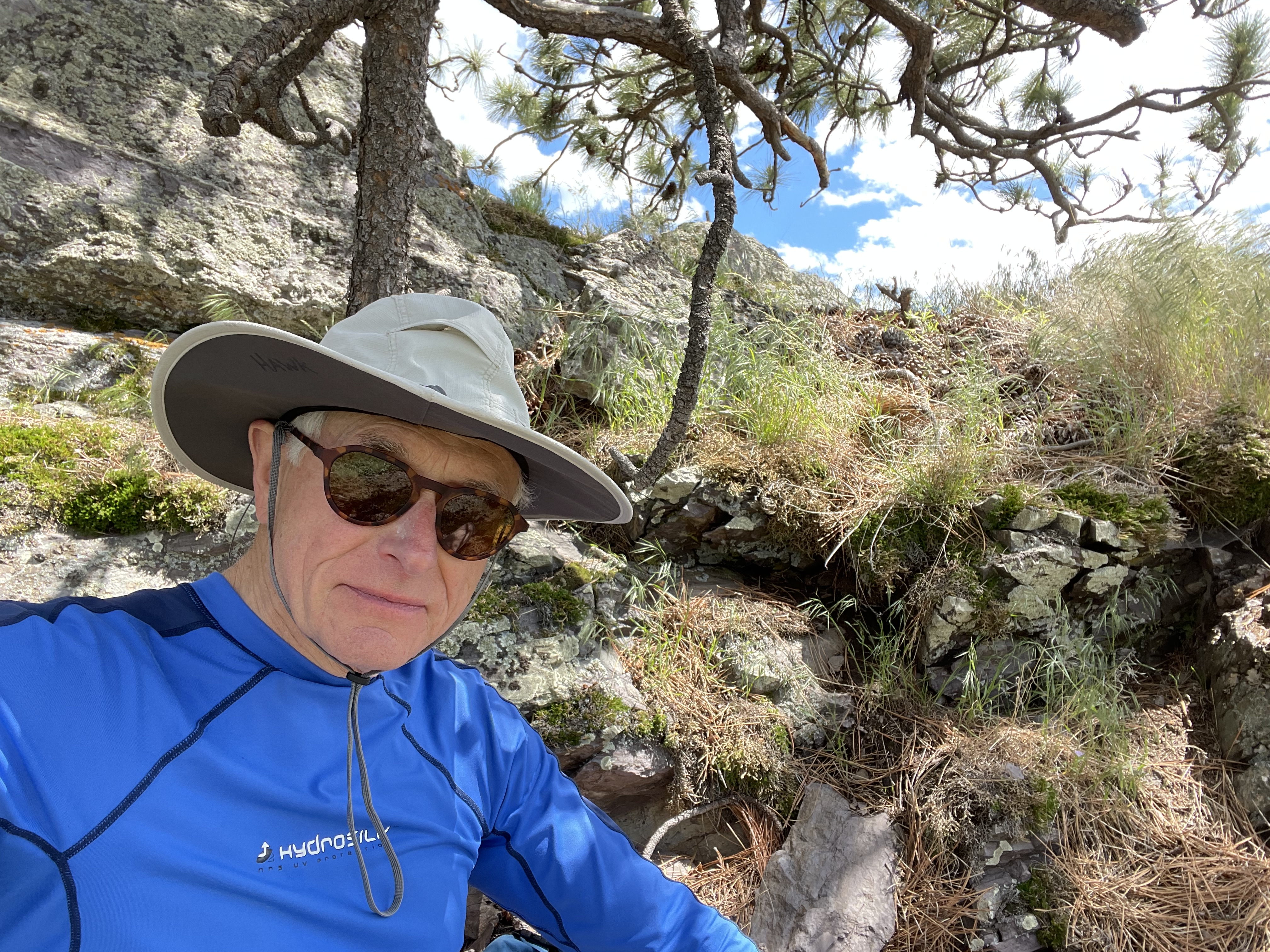
After loading a fanny pack with water, my first aid kit, and an already-peeled orange, I started up the trail. At the saddle where an old cabin still stands in the wind I turned left and took the Overlook Trail. Along the way I passed several families with young children. A toddler fell in front of me and scraped his left knee. I offered a band aid but his mother assured me that they had what they needed to comfort their crying child. I caught up to a couple heading toward the ridge, and as I passed, greeted them and asked if they were going to see the bitterroots. When they seemed mystified, I explained that bitterroots are the state flower and that they grow in the most inhospitable places like the rocky ridge ahead of us. They seemed interested but were not in good enough condition to continue up the steep trail.
During the day I saw lots of other people, talked with some whose accents I could not place. People asked, “Did you see a horse? A sheep? A bear?” I was tempted to say, “Only a lion,” but out of respect, held my tongue. On my way up to the top of the island I kept wondering, how do we do this? How do we welcome the people who are coming despite the changes they bring to a place we love and want to protect? How do we teach them that an animal is not an object to be counted but a particular expression and member of an incredibly complex community? How do we show them that a black-backed woodpecker is evidence of a combination of fire and insect populations; that a bald-eagle kiting in the wind is not something you see every day; that fire can be a friend to the land; that cheat grass is a problem? As I sat under a ponderosa clinging to its rocky footing I reminded myself of how Shoshone peoples must have felt seeing Lewis and Clark approach.
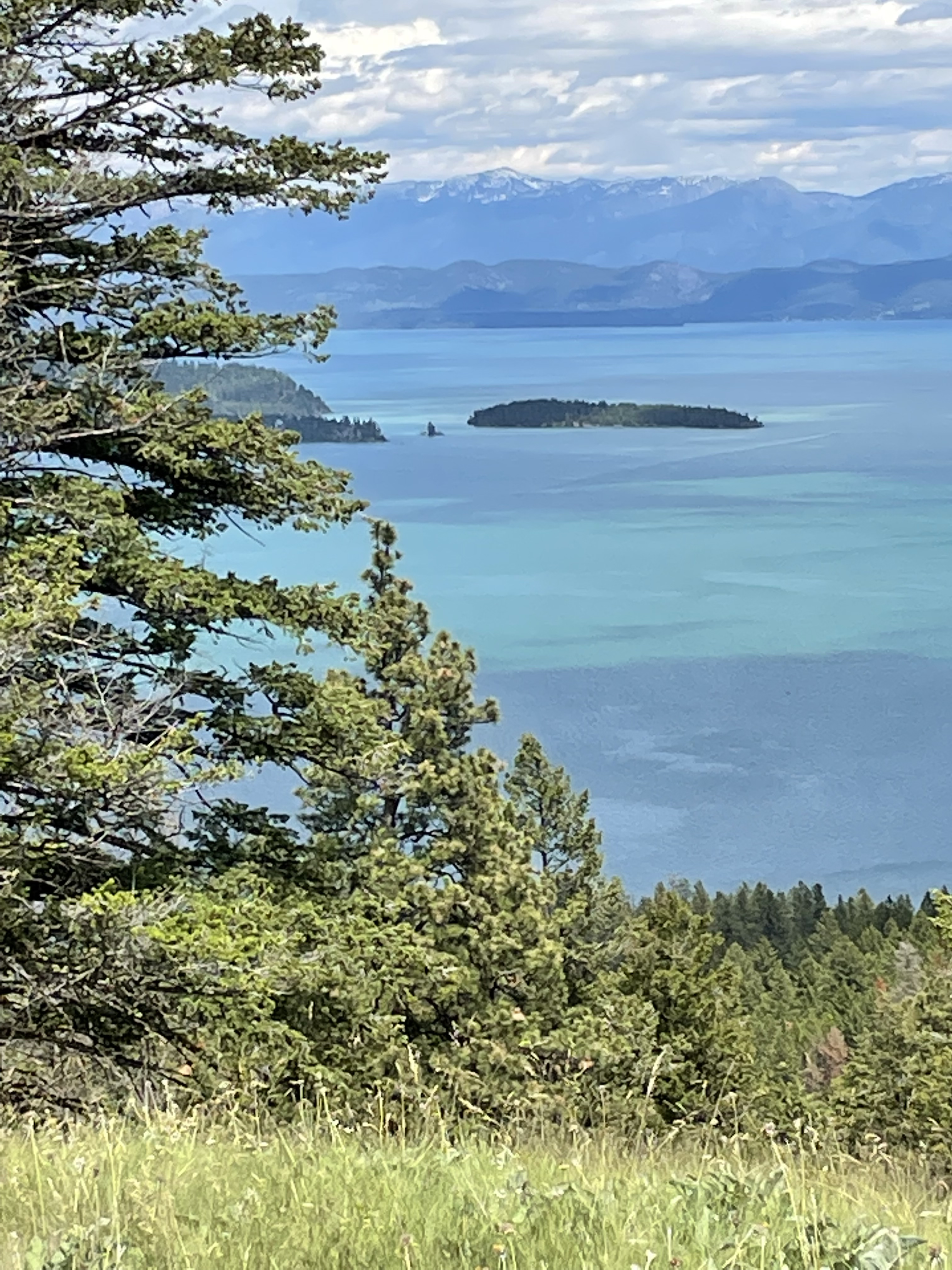
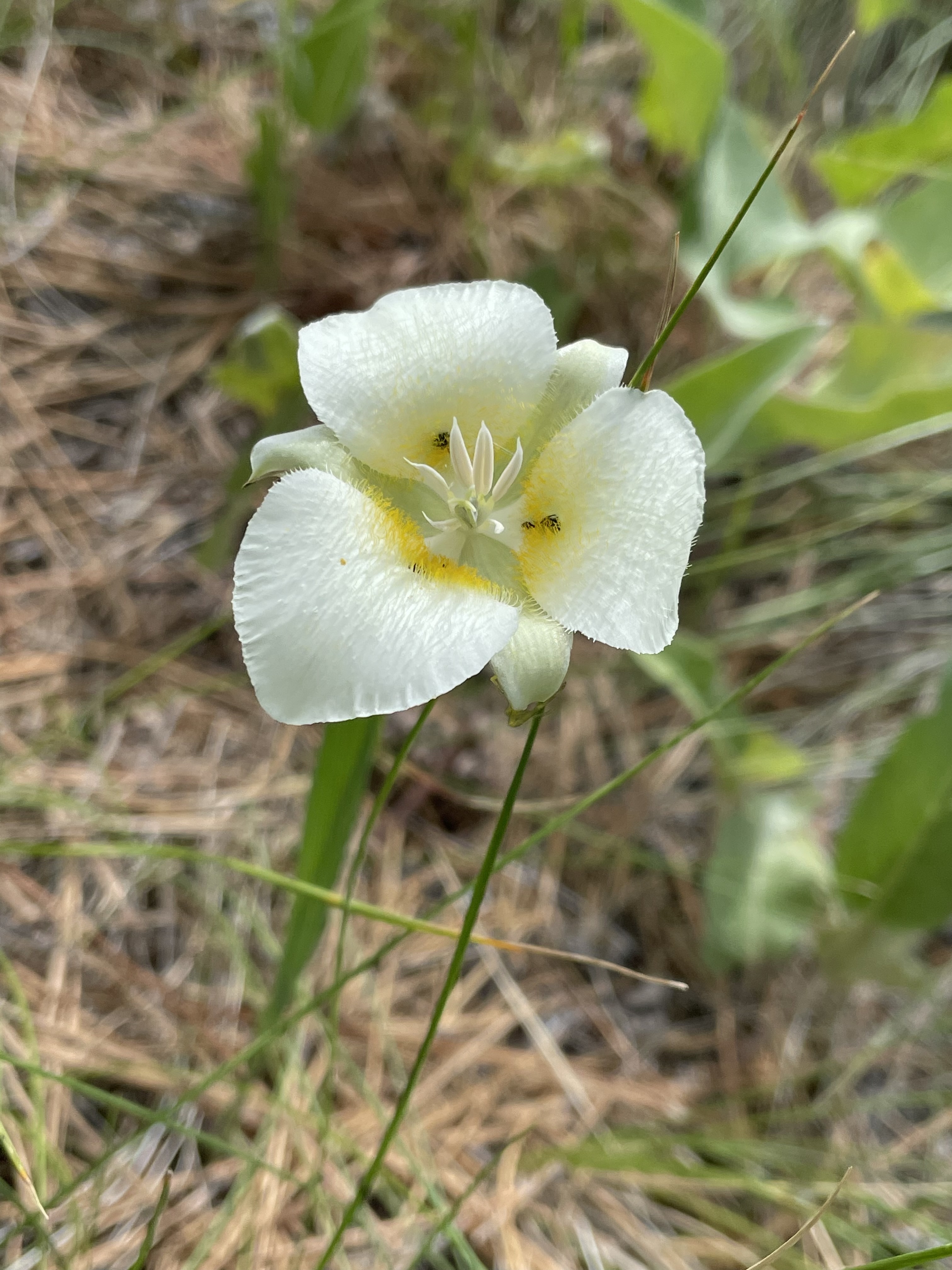
From the top of the island I looked in all directions, marveled at how the lake looked purple under shadows cast by cumulus clouds and a sunny turquoise where sediments in suspension from upstream rivers colored the water. I found several scrapes where animals had bedded down, but saw no deer or sheep. Near the top of the island I found sago lilies in a shady spot.
Watching gusts of wind race across the surface of the lake, I began to feel anxious about crossing back to the mainland, so I headed down the mountain. Along the way I found an Inuksuk, a reminder to act responsibly as a human being. Back at my kayak I changed clothes again and launched as two more boats sought to come ashore in front of me. They focused only on a place to land, not my vulnerability in a kayak.
Despite headwinds and the gusts that tore at my hat, I made it safely back to shore, though I did have to avoid flying hooks and worms cast from the dock. The changes we face won’t be easy to integrate. Yet, I hope to find a way to be friendly, knowing I, too, was once a newcomer, never quite native to this place I love.














 ospreypaddler