Settling in for Winter: A Feeling, a Memory, a Goal                   

Peach and rose-colored leaves lie at the base of the euonymus like a fallen skirt. Now I can see the chickadees who flock there early in the morning. Though this week is unusually warm, by the weekend the weather will be what we expect in mid-November. I turn inward, begin to reflect, retrieve a feeling, a memory, and awaken to a goal in the distance.

When I read from Into This Radiance at the library in Polson, Montana, conversation with people turned toward what it feels like to slide a kayak into the water and begin to bring the boat up to hull speed. The conversation reminded me of Denise Levertov’s poem “Avowal.” From a friend I had learned who might be drawn to the reading. Anticipating that this poem might speak to this audience, I had typed the poem into my outline for the evening and read it to everyone:

As swimmers dare

to lie face to the sky

and water bears them,

as hawks rest upon air

and air sustains them,

so would I learn to attain

freefall and float

into Creator Spirit’s deep embrace,

knowing no effort earns

that all-surrounding grace.

(from Oblique Prayers)

People in the audience described their experience of paddling a kayak in these terms, trusting the lake to bear and sustain them, the all-surrounding grace of buoyancy and wonder. When I read Levertov’s poem to the group, head nods and sighs told me they understood. This shared sensation is one of the reasons I keep returning to the lake.

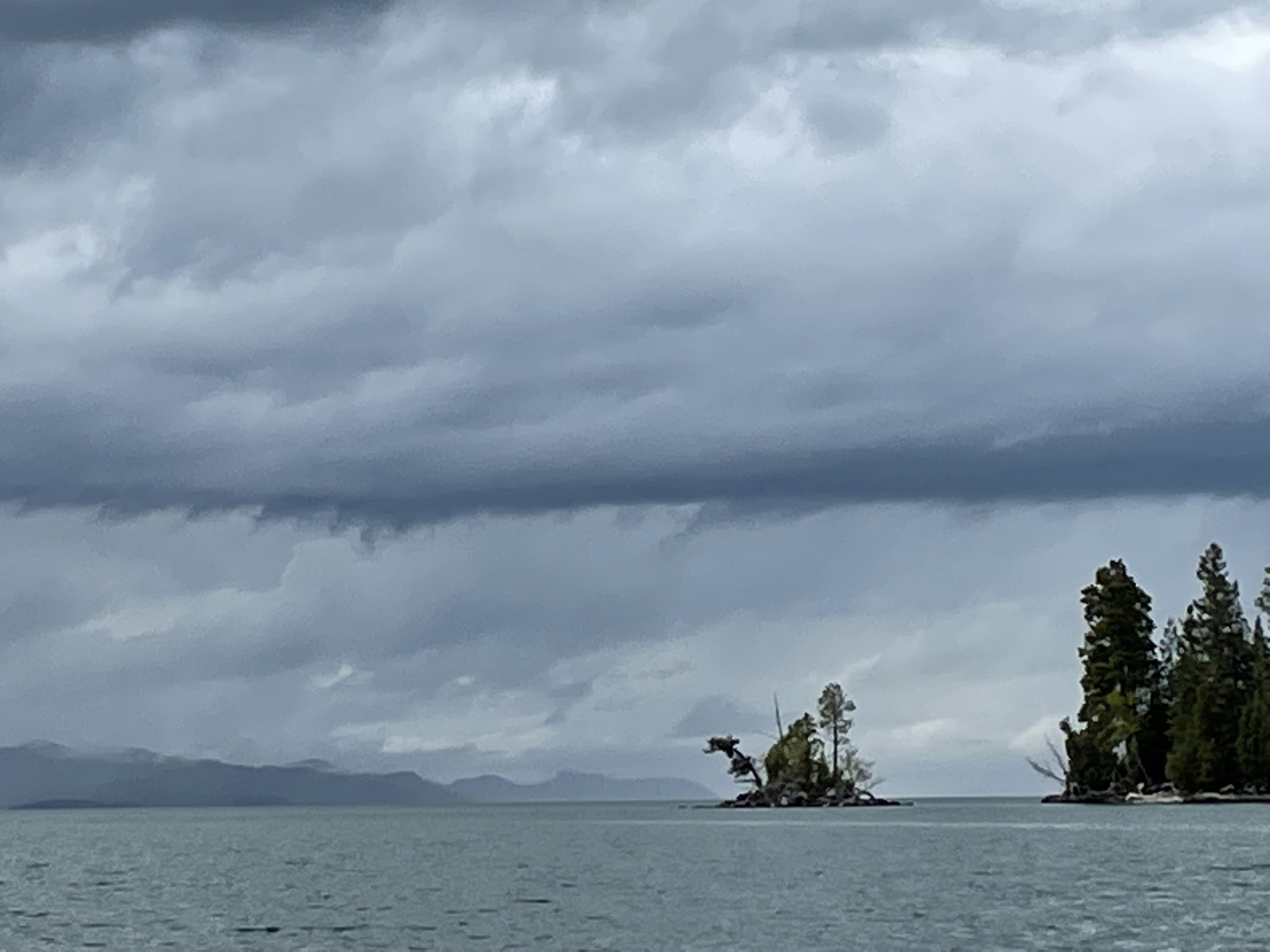
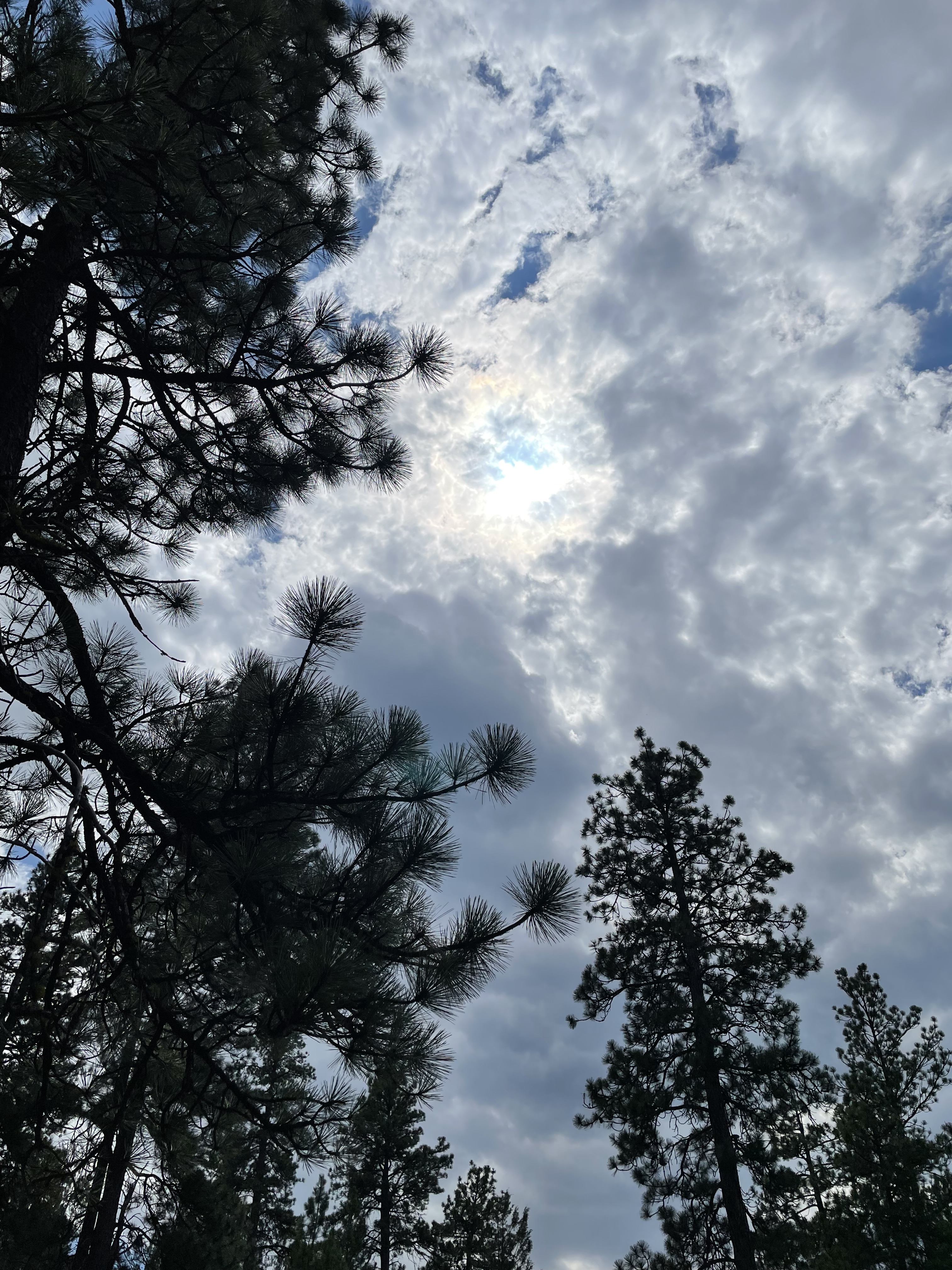
But then there is a memory. This past summer, on two different occasions, I was on the east-facing shore of two islands as weather approached from the southwest. Once on Wild Horse and once on Bird Island, I looked almost straight up and sensed the changes, but because I could not see the whole sky––my vision blocked by trees and the terrain of the islands––I felt alarm. I could see clouds amassing and flowing overhead, but I could not see if they were part of a larger system that might make the paddle home more menacing. Both times I suspended my explorations and resumed paddling so I could see around the islands. Fortunately, the weather systems did not become dangerous, and I returned without incident to my starting points. In November of 2025 it is as if we are on one of these islands, can look straight up but cannot read the whole sky. We see the edges of change and potential danger but have no way of knowing how they will develop, if they will pass benignly overhead or become life-threatening to more of us. On the islands I felt anxious when I sensed what was coming but had no way to evaluate it. If in the kayak, so as a citizen.
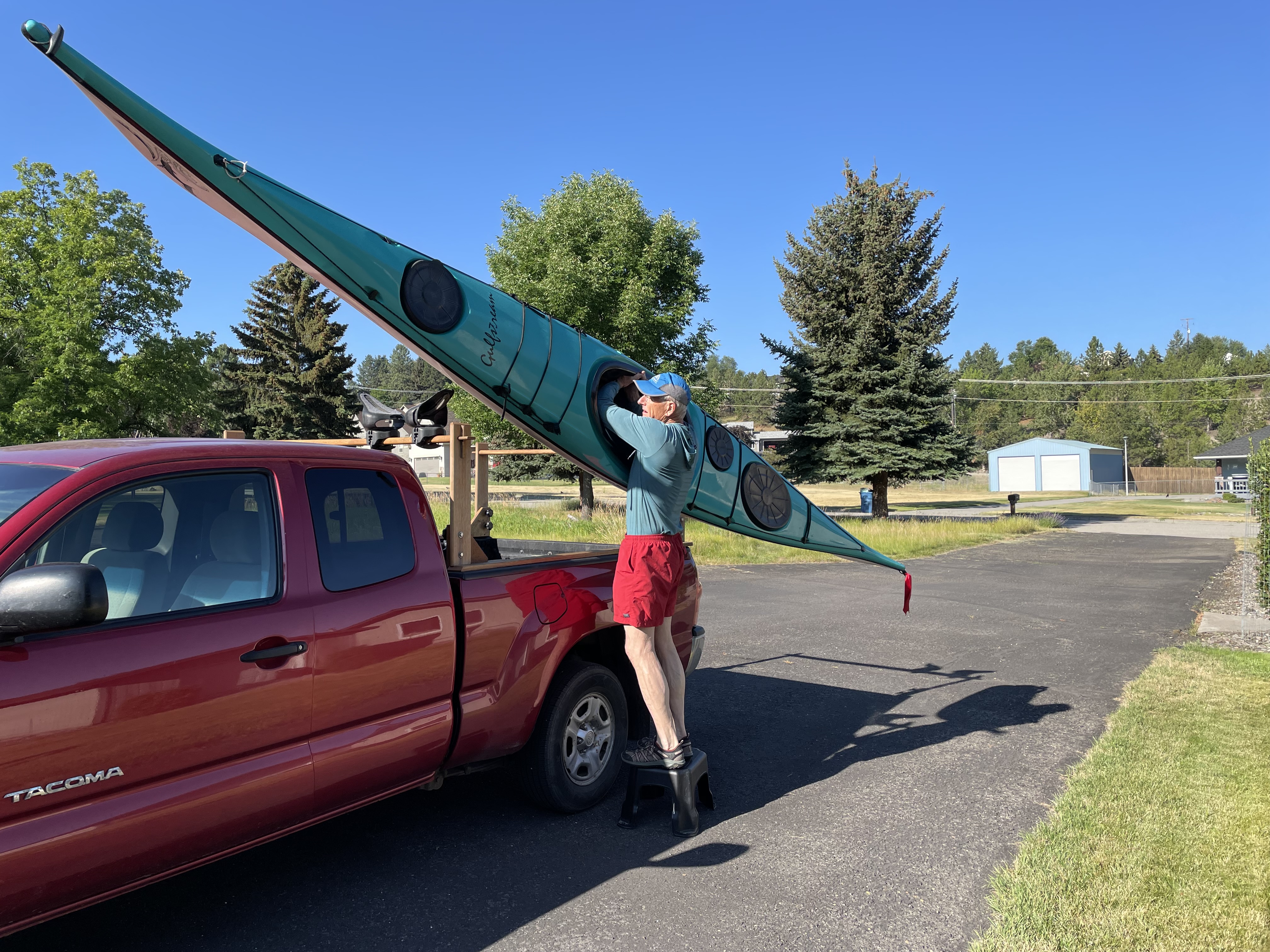
And finally, sorting memories before winter, I have a goal. Next spring I will be seventy-six. It is not getting easier to load my boat on its wooden rack, unload it without bumping the stern on asphalt, or pull knees to chest before sliding my legs into the tunnel of the kayak. Yet, I aspire to move smoothly, to apply strength at the fulcrum when it is called for and ease up at just the right moment. I aim to keep my balance and not move abruptly. As in the kayak, so as a citizen.
Almost every morning I put my hands in a yogurt container full of black oil seed, carry the seeds out the front door and cast a black arc to hungry birds. The way it feels in those first moments on the water, a memory of having only a partial view of the world, and a goal to move through it gracefully will sustain me until late April or early May.

Grounded

In May we arranged to stay at an old resort for three nights on both sides of the summer solstice before desire to see other family members took us out of town. The first afternoon and the next morning I made a couple of paddles––south and then north along the east shore of the lake, covering about 26 miles in total. Everyone seemed anxious, however, about an impending storm.

When the sky turned gray and the temperature dropped into the 40s, leaving a distinct snow line on The Mission Mountains, people headed home, lost restaurant reservations, or tucked themselves inside with a book. Deck chairs sat empty as rain pelted the Trex. We were grounded.

Though I felt tempted to paddle in the cold conditions, having adequate clothing, my old skirt had begun to leak, and I did not enjoy the feel of cold water dripping into my lap. I relented. There was still so much to do. I watched a merganser mother teach six offspring how to chase little fish into a shallow corner between the dock and the storm wall. While the little birds pursued their breakfast, the mother kept a close eye on approaching swells and would eventually lead them toward a safer spot. I enjoyed watching big waves break against the sub-surface boulders marked by the weather station monitored by the Flathead Lake Biological Station. When their energies felt the boulders on the sloping bottom, they spent themselves in a white crash. From our second-floor deck I sensed the rhythm of the swells as they rose, rolled, and slid diminished up the shore. The lake had become an ocean. During the storm, a huge diesel-powered barge loaded with rock and a bucket loader gave the point a very wide berth before rounding it and entering the bay. I imagined interviewing a skipper of such a craft. Commissioned to build shelter all over the lake they would have weather stories to tell. Meanwhile, squalls like giant thumbs, pressed on the roiled surface of the lake.

In a brief interlude, I watched a man using a four-footed cane. While supporting himself with his sturdy prop, he worked patiently to make a transition from steep steps to dock to beach. With one hand he undid the knot tying the board to a stanchion, then positioned himself on the board so he could take a few strokes into the bay and back. He did not let the lack of adult-sized floatation devices stop him. I was pretty sure he would have been offended if I had offered to help. Later, I met him in the rain as he walked slowly up the driveway. He introduced himself and his Parkinson’s disease. He summarized his relationship to the diagnosis by saying, “I have learned a lot.” He did not linger or extend the conversation, however. Taking another step, he said, “I’ve got to keep moving.” I later learned that he had devoted his life to the protection of the Great Burn area along the divide between Montana and Idaho. It was a place he knew and loved even if he could not secure its final protection as wilderness.

I am glad I accepted my grounding. I know I would have enjoyed the thrill of paddling in a storm, but I was richly rewarded in my observations. Thwarted, we discover new doors and windows on a changing world.

Snake, Geese, Shooting Stars and Sheep

May 12, 2025

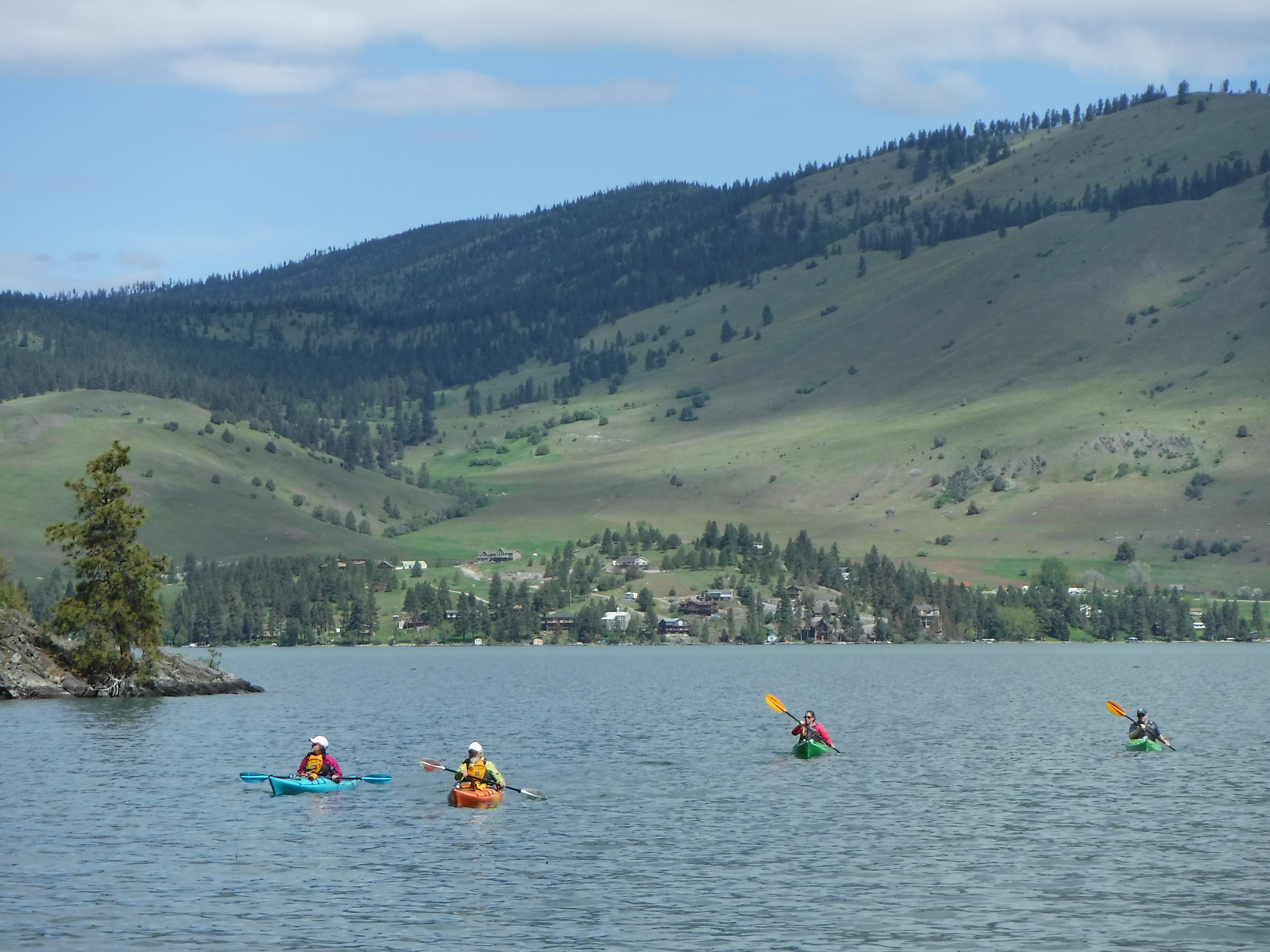
Calling from Colorado, Ed, my brother-in-law, expressed the hope that we might paddle out to Wild Horse Island, a capstone of sorts to his long driving trip through the Rocky Mountain West. On Wednesday, we paddled from the Walstad Fishing Access to the biggest island in Flathead Lake. After we returned home I wanted to write about the experience, but it took me awhile to realize what most needed to be expressed. Not what it is like to paddle against a headwind both in crossing to the island and in returning to shore. Not the contrast between May’s warm air and lake water at 43 degrees. Not the island’s eponymous horses we never saw. I want to describe sight and insight about the snake, the geese, the rams, and the Shooting Stars.

After reaching the island and padding up its west shore I waded ashore in Skeeko Bay. I noticed a garter snake swimming about my ankles; it too wanted to be on shore and to warm up. After lunch on a sun-silvered Ponderosa log, I returned to the boat and found the snake in the shade of the kayak where it had sought shelter from the sun. While Ed and I prepared to walk the trail to the island’s isthmus, we watched a mated pair of geese sail through the trees behind us, fly out over the water, and with sun on their backs, make synchronous wing beats to slow their descent and land smoothly on the bay.

On our walk through the forest, we paused at the trees where Native people found the sweet layer of cambium beneath the bark during the starving time of early spring. Along the way, we did our best to name the season’s ephemeral flowers, then at the saddle, I outlined some of the island’s history.

We scanned the slopes and margins for bighorn sheep, mule deer, or horses, but we did not find any of these large animals. On the way back to the bay, I noticed that eagles that nested last year in a snag above the most visited area of the bay chose to locate this year’s nest somewhere else. I hope they found a safer and more secluded part of the island to raise their young. As we paddled out of the bay, we caught sight of three young bighorn rams. As easily as boys playing on a jungle gym, they scrambled over the rocks a few feet above the waterline, stood as silhouettes at the top, then vanished from view.

Leaving the cliffs, we felt the wind shift 180 degrees and oppose our every stroke. The return was even more difficult than getting to the island. We were not given the free ride we thought we deserved after paddling to the island.

As I think about the day, I feel as though I see clearly that each creature we encountered has its own life, a life separate from our own. Each animal and plant has a center to its own being, its own way in the world, and its own relations. They are not on the island for us, for our amusement, but for themselves. Each makes its own adjustment to temperature and light, to adversity or comfort, seeks its own safety, nourishment, and shelter. Each star has its own fire, trajectory, and circuit. In the same way that we humans had to adjust to not being the center of the universe at the dawn of the Copernican revolution, so we are not central to these other lives no matter how powerful we think we are. This was a good day because it de-centered us, dethroned us, and let us see, briefly, the autonomy of other living things. The grand total of two headwinds amounts to a warranted and appropriate humility. This is the gift we took home.

Getting Ready

My brother-in-law is climbing through the turns along the river, on his way to Montana. On the phone he told me he wants to paddle to Wild Horse Island. I need to get ready. The lake temperature is still in the 40’s and no one has access to NOAA’s Graphical Forecast with its critical information about wind direction, speed, and wave height—another casualty of government efficiency. Preparation and experience count now more than ever.

I lift the heavy, dark-green Maine Guide Bag off the shelf in the garage and carry it into the house. It contains most of the things I load into the car before driving up to the lake. Inside the main compartment I find the skirt my friend Mary repaired over the winter. The Velcro had become fuzzy and did not tighten across my tummy as securely as it should.

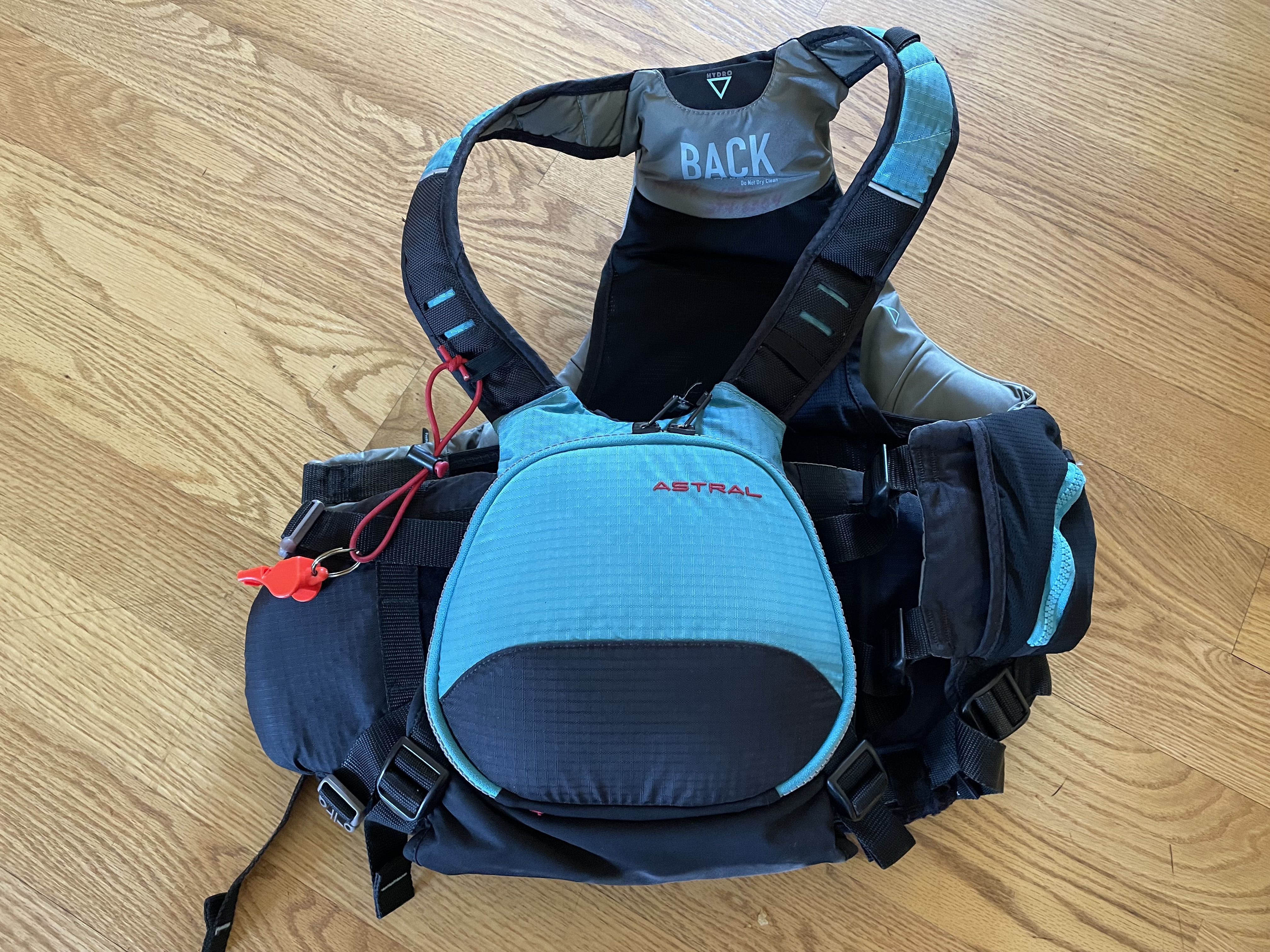
I pull out my Astral personal flotation device and test my memory of what I put where. Is the extra energy bar still in the narrow pocket and is the wider pocket still available for my phone, at hand when I want to take a photograph but also available in case of emergency? Do the inner pockets still contain nose plugs for later in the summer when I practice self-rescue techniques, extra sunscreen and lip balm? Does the small outer pocket on the left contain a stirrup to help me step up to the cockpit in the event of an unexpected spill? Does the opposite little pocket contain a paddle leash for exceptionally windy conditions?

I review what I’ve placed in the lime green bag for emergencies—water pump, fire-starter, a can of sardines, pouch of electrolyte solution, a towel, headlamp, and knit hat.

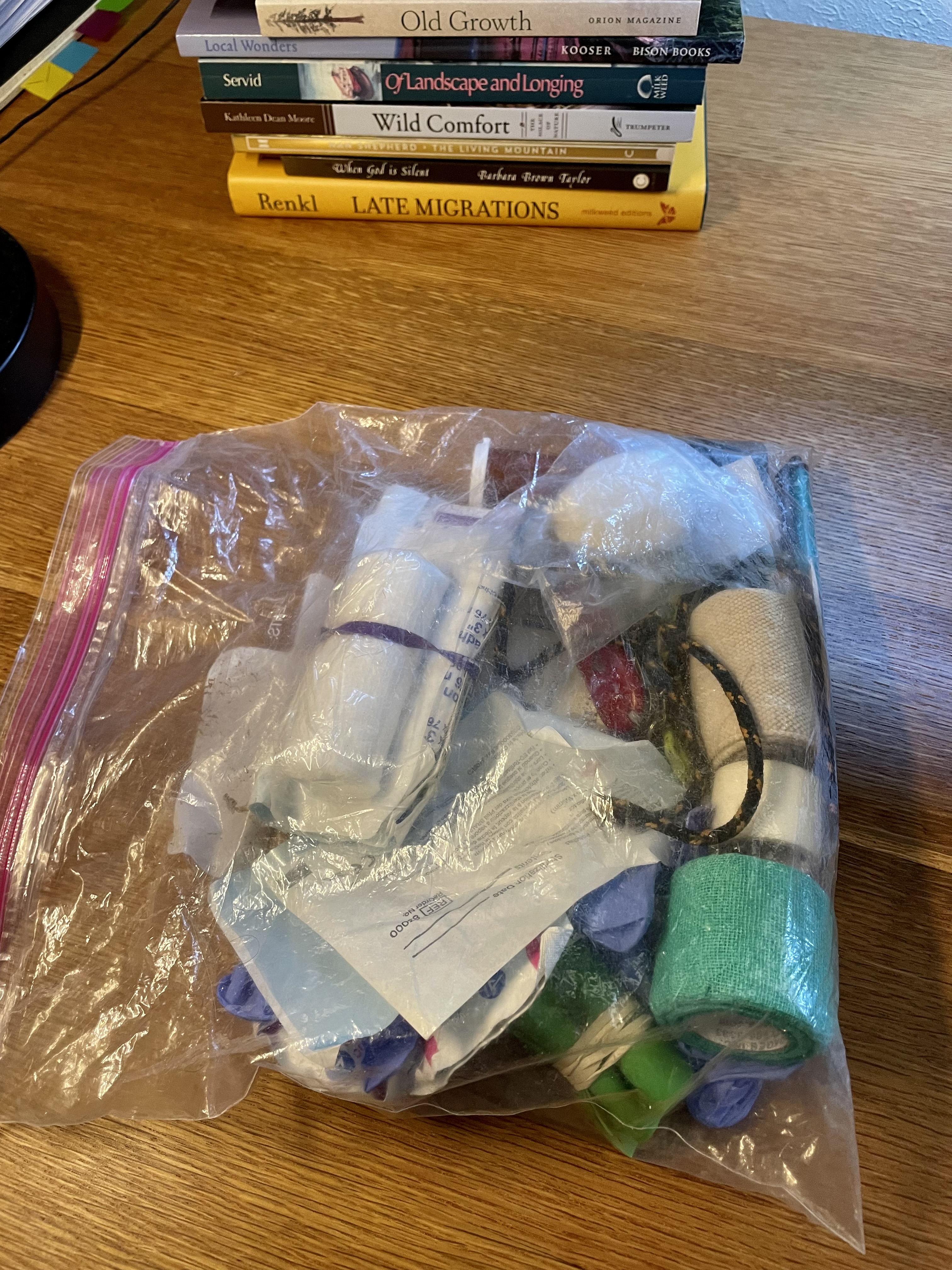
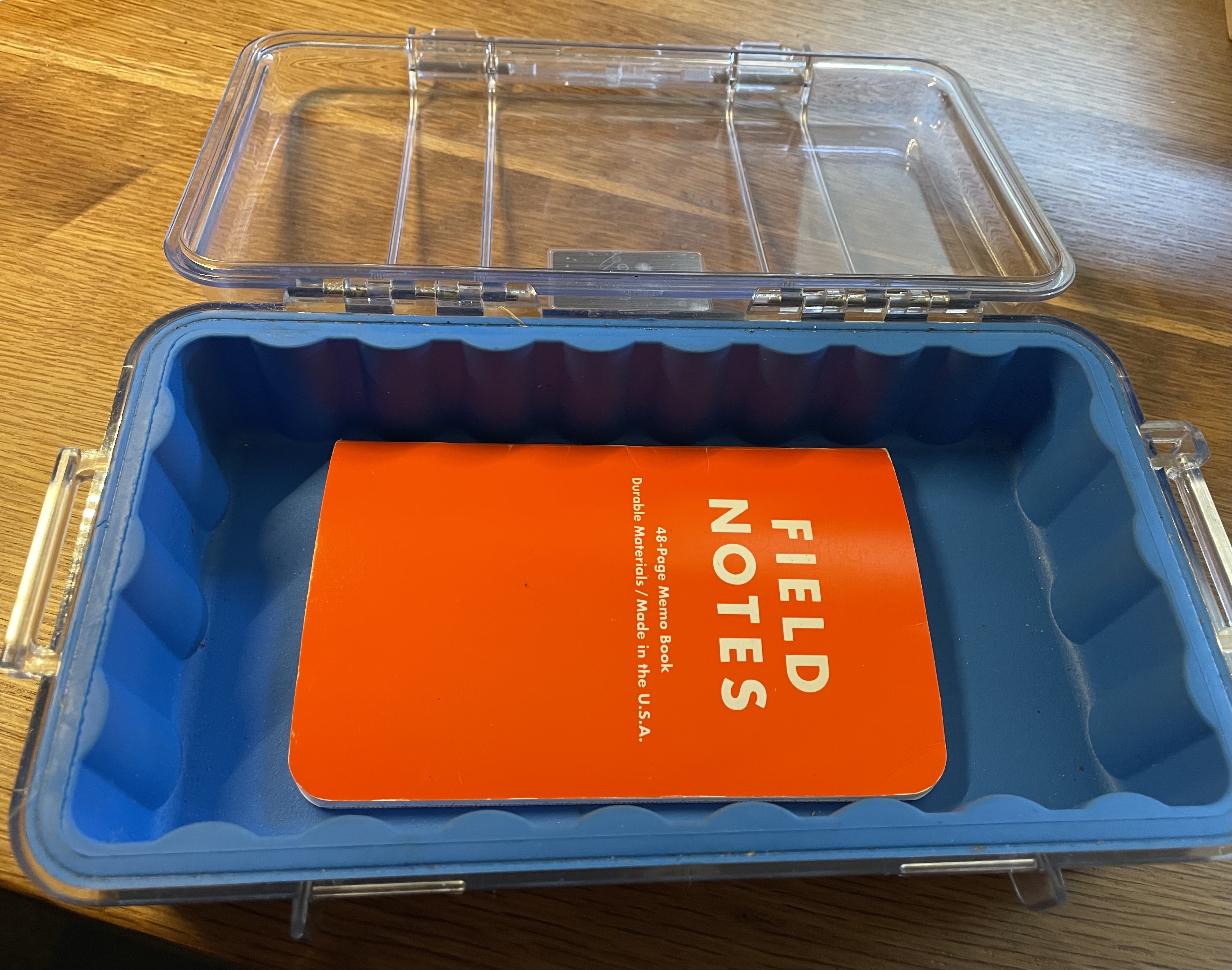
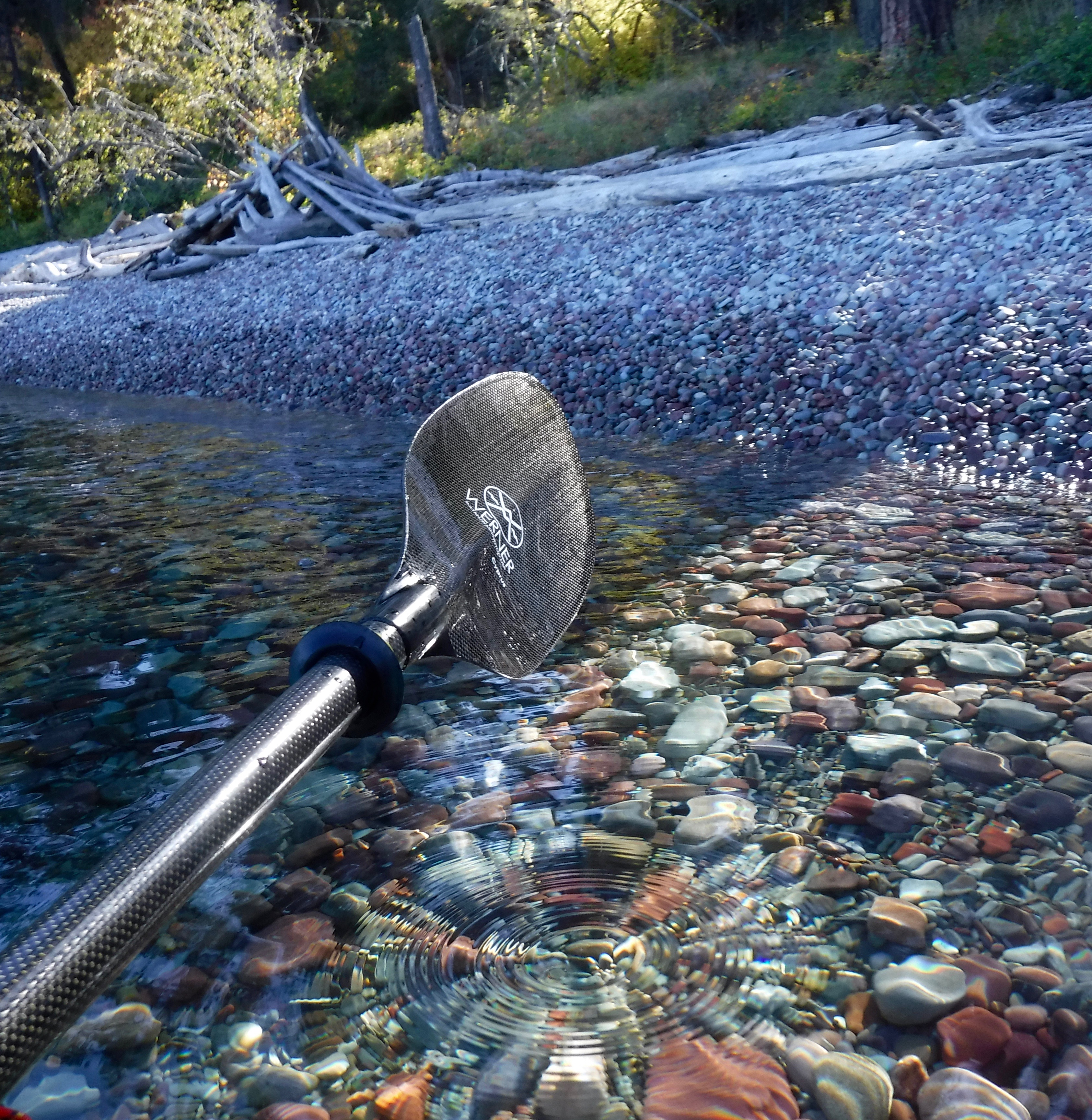
Because Ed and I will paddle in early May I want to make sure that I have my dry suit with its new wrist gaskets. I see the tightly folded Farmer John wetsuit for Ed and a synthetic shirt.  Reassured by what I am finding, I unzip the side pockets of the gear bag. Here I find my old neoprene booties and wonder if they will get me through another season. The ankle gaskets have cracked. I’ll give Ed my paddling gloves and trust my hands calloused from gardening to hold up under the friction of paddling. Ed can have the Pelican box for his phone. I make sure that the first aid kit has a spare key to the truck, my old Swiss Army knife, appropriate bandages, medications, a pen, tourniquet, and Ace bandage. In the opposite pocket I see my cerulean-colored paddle jacket that I love to pull on over my head and shoulders.

Satisfied that I have the essentials I need and that I won’t forget an extra paddle for Ed, I feel almost ready. I enjoy the rituals of preparation, the creation of order, and access to items that add to the margins of safety. At the same time, I notice how these objects stimulate memories. It is almost as if memories stick to pieces of gear. Handling my thickest neoprene gloves I remember conditions during a cold autumn when I welcomed their insulation. Looking at the leash I remember a time when a gust of wind stripped the paddle from my hands. Reviewing the first aid kit I remember a time when I desperately needed what it contained and did not have it. The towel reminds me of a swim and times I used it as a tablecloth.  As memories adhere to the big Stanley screwdriver, a silk tie, or the red sweater I inherited from my father, so stories abide in faded fabric, the snap of a buckle, the sound of a zipper. All this is part of the pleasure of paddling a kayak, an experience I hope to share with Ed, a man at home in the mountains, but eager to cross the strait on the way to the island. Now we can both look forward to Wednesday.

Introducing a Granddaughter

On Father’s Day I am still thinking about taking my oldest Pennsylvania granddaughter paddling on Monday, June 10. Bodhi spends time in the gym, treadmills at a steep angle and lifts weights. She is broad-shouldered and almost as strong as her father. Even though most of her paddles take place on the lazy Brandywine where she and her sister look for turtles, I thought she might be able to paddle from the Walstad access to Skeeko Bay on Wild Horse Island.

After pulling into the parking lot, I walked down to the dock, the lake now full as my wife’s coffee cup. I saw conditions like those predicted by the NOAA site I faithfully consult—winds out of the southwest at 15 mph, waves less than one foot, locally up to two feet. The only catch was that we would have to contend with quartering seas that would consistently push us off our compass point.

We laid out our gear and placed the boats on softer ground than the concrete handicapped pad. I offered my boat to Bodhi, a little more stable and faster than my old plastic Perception Carolina 14.5. When she accepted the invitation, I put my head inside the tunnels to adjust four foot pedals. On the second try I got them right. Because of the wind I also suggested that we wear our blue paddle jackets.

I nudged her off the ramp and told her to hang out and get a feel for the boat while I made ready to launch. At first, she felt uneasy with the rolling motion as waves pushed her port stern quarter, so we advanced slowly into the lake, giving her time to adjust herself to the conditions. I could tell that she felt anxious because she paddled hard and fast, as if eager to get to the island. In the shorter, heavier boat I found it difficult to keep up with her. We worked in manageable conditions for a little less than an hour, but the waves kept knocking her away from the tail of the island that we needed to be able to round. I occasionally dropped off the mark, urged her back up and tried to match her fast pace. About fifty yards from the island, I could tell that I had not made myself clear: she was going to try to land on the south-facing shore of the island where waves broke against the blocks of argillite. I had not adequately explained that she would need to postpone her relief until we entered the slightly calmer conditions around the corner of the island. Even before I drew close to warn her about landing, her instincts kicked in and she began back-paddling. Gradually, she came away from the island and, sighing, followed me around the corner where we both could catch our breath, though the wind still blew.

Deep in the shadows a mule deer buck, still in velvet, foraged for still-soft greens. Sight of her first mule deer seemed to inspire her and we paddled on. Still, I had a hard time matching her pace. Eventually we rounded the gravel bar that defines the entrance to Skeeko and we relaxed inside the protection of the bay. Bodhi called out her amazement as two bald eagles circled above us.

With the lake much higher than on my paddle less than a month earlier, we pulled the boats up onto the driftwood. After we extracted ourselves from our paddle jackets it was clear that we had both worked hard. My NRS shirt was soaked, as was her long-armed bathing suit. A cooling breeze felt great. Hungry now, we lifted tuna salad sandwiches from the bear vault and agreed that a person would become strong as a bear from trying to rotate the lid past two spurs and their catch. Orange and apple slices were the perfect accompaniment to our sandwiches.

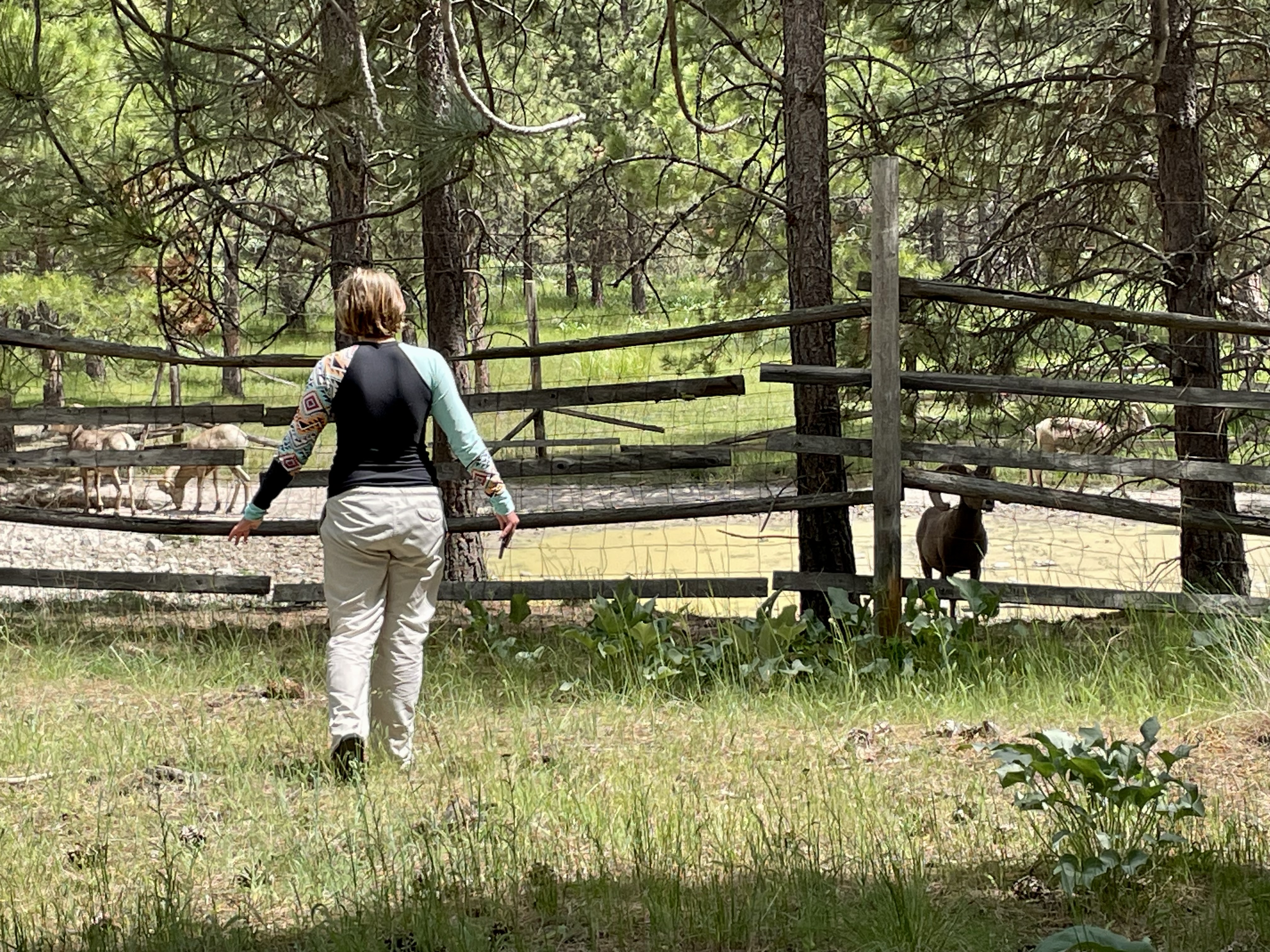
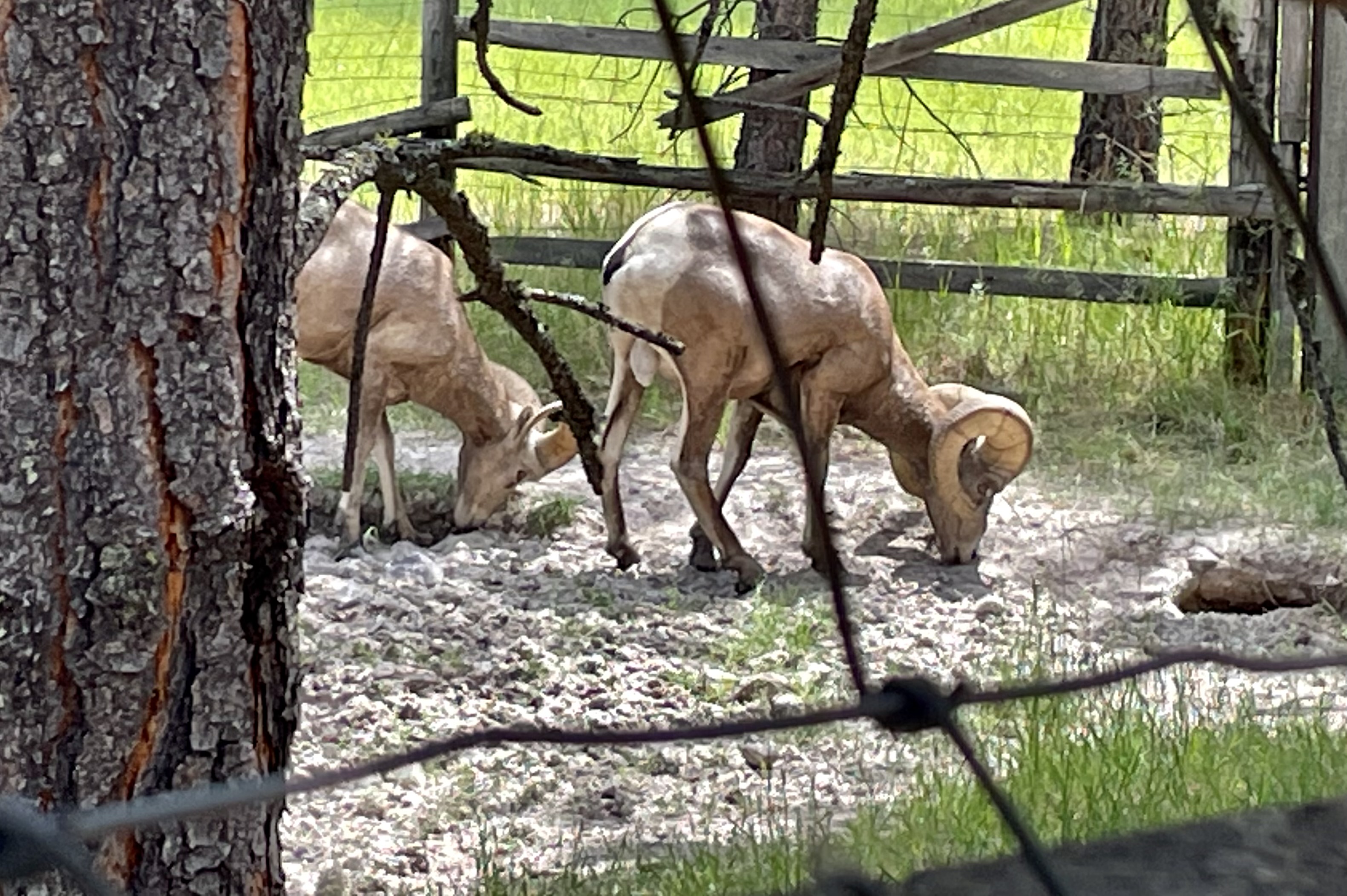
After lunch I proposed that we walk uphill to the island’s isthmus in the hope of seeing the wild horses who sometimes graze in the grass around an old and derelict corral. As though she were on the treadmill at home, she strode up the trail leaving me out of breath at the top where we paused and studied the slope below. Not horses but Rocky Mountain Bighorn sheep moved in and out of deep shadows cast by the pines. I said, “Let’s see if we can approach. We’ll use the wind in our faces to our advantage. They won’t smell us. Be sure to pause in the shade of each little cluster of trees.”

Like a huntress, she moved toward the animals who seemed nervous but did not flee. We got closer and closer until I realized that the big animals were drawn to minerals on the margins of an evaporating vernal pool. This was a magnet for them. As a wildlife biologist later explained to me, their exposure to green grass had elevated their potassium levels which could be re-balanced by consuming sodium in the drying soil.

Bodhi and I stayed outside the old fence and never blocked an opening where the rails had failed. One time the largest ram, the tips of his horns blunted by time and competition, faced us squarely and stared, setting off our own alarms. But we kept getting closer and closer until only the wire stood between us and animals we could smell. We watched for several minutes, astonished by the good fortune of having such a close encounter with animals that often elude detection.

More than satisfied, we climbed back up the slope, pausing to find a couple of tired bitterroot flowers still blooming on the hot and dry slope behind the solar outhouse. Back at the boats we enjoyed more slices of fruit and kept telling each other how lucky we were.  

Though the water temperature was around 52 degrees, we knew we would stay warm while working against the wind and waves approaching us now from the southwest. I told Bodhi, partly for my own benefit, that we did not need to hurry. We needed only to paddle at a pace we could maintain as the waves, taller now, pushed against us from the starboard corner and occasionally washed over our decks. This time Bodhi took my advice, controlled her anxiety about the long crossing from island safety to the southern shore of the lake. Having learned a great deal in the morning, she remained calm in even rougher conditions, let the boat move under her and paddled just behind me as I led us back to Walstad.

After landing, reloading the boats and stowing two mounds of wet gear I felt incredibly proud of my granddaughter. This had been her first visit to Montana, her first long paddle in challenging conditions, and her first encounter with heavy-bodied wild animals. Due to the trajectories of our lives and other commitments I have never been able to give my sons this experience. But my granddaughter will carry this memory as a prize in the pocket of her vest for the rest of her life—a gift for me on Father’s Day.

Renewal in June

Renewal in June

Have you visited the storehouses of the snow
or seen the arsenal where hail is stored…?
(Job, 38.22)
img_2002
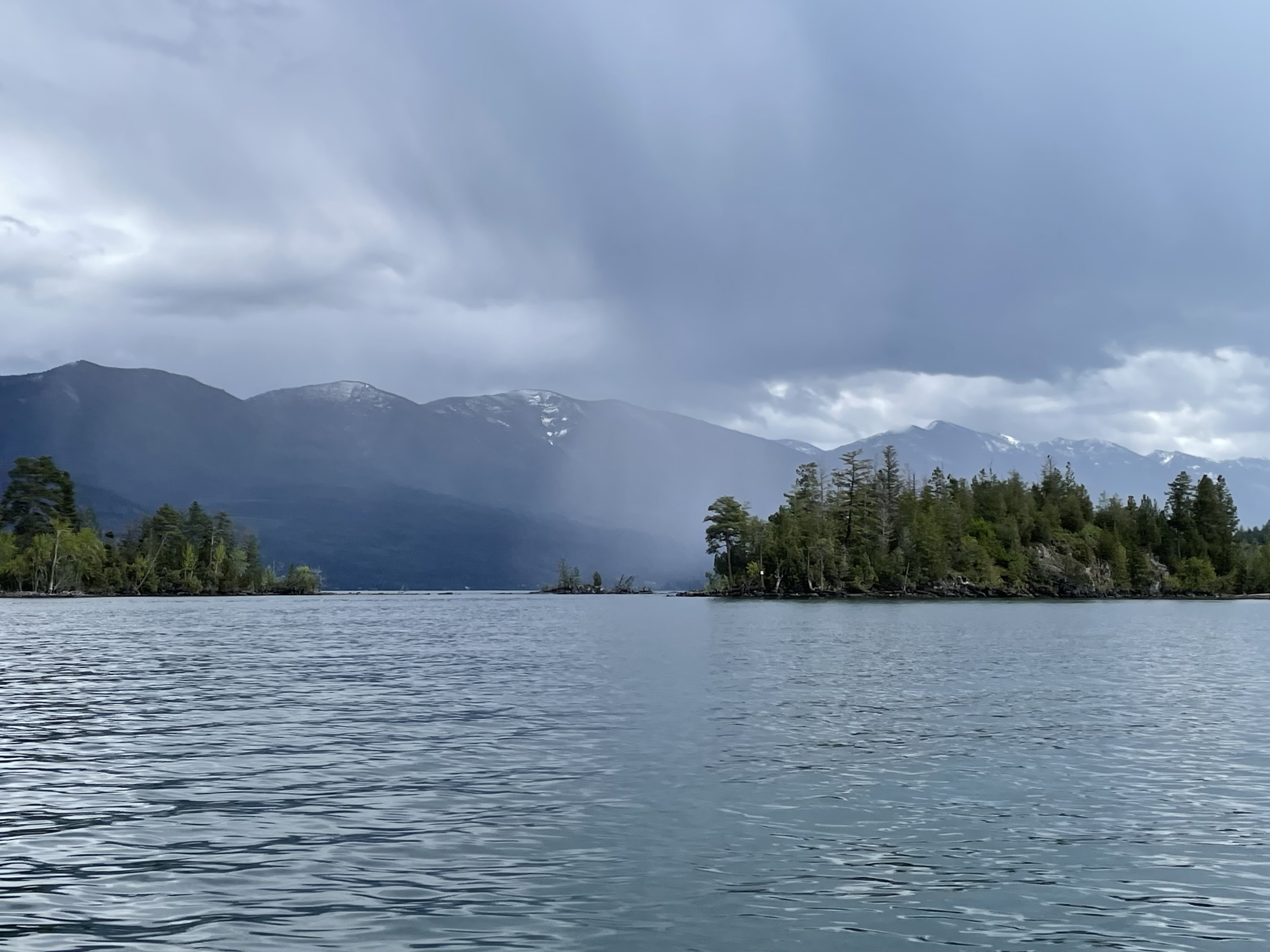
In the southwestern U.S. conditions are drier than at any time in the last 1200 years. If Lake Powell drops another 33 feet, the water level will be too low to power the turbines that send electricity across the region. In Los Angeles people will soon have to choose between saving water to drink or watering their lawns. In my region of the country parts of the state remain in a state of severe drought. But around Flathead Lake it rains intermittently for two days and two nights, raising the water level of Flathead Lake over a foot across its 191 square miles, more than 122,000 acre feet of water.

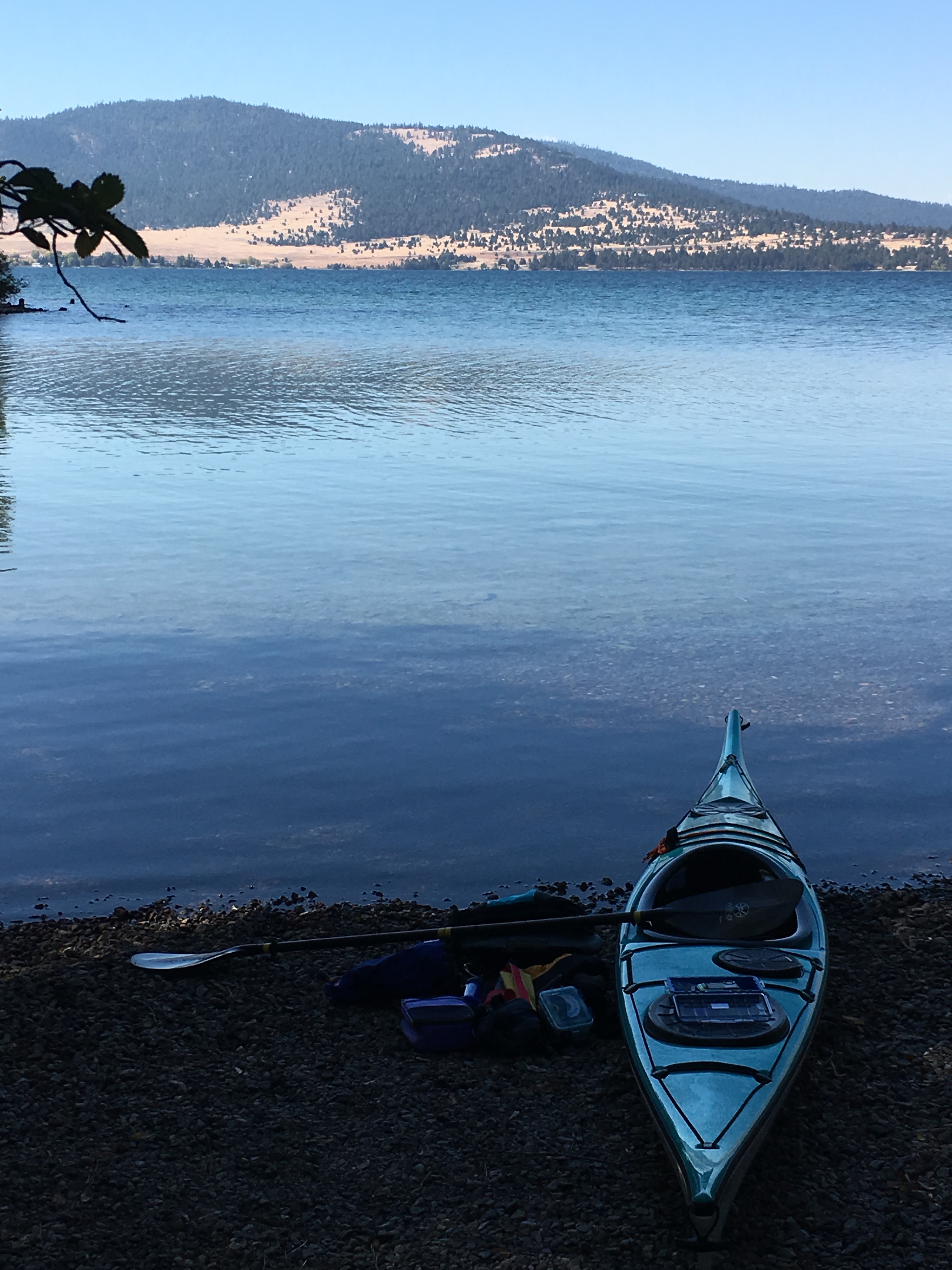
Unable to reserve my own campsite because competition for these spaces is so keen, I ask a friend to let me set up my tent next to his recreational vehicle in space 11 at Finley Point State Park. He kindly allows me and Big Agnes to create shelter next to the picnic table in exchange for an oatmeal crisp made from cherries grown in the orchards above us and the reading aloud of two Kathleen Jamie poems while he drinks his morning coffee. My friend is in the grip of the latest James Lee Burke novel, so I take Bluebird down to the marina and paddle in the rain.

Wary of lightning and the risk of waving a wet piece of carbon in the air during a storm, I plan a short paddle through The Narrows, threading my way in a figure-eight pattern around the islands. But when clouds to the north look particularly ominous, I make a broad sweep, reverse course, head south along the backside of Bull Island and cross back to the protection of the marina. If it is gray above, it is blue and green below.

Since everything is wet when paddling a kayak, it makes little difference if it rains. So I go out the next day too. This time I head north across Finley Bay, the tip of the peninsula and the chain of rocky shark’s teeth disappearing under rising water. I have paddled in many different conditions but never before in a hail storm. This time a trunk of hail drops down to the lake surface and balls of ice pelt my hat, drysuit, bare hands and deck. Though the particles are little larger than course rock salt, they turn the lake surface into a layer of froth not unlike a beer poured too fast or a latté covered in a milky hat. When dramatic things happen while paddling I wish I had the poise to unzip my pfd pocket, reach for my phone and take photos; but the best I can do is hang on, hunch my shoulders like a hawk on a limb and wait for the storm cell to pass. Until the gray column of falling ice advances to the east I listen to the sounds of hail, each sound different depending on the surface it strikes.
IMG_2009
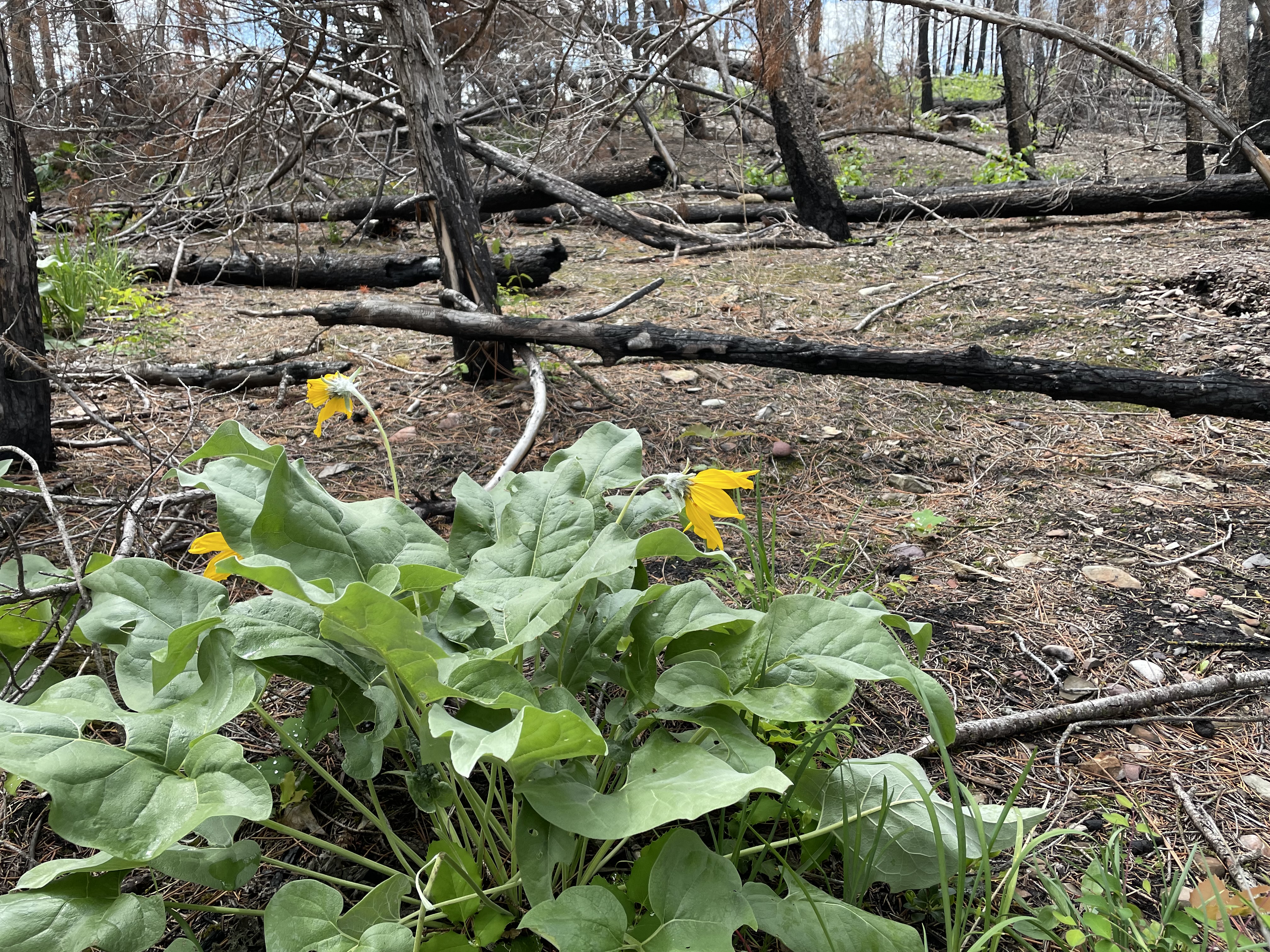
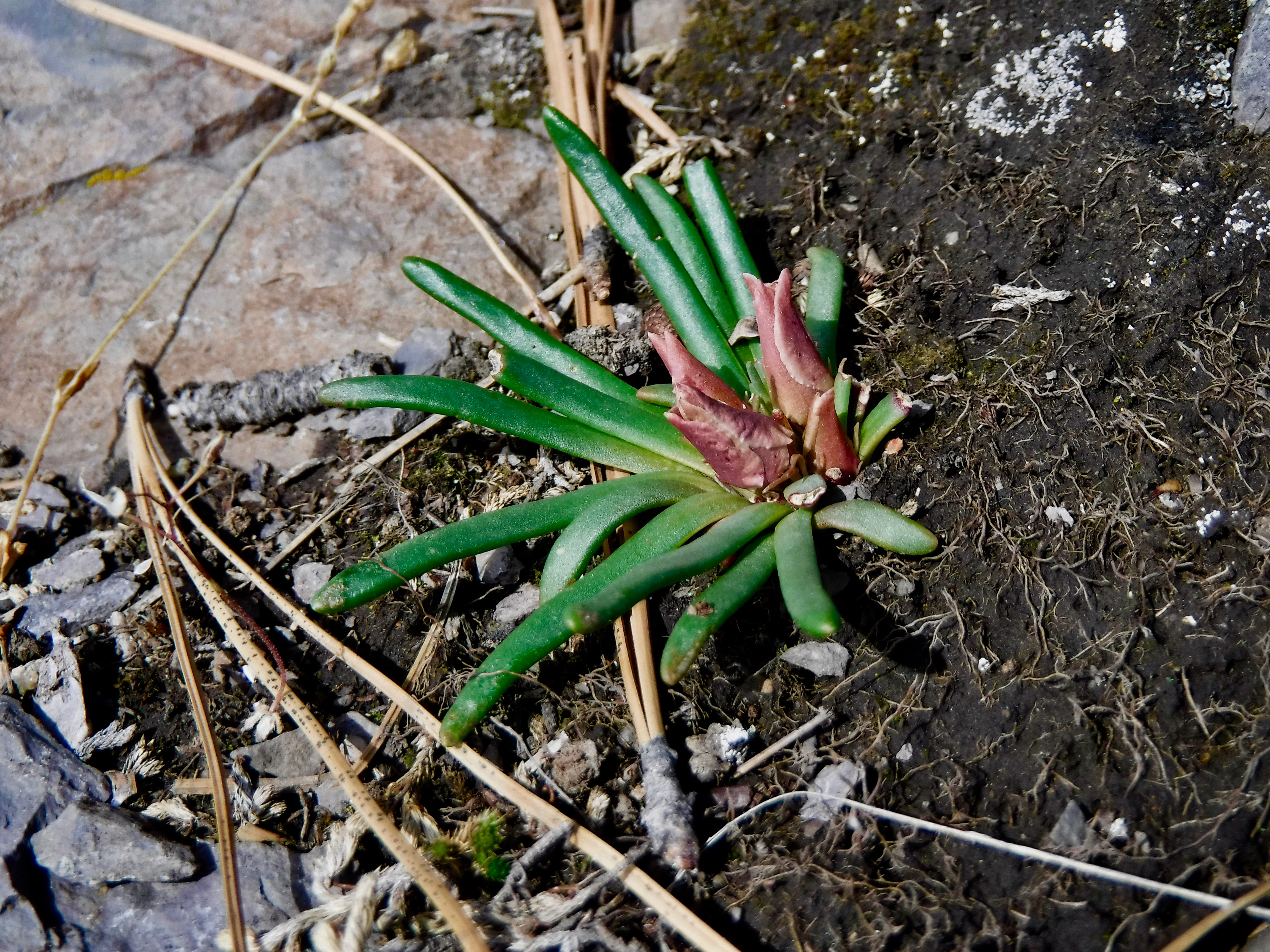
In time I circle Bird Island and begin to head south, eventually finding that perfect paddling rhythm that makes distances dissolve. Along the way I think of our good fortune. Though climate change models still predict a hot, dry summer and the potential for fire, at the moment we are being given the gift of rain and experiencing the release of more water from the storehouses of snow and hail. On Bird Island and the slopes of the Mission Mountains after the Boulder 2700 fire, mahonia, Rocky Mountain maple, chokecherry, arrowleaf balsamroot and cottonwoods rise from blackened ground. The hidden power in seeds is being set free by rain and light; the birds are having families; we will have water to drink and irrigation for our gardens and fields.
IMG_2007
After the isolation and fatigue associated with a pandemic; during the ravages of war; in the aftermath of gunfire in classrooms and shopping markets; after the danger of insurrection has passed—at least for now—we have rain, an unmerited gift from the sky that renews everything that is tired and worn. For a couple of days I visit the storehouse of life-giving water—whatever form it takes—and return with nothing but gratitude, rich in ways that cannot be counted.

And my friend steps out of his camper and says, “Would you like a cup of coffee?”


Report from the Island, May 18-19

The forecast was not good—wind out of the northeast at 15 miles-per-hour with gusts to 30, rain, and waves 1-2 feet. Water temperature 39 degrees. I was tired of pulling dandelions so I went paddling. In a year of record snowfall and now epic flooding I knew the island would be green. It would be worth the effort to cross from Big Arm to Wild Horse.


When I pulled into my campsite conditions were dismal. I waited for a lull before setting up my tent. The only flat ground was next to the fire pit. It was a good thing I don’t make fires.

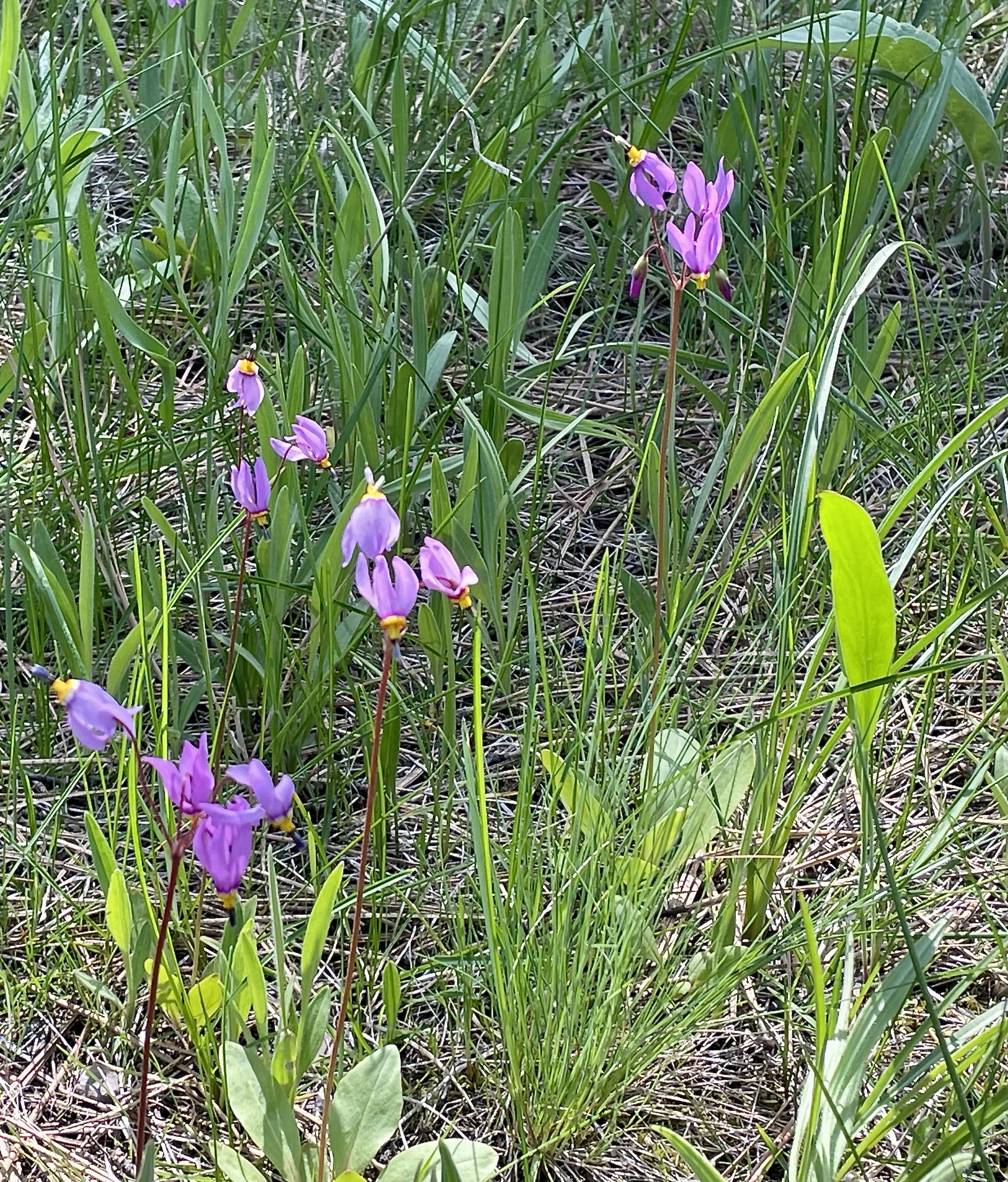
From time to time I checked my latest weather app until I had a sense of the pulse of the storms. In the diastole I pulled on my neoprene top and dry suit. I slid Bluebird into the gray water and pulled for the island. It felt good to sink into the headwinds. When gusts approached I ducked and made low angle strokes. In the lulls I returned to more efficient high angle strokes. Two hours later I pulled my kayak over some logs and secured it in the arms of driftwood. Arrow leaf balsamroot covered the hillsides. Walking through the clusters felt like wading through leather. In the interstices lupine, harebells, biscuit root and vetch reached for their share of the light. Climbing the first slope I came across patches of death camas, false asphodel and starflower. On the rocky crest I watched a pair of young eagles make intersecting gyres or hold positions in the wind with only the slightest movement of individual feathers. Knowing my interval would not last I waded back down the hill and let the rolling chop push me back to camp.

Joyce’s Yucatan soup, heated in my WhisperLite stove, and tortillas warmed on the lid of the pot never tasted so good. I was in my bag by 9 p.m.

The next morning was gray but not raining. The wind had not had time to build waves so I did it again, this time paddling around the corner of the island and into Skeeko Bay. After signing in at the register and seeing that I was only the second kayak to make it to the island this year, I walked the trail to the saddle with, as Andrew Marvell says, a green thought in a green shade. I continued up the east-west ridge and watched the bronze backs of retreating turkeys. They walk uphill faster than I do. Seeing the birds helped explain the broken feather I had found the day before. Peaking over the ridge I spotted four Bighorn rams lounging in the balsamroot. On a rocky nob where I know to look for bitterroot I found the flowers. This early in the season they were all promise and no bloom.


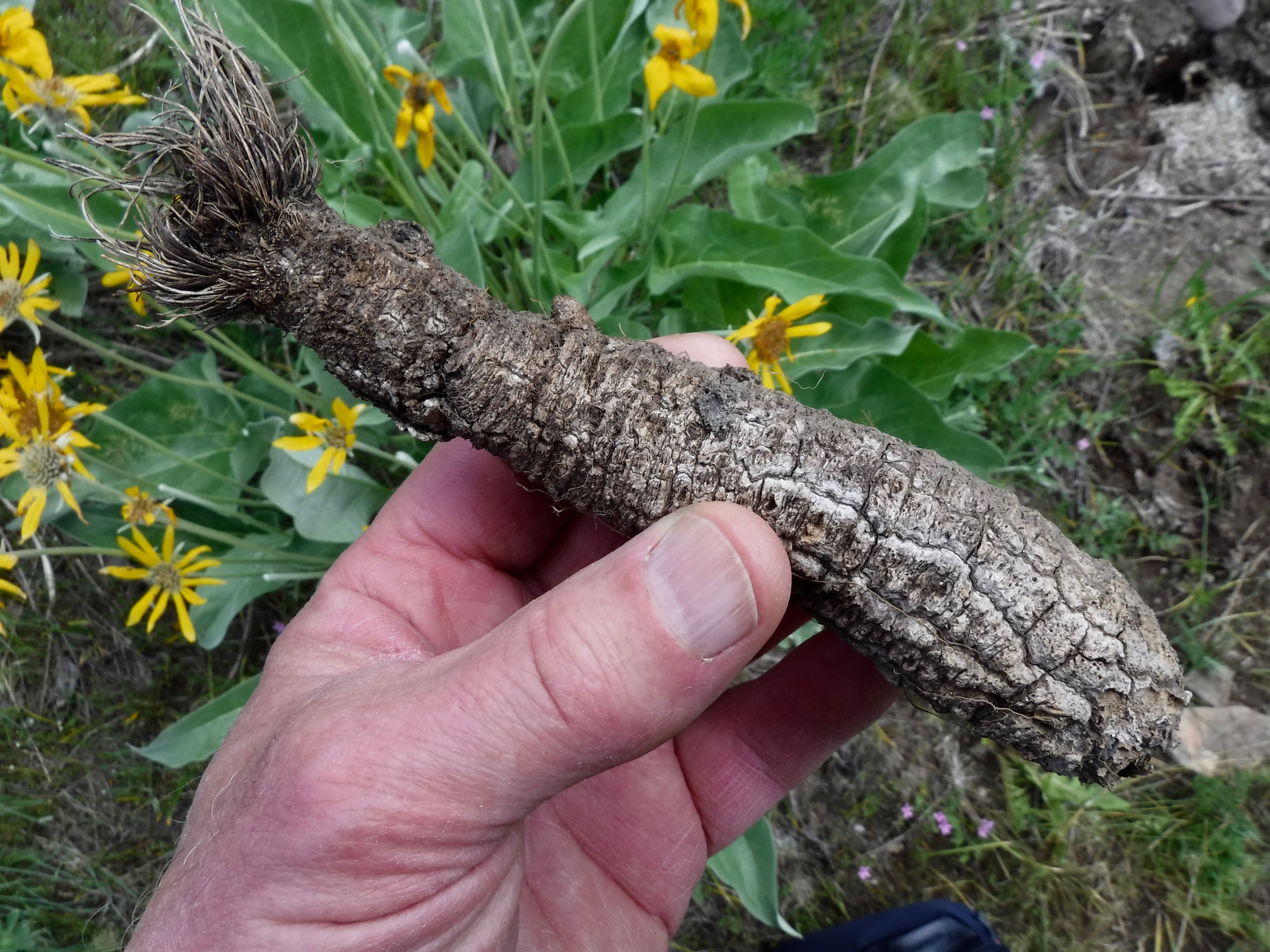
Satisfied that I had again made a deep connection to the island I started back down. On the way I heard a low growling off to my right. As I turned my head I caught a glimpse of a red fox in full plumage leaping between the flowers, unhappy that I had disturbed his proprietary rights to the island. Further down the trail I saw where the fox had excavated a vole, exposing the now-dry root and source of the flowers. Gliding down through the trees it seemed this island belongs to its non-human creatures first of all. They take as much pleasure as we do in all the life brought into the open by rain and light. They have first rights to the air and its breezes, the flowers and their variations.

Back on the beach and while climbing back into my yellow ziplock of a dry suit I noticed a group of paddlers crossing over to the island from Dayton. After they landed I walked over to greet them, a pair of guides with a new paddling business and two clients. They, too, had come to see the island in its green splendor. In Montana after a year of fire, snow and flood, this place felt like our Sistine ceiling, our Louvre, our MOMA. It was ours to visit but not remain.


Deeper Currents

Deeper Currents

As everyone in the Northwest knows, the summer of 2017 was difficult. From the first week of July through the first week of September our forests were on fire and more smoke than we had ever experienced piled up behind a ridge of high pressure. Smoke poured into our valleys, filled our lungs, left ash on every surface, and embers in our yards. For many this was also a summer of anxiety and hasty preparations for evacuation. Some of us returned home to the smell of wet charcoal, black fields of devastation, and worse. In response to the casual question, “How are you?” people often answered “Depressed.”

As a paddler I occasionally inserted a trip on Flathead Lake between the darkest days of smoke, encountered locked gates at state parks, and waited like everyone else for the air to clear and costs to mount.

On September 29, I finally found a bright and fresh day for a solo paddle out to Wild Horse Island and a clockwise trip around its perimeter. It felt healing to exercise in pure air, to be reminded that our world is indeed beautiful after weeks of finding it fouled, polluted and threatened. Late afternoon light backlit every snowberry, spider web, needle and turning leaf in the draw above Osprey Cove. A shift in the wind gave me five fast miles at the end of the day.

During this paddle I thought I might feel elevated by the knowledge that our world we love had finally been returned to us. But after this summer I felt more reflective than jubilant. All the evidence suggests that what happened this summer will happen again.

I have always been skeptical of the human inclination to use nature for our own purposes, reducing it to one more resource that we exploit for our own pleasure. I know, it is good to wash one’s mind in the bath of green and blue water. It is good to test one’s inner strength in the face of variable winds and distance. It restores balance to play on the waves. But time in a kayak, especially by oneself, gives a paddler occasion to ask, “What is all this for? What larger purpose does it serve?”

In my post of May 7, 2017, I proposed that we have a responsibility to attend to and behold the things we encounter. But on this Friday in September the currents took me deeper. After this summer it seems we have an inescapable responsibility to address the forces that are making our world increasingly uninhabitable. It is no accident that our forests are burning and coastal cities are awash in water that overwhelms the land and its inhabitants. We are doing this to ourselves and we must undo what we have done. Or, to shift the metaphor, we must change course because the one we are on leads to ruin, especially for the most vulnerable among us.

It is not for me to say what others should do. We must see this for ourselves. But I am clear that I have a responsibility to understand the impacts of what we are doing to the planet and take action in word and deed to promote choices that lead toward better ways of being in the world. A paddle in bright light makes this clear. It is time to do more than sigh with relief or toss up our hands. We have work to do, changes to make, a course to correct, while there is time.


Waves Lift


On the summer solstice my wife and I camped at the lake, finding one of the few sites open for tents next to parking lot full of trailers and RVs. Our “overnight” allowed me to make a long afternoon paddle the first day and a morning paddle on the second day to some of my favorite islands and bays. Both days windy conditions kept other boats off the lake, but I ventured out anyway, my desire to paddle stronger than my fear.

Both days I faced strong headwinds, quartering winds, and less often, a downwind ride, paddle held aloft like a pair of sails, all conditions that made it difficult to relax. One particularly strong gust of wind stripped the paddle from my hands. I immediately plunged my hands into the cold water to arrest my forward movement. Then, I hand-paddled backwards to intercept the drifting paddle before continuing my entrance into a new bay I wanted to visit. After losing and regaining my paddle I decided to pull a leash from my vest. Never before had I felt the need for this precaution.

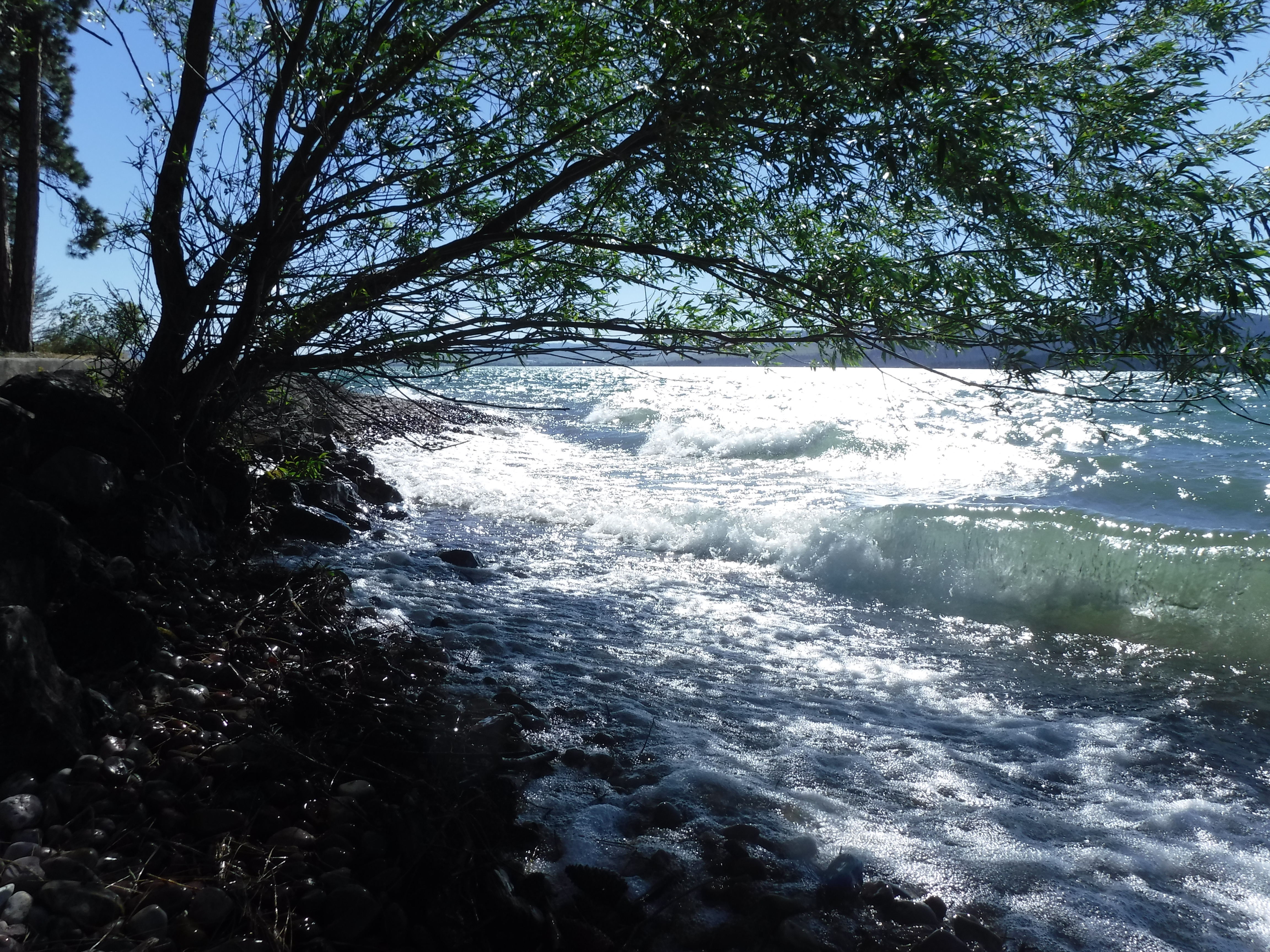
Naturally, windy conditions produce waves, waves that vary depending on lots of factors—the length of the fetch, the deflecting effect of islands, the influence of shoals, the temporary flattening effect of gusts, and so on. Some waves on Flathead Lake are powerful or turbulent enough to overturn a kayak. On both days around the solstice, however, I experienced something I have wanted to describe. When I am in the trough between waves the approaching wave seems like it will swamp the boat or overturn me. While these waves sometimes broke over the boat and sent spray into my face, to my amazement I know that waves also lift. Because boats are buoyant waves slide under and suddenly elevate the trusting paddler.

I have never been able to photograph this phenomenon while paddling. Windy conditions demand my whole attention. Nevertheless, I have come to trust this process and believe it has implications for other aspects of our lives. The forces that potentially threaten us—an unexpected set of demands, a danger or fearful encounter, all these things also have power to lift us. Experience tells me, if we keep breathing (our own form of buoyancy), the energy of waves rolls under us. The waves have power to lift us above the troughs, the trough of fear, tension, or lack of perspective. Nevertheless, I have found it necessary to let this happen. We cannot stop the advancing wave, but we can allow it to roll under us and lift us above the turbulence.


Paddling Lessons, II: Learning to Yield

(May, 2008)

When two great forces oppose each other,

The victory will go

To the one that knows how to yield (Tao 69)

A few years ago my brother and I arranged to paddle together on the first anniversary of our mother’s death. She had been a difficult person in our lives, chronically ill and prone to trying to trying to control her sons. By paddling together on this anniversary my brother and I would celebrate our good health and freedom, two riches she never enjoyed. One day in May my brother drove to Montana from Seattle. The next day we drove together up to Flathead Lake. At this time of the year it was not hard to find a campsite at Big Arm State Park, so we erected his old Sierra Designs Starlight close to the beach. We spent the late afternoon and long evening paddling around Cromwell and Wild Horse islands.

During the night the weather changed. From inside the tent we heard wind in the trees and waves breaking on the shore next to us. In the morning we crawled out to find the wild conditions that made for a restless night. As we stood on the shore wind bore through the strait between Wild Horse and Melita Islands, turning the blues and greens into a froth of white. We knew it would not be a good day to paddle in an area receiving the full brunt of the wind. Hoping for calmer conditions elsewhere, we decided to drive up to Westshore Campground.

Conditions at Westshore were much the same. Determined but with trepidation, we launched at the boat ramp and paddled south—downwind and down wave, hoping to reach Cedar Island about four miles away. On the way conditions become even more severe. The wind blew harder and the waves became more ominous. We drew closer to shore in case we got into trouble. By the time we reached the Douglas Islands we knew it was not wise to continue; the further south we went the more difficult the return trip would be. The water opposite the cliffs at Painted Rocks would have been chaotic and dangerous.

In the narrow channel between shore and Mary B Island we turned around. In the lee of the little island we hopped out of our boats, stood in the shallows and rested. We kept our boats from blowing away by holding onto the combing around each cockpit. We took a few minutes to reconcile ourselves to the work ahead of us; returning to Westshore would be exhausting, a hard beat against the wind. Resigned to the inevitable we resumed positions. Choosing safety over further adventure, we headed north against waves that broke over our decks and swept up and around our skirts. Waves swallowed the upwind arm when we reached for a stroke on the starboard side and ate the downwind arm as they rolled under us. Looking north we saw wind gusts rattle the surface of the lake and then flail us. It took our best effort to make any progress. Someone observing our struggle from his deck shouted at us, but neither of us could afford to pause between strokes, turn to the side, or respond. We never knew whether he was shouting encouragement, offering us a chance to come ashore and rest, or whether he was cursing us for being on the lake. Each wave required our complete attention. Photographs were out of the question. Using my ears I kept track of Jeff just off my stern on the port side. We saved words for later but listened to the sound of each boat meeting the train of waves. Hoping that the peninsula above West Shore would break the wind for us, we dropped into the crescent of Goose Bay and circumscribed its perimeter.

When the dock at Westshore finally came into view we felt a great sense of relief. Three miles of this kind of paddling had been enough. We pulled in next to the dock wanting to avoid having our boats smashed on the rocks adjacent to the ramp. But even as we stood on the dock, waves blew through gaps in the planks and shot into the air. A gust of wind caught Jeff’s paddle and nearly blew it off the dock into the bay. He caught it with a toe. Barely able to control the boats when we lifted them into the wind, we secured them to Jeff’s rack and climbed into his Forrester. Inside the shelter of the car we felt the buffeting of the wind and gave thanks to be out of it. In the warmth of the car we noticed maple leaves beginning to unfold. We began to relax.

As hard as the return trip was for us, Jeff and I learned our own limits and the maximum conditions we can face in our boats. We learned that sometimes it is necessary to abandon a goal, no matter how desirable it seems. In the face of forces far greater than our own strength and determination it was prudent to yield and turn back.

After this day, as much as I love to paddle, I can imagine choosing not to paddle. There are days when morning wind whips the willows and causes big pines along the shore to sway. On stormy days light and shadow shift continuously and each leaf or needle or wave crest becomes a chip in the mosaic of light. On such days I must be able to imagine sitting inside, relieved that I am not contending with waves that break over the bow or lift the boat from behind and spiral it down into deepening troughs. There are days for tea in the tent.